When Is the Best Time to Sell Your Property in Singapore?
Quick answer: There is no universal best month.
For private property the timing is set mostly by dates you can look up — your Seller’s Stamp Duty window, your loan lock-in, your tenancy, and the clock on your next purchase.
Market conditions matter, but they move slower than those dates and you control none of them.

Table of Contents
What decides the best time to sell in Singapore?
Most sellers open this question by asking whether the market is up or down. It is a fair instinct and a poor starting point, because the answer changes nothing you can act on.
Four dates, by contrast, are fixed, checkable, and carry real money. Get them on a calendar before you speak to anyone about price.
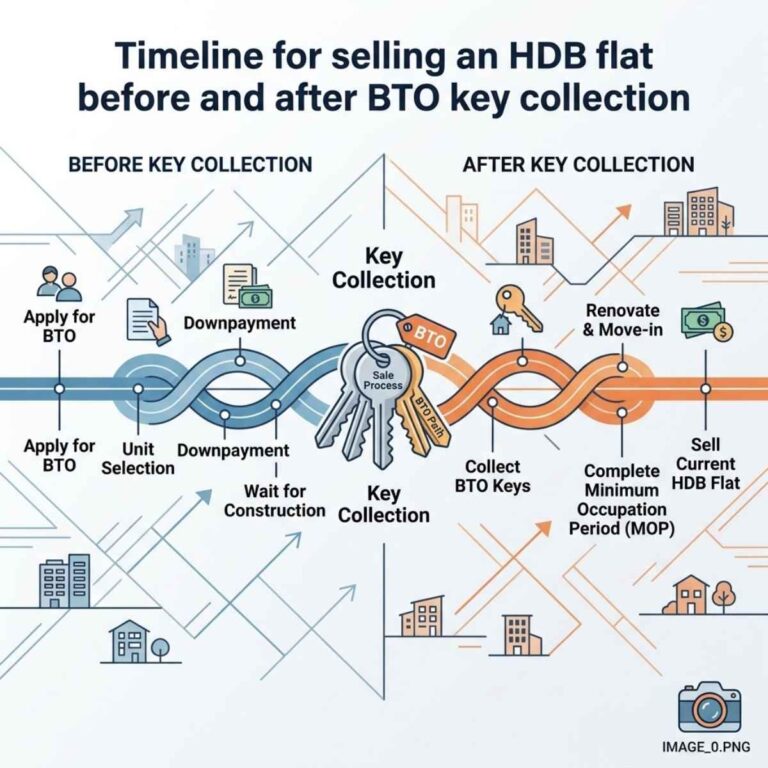
If you are selling an HDB flat, the mechanics are different — minimum occupation period, ethnic quota, resale application timing. That question is answered separately in our guide on whether to sell your HDB now or wait.
How long must you hold before selling without SSD?
This is the first date to check, and the one that catches people out most expensively.
Seller’s Stamp Duty is charged when you sell residential property within a set holding period. It comes out of your proceeds at completion, it cannot be passed to your buyer, and it cannot be deferred.
Here is the part most articles still get wrong. Since 4 July 2025 there are two schedules running side by side, and the one that applies to you depends on when you bought.
Seller's Stamp Duty: two schedules, decided by when you bought
The rules changed on 4 July 2025. Which set applies to you depends on the date you acquired the property, not the date you sell. The holding period runs from the date your Option to Purchase was accepted.
| Sold within | Bought 11 Mar 2017 – 3 Jul 2025 | Bought on or after 4 Jul 2025 |
|---|---|---|
| 1 year | 12% | 16% |
| More than 1 year, up to 2 years | 8% | 12% |
| More than 2 years, up to 3 years | 4% | 8% |
| More than 3 years, up to 4 years | Nil | 4% |
| More than 4 years | Nil | Nil |
Source: IRAS, Seller's Stamp Duty for residential property. The 4 July 2025 revision extended the holding period from three years to four and raised each tier by four percentage points, with no transition period. SSD is charged on the higher of the selling price or market value, is payable within 14 days of the executed sale contract, cannot be deferred, and cannot be passed to the buyer. Exemptions apply in specific circumstances. Position as of August 2026 — confirm your own dates and rate with IRAS or your conveyancing lawyer before acting.
Note: These figures are illustrative and opinion-based, produced with calculation tools — not a valuation or financial advice. Human error is possible; verify against official sources before relying on them.
Three details worth holding on to.
The clock starts at the Option to Purchase.
Not at completion, not at key collection — the date your OTP was accepted. If you are near a boundary, that is the date to find.
A boundary is worth real money.
On a S$2 million sale, moving from the 4% band to nil is S$80,000. If you are within a few months of crossing, the arithmetic of waiting is usually not close.
The duty is on the higher of price or market value.
A lower agreed price does not reduce it.
Exemptions exist in specific situations, including death of an owner, a divorce court order, and en bloc sales.
If you think one applies, confirm it with IRAS or your lawyer rather than assuming.
Loan lock-in, tenancy and your next purchase
SSD gets the attention. These three decide as many sales.
Your loan lock-in
Most bank packages carry a lock-in period, with a redemption penalty if you repay inside it — commonly around 1.5% of the outstanding loan, though it varies by package and bank.
On a S$1 million loan that is a five-figure cost for selling a few months early.
Your loan documents state the exact date and penalty.
Ask your banker to confirm both in writing before you commit to a timeline, and ask whether the penalty is waived on a full redemption from sale.
Your tenancy
If the unit is tenanted, you are choosing between two different sales.
Selling with the tenancy in place limits your buyer pool mainly to investors, and the tenancy transfers.
Selling with vacant possession opens the pool to owner-occupiers, who are usually the stronger bidders — but requires the lease to have ended.
Neither is wrong.
What matters is that the decision is made deliberately, with the lease expiry on the same calendar as everything else.
The clock on your next purchase
If you have already bought your next home while still owning this one, your deadline is no longer flexible.
Married couples with at least one Singapore Citizen can apply for ABSD remission, but only if the first property is sold within six months of buying a completed property, or within six months of TOP or CSC for one still being built — and IRAS does not grant extensions.
In that situation the sale date is not a preference.
It is a condition of a refund you have already paid for
Selling because of schools, work or family
Sometimes the calendar is set by something other than a rule, and that is a legitimate reason to move.
Schools.
If the move is tied to a primary school posting, the timeline runs backwards from registration, not from market conditions.
Give yourself a year or two of room.
A sale running against a school deadline is a weak position on both legs — you accept less on the way out and pay more on the way in, because the other side can see the clock.
Work, and the hours it costs you.
A shorter commute is the return that never appears in a price index.
An hour a day each way is roughly ten working weeks a year of your life, repeated for as long as you stay.
Whether that is worth a move is a personal calculation, but it deserves to be in the decision explicitly rather than treated as a soft preference next to hard numbers.
Ageing parents.
Moving closer to family carries the same arithmetic and usually a shorter runway.
Being twenty minutes away rather than an hour changes what you can realistically do on an ordinary weekday, and that gap tends to matter more each year.
On timing the move earlier or later.
Owners often ask whether moving sooner protects them from paying more later in a sought-after area.
The honest answer is that nobody can promise the direction. What matters is not the price of either home on its own but the gap between them, and that gap can widen or narrow depending on how the two segments move relative to each other.
What is knowable is this: a compressed timeline costs you on both sides of the transaction, and a plan with runway does not.
If the move is coming in the next couple of years, the useful work is preparing the numbers and the shortlist now — not trying to call which year is cheaper.
Should you sell an underperforming property?
This is where investors most often reach for the sell button early, and where the evidence needs to be better than a feeling.
A property lagging its own neighbourhood over a long period is a different situation from a quiet quarter.
Before concluding either way, look at what is actually checkable: transacted prices in the same development compared with comparable projects nearby, whether the gap holds across several years rather than one, the layout and stack against what sells well there, the remaining tenure, and what supply is coming into the area.
If the lag is real, persistent, and explained by something structural, redeploying may be the better long-term position.
If the pattern is one slow year in a project that has otherwise tracked its neighbours, selling into it converts a paper dip into a realised one.
Two of our other guides go deeper on the assessment itself: how to read whether a property is undervalued, and the six questions behind a property exit strategy.
Some sellers also consider restructuring — releasing one property to fund two.
That route carries its own stamp duty, financing and risk profile, and it suits a narrow set of circumstances rather than most; it is worth examining properly rather than assuming.
What does a property scorecard actually tell you?
The section above asks a question that is hard to answer from feel alone, so it is worth being systematic about it.
One of the tools I use is PrimeKey Analysis, a scoring framework within the Navis platform that reads a property across eight fundamentals — MRT access, remaining tenure, project size, rental yield in the area, nearby primary schools, the Government Land Sales pipeline, proximity to designated growth areas, and the pool of nearby HDB flats reaching MOP.
Used properly, it answers one question and not another.
What it can tell you: whether the fundamentals behind your property are strong or weak, and how they compare with alternatives on the same measures.
If a property has lagged its neighbours for years and the score is weak on structural factors — poor transport access, a short remaining lease, thin future demand nearby — the underperformance has an explanation, and that explanation is unlikely to resolve itself.
If the fundamentals score well and prices have simply been flat, you are looking at a different situation entirely.
What it cannot tell you: when to sell. A score compares properties.
It knows nothing about your stamp duty window, your loan lock-in, your tenancy, your next purchase, or how long you can comfortably hold.
Those four dates still decide the timing, and no scorecard replaces them.
That distinction is the whole point.
The score tells you what you are holding. Your calendar tells you when you can act on it.
You need both, and confusing one for the other is how sellers end up making a good decision at the wrong moment — or the reverse.
Our guide to the framework covers what it measures and where it deliberately stops.
Where does the gain go when you sell?
Most owners carry a simple picture of their home: bought at one price, worth another today, so the difference is theirs.
That picture is arithmetic, and it is missing one line.
The missing line is CPF accrued interest.
It is not a fee and nobody bills you for it.
It is the interest your CPF savings would have earned had they stayed in your account instead of going into the property — and it has been accumulating quietly since the day you bought.
At sale, it must be refunded along with the principal before any cash reaches you.
It never appears on a monthly statement. It is never deducted from your salary.
That is exactly why it is the number most owners leave out when they picture what their home is worth to them.
Here is the same purchase followed the whole way through, so the missing line has somewhere to sit.
Where the gain goes: an eight-year hold, on paper and in cash
An illustrative private purchase in 2018 at S$880,000, sold in 2026 at S$1,000,000 — followed step by step, from what went in to what comes out. Figures are rounded; assumptions are listed beneath.
Step 1 — What went in, 2018
| Purchase price | S$880,000 |
| Cash — 5% downpayment | S$44,000 |
| Cash — Buyer’s Stamp Duty | S$21,000 |
| CPF Ordinary Account — 20% downpayment | S$176,000 |
| Bank loan — 75%, at 2% over 30 years | S$660,000 |
| Monthly instalment, paid from CPF | about S$2,440 |
Step 2 — What eight years did
| Instalments paid, all from CPF (96 months) | S$234,200 |
| — of which repaid the loan | S$139,300 |
| — of which was interest to the bank | S$94,900 |
| Loan still outstanding in 2026 | S$520,700 |
| Total CPF used — downpayment plus instalments | S$410,200 |
| CPF accrued interest at 2.5%, the line most owners leave out | S$62,800 |
| Total CPF to be refunded at sale | S$473,000 |
Step 3 — The picture in the owner’s head
| Sale price, 2026 | S$1,000,000 |
| Purchase price, 2018 | S$880,000 |
| Apparent gain | S$120,000 |
Step 4 — What settlement takes, in order
| Sale price | S$1,000,000 |
| Less outstanding loan redeemed | − S$520,700 |
| Less agent commission, GST and legal costs | − S$24,800 |
| Available before the CPF refund | S$454,500 |
| CPF refund due — principal used | S$410,200 |
| CPF refund due — accrued interest at 2.5% | S$62,800 |
| Total CPF refund due | S$473,000 |
Step 5 — The position at completion
| Cash reaching the bank account | S$0 |
| Restored to the CPF Ordinary Account | S$454,500 |
| CPF refund left short (not topped up in cash where the sale is at market value) | S$18,400 |
Step 6 — Where the S$120,000 went
| Loan interest paid over eight years | S$94,900 |
| Selling costs | S$24,800 |
| Total | S$119,700 |
Note where the accrued interest sits. It is not in Step 6, because it did not consume the gain — it is the owner’s own retirement money returning to their own account, where it keeps earning. It belongs in Step 2, as a claim that has been growing quietly since 2018 and has to be settled before any cash is released. That is why it is the line most often missing from an owner’s mental arithmetic: it never appears on a statement, it is never paid monthly, and it grows every year the CPF stays in the property.
Assumptions: 2018 purchase at S$880,000 with a 75% loan at 2% p.a. over 30 years; the 20% downpayment and all monthly instalments paid from CPF Ordinary Account; accrued interest at the 2.5% OA rate; 2026 sale at S$1,000,000; selling costs of 2% plus GST and legal fees. Every household’s figures differ — loan rate, tenure, how much CPF was used and when, and the actual sale price all change the result substantially. Check your own CPF refund figure on the CPF Home ownership dashboard.
Note: These figures are illustrative and opinion-based, produced with calculation tools — not a valuation or financial advice. Human error is possible; verify against official sources before relying on them.
Three readings of that table matter.
The accrued interest is a fact, not a fee.
S$62,800 accumulated over eight years without a single notification.
It does not reduce this owner’s wealth — every dollar goes back to their own CPF account and keeps earning there.
What it does is decide the form the money comes back in. Wealth, yes. Cash, no.
An owner planning around cash they do not have is the whole problem this line causes.
And it grows.
Accrued interest compounds at 2.5% for as long as CPF sits in the property, and it grows faster the more CPF you use each month. Eight years in, it is S$62,800.
Left another decade, on a larger CPF principal, it is a materially bigger number.
This is why the gap between what an owner believes they will receive and what they actually receive tends to widen with time rather than close.
The gain and the cost of holding cancel almost exactly.
Eight years of loan interest came to about S$94,900 and selling costs about S$24,800 — S$119,700 against a S$120,000 gain.
That is not a freak result; it is what a 2% loan over eight years costs on a sum that size.
The accrued interest is not part of that total, and should not be blamed for it.
So what does this actually tell an owner?
Not that the property failed, and not that selling is wrong.
It tells them that liquidity and wealth are different things, and that a position can be perfectly healthy on paper while producing no usable cash on exit.
That is worth knowing before making a plan that depends on cash appearing.
If the intention is to release funds — to reduce leverage, to move, to hold something with a different profile — the honest first step is to run your own version of this table, because the answer varies enormously with your loan rate, how much CPF you used, and when you used it.
And if the numbers do point toward a change, weigh what the change itself costs.
Moving means stamp duty on the next purchase, possibly Seller’s Stamp Duty on this one if you are inside the window, a fresh set of transaction costs, and a new loan on current terms.
Those can exceed the benefit. Sometimes the better answer is to keep the property and change the financing; sometimes it is to hold and let the loan amortise further; sometimes it is to move.
The table does not decide that — it just makes sure the decision is made with the real numbers rather than the headline ones.
Is now a good time to sell property in Singapore?
Market conditions are context, not the decision.
Read them last, and read them honestly.
Private home prices have continued rising modestly through the first half of 2026, with the URA private residential property price index up around 0.5% in the second quarter and roughly 1.4% across the half year.
Momentum on the public housing side has run the other way over the same period.
Two things follow. A rising index does not mean your project is rising, because index movements are averages across very different segments.
And a moving market is a poor reason to override a date that costs money — a percentage point of index movement rarely outweighs an SSD band.
Seasonality is often cited too, with listing volumes and achieved prices claimed to vary by quarter.
Treat that as a marginal factor.
It is not sourced from official data in the way the stamp duty schedule is, and it has never outweighed a lock-in date.
When is it better to wait before selling?
Waiting is a decision, not the absence of one. It usually fits when:
- You are within months of crossing an SSD band or a loan lock-in expiry.
- Your next purchase is not yet funded, and selling would leave you renting without a plan.
- The tenancy has months to run and vacant possession would materially widen your buyer pool.
- The reason to sell is a single quiet quarter rather than a persistent pattern.
- A school, job or family timeline means selling now creates pressure you would carry into the negotiation.
Waiting is not free either. Holding costs continue, and if the property is genuinely underperforming, time compounds against you. The point is to choose, with the dates visible.
Three things sellers get wrong about timing
“SSD is three years.”
For anything bought on or after 4 July 2025 it is four, and every tier is four percentage points higher.
Two schedules exist at once; check your purchase date, not the newest article you read.
“I’ll sell when the market peaks.”
Peaks are visible afterwards. Meanwhile the datable costs — duty, penalties, a rushed purchase — are knowable now.
“A strong market is a reason to sell.”
If you are buying again in the same market, you are selling high and buying high. A strong market is a reason to review your position, not a reason on its own to move.
Frequently asked questions
How long must I hold a property before I can sell without SSD?
For residential property bought from 11 March 2017 to 3 July 2025, no SSD is payable after more than three years. For residential property bought on or after 4 July 2025, no SSD is payable after more than four years. In most private-property purchases, the holding period runs from the date of acceptance of the Option to Purchase, subject to IRAS rules for specific acquisition situations.
How much is Seller's Stamp Duty?
For purchases from 11 March 2017 to 3 July 2025, the rates are 12%, 8% and 4% across the first three years. For purchases on or after 4 July 2025, the rates are 16%, 12%, 8% and 4% across the first four years. SSD is computed on the higher of the selling price or market value and must generally be paid within 14 days from the executed sale contract.
Can I avoid SSD by agreeing a lower selling price?
No. IRAS computes SSD on the higher of the selling price or the market value of the residential property as at the date of sale or disposal.
Should I sell my condo before or after buying the next one?
That depends on your housing, financing and tax position. For an eligible married couple buying a second residential property jointly, with at least one Singapore Citizen spouse and the other IRAS conditions met, the first property must be sold within six months of the applicable purchase, TOP or CSC date to qualify for the ABSD refund. Selling first removes that particular deadline but may create a housing gap between transactions.
Is there a best month or quarter to list property in Singapore?
There is no universal best month. Your SSD window, loan terms, tenancy and next-home timeline are usually more actionable than trying to call a seasonal peak. Use market conditions as context rather than as a promise about the best date to sell.
Does this timing framework apply to selling an HDB flat?
Only partly. HDB flats have their own Minimum Occupation Period and resale procedures. For the HDB-specific decision, see our HDB selling guide.
Stamp-duty and ABSD timing points checked against IRAS on 8 August 2026. Re-check official rules before relying on them.
Your next step
The best time to sell is usually the date your own calendar produces, once the stamp duty window, the loan, the tenancy and the next purchase are all on it together.
If you would like a second pair of eyes on those dates before you commit to a timeline, I am happy to work through them with you.
What's left is the part no article can do — your own four dates, on one calendar. One session with Rick closes that gap.
✓ Article read — you've done the groundwork.
Rick will confirm the session with you directly on WhatsApp.
If WhatsApp didn't open, tap here
This sends a session request via your own WhatsApp — Rick confirms the timing and meeting place with you personally. Nothing is stored on this page.
About the author
Rick Long is an Associate Senior Division Director at Huttons Asia.
Through YouHome.sg — Right Property Matters — he shares the frameworks, tools and field experience behind his advisory work, helping Singapore buyers and sellers across HDB, EC and private residential decisions with structured, calm, next-step guidance.
CEA Reg. R026818Z · Huttons Asia · YouHome.sg

For more Singapore property planning tips, follow me on Instagram.
@agent_rick_longWhat My Clients Say | Genuine Experiences
Real stories, real experiences—because your journey deserves nothing less than the best.















Awards and Accolades






The Best Time to Buy is to get the right moment, good entry price, and discounts, and before the market start to shoot up .
Thank you for the tips on best time to sell. It is indeed very informative.
Thanks for reading my article and sharing your views.