Singapore Property Growth Plans: How to Read the Master Plan Before You Buy
A growth plan can support future demand for a home, but it does not, on its own, make that home a good buy.
Singapore’s growth plans — the URA Master Plan, new MRT lines, regional job centres and new housing areas — signal where homes, jobs and transport may go over the next 10–15 years.
They point to direction, not a delivery date and not a price.
A plan can support future demand for an area, but it does not, on its own, make any single home a good buy.
Many buyers hear “Master Plan” and think upside.
It’s an understandable reflex — Singapore plans far ahead, and a lot of those plans land.
The skill is separating what is confirmed from what is still early, asking what today’s price already assumes, and checking the place still fits your budget, your holding power and your exit timeline.
This guide is the calm version of that conversation.
No “sure profit,” no “act now.” Just how to read the signals — and how to know a real one when you see it.
What’s current for Singapore growth plans
A snapshot of the Master Plan and transport milestones buyers ask about most. Timelines can still move, so treat this as a starting point and check the official source before any decision.
For buyers, the useful takeaway is not “buy because a plan exists”. Read each item as a planning signal, then compare it against entry price, supply, holding period, buyer pool and exit route. A good location story still needs numbers that make sense.
| Item | Status | Source / note |
|---|---|---|
| Master Plan 2025 |
Status
Statutory land-use plan Gazetted on 1 Dec 2025 and now used as Singapore’s statutory land-use plan for the next 10 to 15 years. |
Source / note Check the Master Plan 2025 land-use layer on data.gov.sg and the URA Master Plan 2025 site. Read it as long-term direction, not a price guarantee. |
| New homes under MP2025 |
Status
Housing supply signal Several new and upcoming housing precincts are mapped across the island over the next 10 to 15 years, including homes near amenities, job nodes and transport nodes. |
Source / note See URA’s Liveable and Inclusive Neighbourhoods page. Treat any islandwide home total as an estimate unless tied to a specific URA, HDB or GLS release. |
| Circle Line Stage 6 |
Status
Near-term opening Opens for passenger service on 12 Jul 2026, with a public preview on 4 Jul 2026. Keppel, Cantonment and Prince Edward Road stations complete the Circle Line loop. |
Source / note LTA announcement: Circle Line Stage 6 public preview and opening. High-certainty near-term milestone, but still verify once service begins. |
| TEL Stage 5 + Downtown Line 3 Extension |
Status
Scheduled for 2026 On track for the second half of 2026. TEL Stage 5 adds Bedok South and Sungei Bedok, while DTL3e adds Xilin and Sungei Bedok. |
Source / note Check LTA’s 2026 rail development update, TEL page and DTL extensions page. Scheduled, not operational, until service starts. |
| Cross Island Line Phase 1 |
Status
Medium-term rail theme Twelve stations across Aviation Park to Bright Hill, with construction targeted for completion by 2030. |
Source / note LTA project page: Cross Island Line. Useful as a medium-term connectivity theme, not an immediate price catalyst. |
| CRL Phase 2 and CRL Punggol Extension |
Status
Longer horizon CRL2 stations are opening by 2032, while the CRL Punggol Extension is also targeted to be completed by 2032. |
Source / note LTA project page: Cross Island Line phases and extension. Good for long-range area context; avoid treating it as a short-term trigger. |
| Jurong Region Line Stage 1 |
Status
Delayed timeline Stage 1 is now expected around mid-2028, instead of the earlier end-2027 timeline announced previously. |
Source / note LTA update: Jurong Region Line Stage 1 timeline update. Avoid older 2026 or 2027 assumptions when advising buyers. |
| RTS Link: Woodlands North–Bukit Chagar |
Status
Cross-border link Under construction, with passenger service targeted to commence at the end of 2026. |
Source / note LTA project page: Johor Bahru–Singapore RTS Link. Operations are still pending until service begins. |
| MRT proximity premium |
Status
Buyer-pool factor Real, but not uniform. It varies by station, estate maturity, lease, supply, project age, layout, price quantum and competing options. |
Source / note Qualitative buyer lens. Avoid quoting a fixed percentage unless citing a specific study, transaction set or valuation report. |
Last checked: June 2026. Official sources are prioritised where available. This table is a quick reference, not investment advice. The right decision still depends on entry price, timeline, holding power, buyer pool and exit plan.
Table of Contents
What do Singapore growth plans actually mean for property buyers?
Growth plans are Singapore’s forward land-use decisions: the URA Master Plan, new MRT lines, regional employment centres, business hubs, new housing areas and lifestyle upgrades.
Together they signal where future homes, jobs and transport may go over 10–15 years — a direction, not a delivery date and not a price.
The URA Master Plan is the statutory plan guiding Singapore’s physical development for roughly the next decade.
Master Plan 2025 was gazetted on 1 December 2025, after a two-year public exercise that drew close to 250,000 exhibition visitors.
It sets out where land is zoned for housing, business, parks and transport.
Sitting alongside it are the moving parts buyers react to:
- New MRT lines and stations (LTA) — the most visible catalyst, because access is tangible.
- Regional and sub-regional centres — Jurong Lake District, Woodlands Regional Centre, Punggol Digital District, and an emerging Bishan business node — meant to bring jobs closer to homes.
- New housing areas — Master Plan 2025 maps new public and private housing across more than ten areas over the next 10–15 years, including Mount Pleasant, Pearl’s Hill, the former Keppel Golf Course, Bukit Timah Turf City, the former Singapore Racecourse at Kranji and Dover–Medway.
Yields are published per site rather than as one official total, so treat any aggregate number as an estimate. - Lifestyle and green upgrades — parks, the Rail Corridor, coastal and community spaces.
Read together, these tell you where Singapore intends to grow.
What they don’t tell you is when it lands, or what today’s asking price already assumes.
Why can growth plans influence property demand?
Growth plans can lift demand by improving access, amenities, jobs and how desirable an area feels. Better transport widens the pool of buyers and tenants.
New job and education nodes bring people closer. These factors support demand — but support is not the same as a guaranteed return.
A few honest mechanisms are at work.
Values don’t move just because a project is announced; they move when infrastructure becomes real, amenities are delivered, and demand patterns shift.
- Better accessibility. A new MRT station — especially a second line within walking distance — widens the group of buyers and tenants who’ll consider an area.
A second line tends to matter more than the first, because it solves more commute directions. - Stronger amenities. Malls, parks, schools and community hubs make daily life easier and lift everyday desirability.
- Jobs and education nodes. Business parks, innovation districts and campuses can grow a local tenant base over time.
- Buyer perception. A credible plan changes how people feel about an area’s future, which can move demand before anything is built.
- Repositioning or scarcity. Re-zoning or a new precinct can shift an area’s character over a decade.
All real. All capable of supporting demand.
None of them a promise that a specific unit, bought at a specific price, will be a good investment.
That gap — between “this area may do well” and “this purchase will do well for me” — is the whole game.
The four growth signals every buyer should separate
Treat every growth claim as one of four things: confirmed and delivered, under construction, announced long-term, or a market story.
Sorting a claim into the right box is most of the work — the most common buyer mistake is treating a story as if it were a delivered fact.
Confirmed and delivered
Already open and usable today — TEL Stage 4 (open June 2024), Punggol Coast MRT (open December 2024).
This is the most reliable signal, and because the benefit is already visible to everyone, it’s the one to test directly against recent transacted prices nearby.
Under construction
Funded, building, with a target date — TEL Stage 5 (2H 2026), Cross Island Line Phase 1 (2030), Jurong Region Line Stage 1 (mid-2028).
Likely to land, but dates can move — and once construction is visible, the question is how much of that future benefit today’s price already assumes.
Announced long-term plans
In Master Plan 2025 with direction but no firm completion date — the Greater Southern Waterfront, Paya Lebar Air Base, the Kranji racecourse estate.
Real intent, decade-plus horizon. Useful for understanding where Singapore is heading; not something to underwrite a 3–5 year hold on.
Market story
The “second CBD,” the “next big thing,” the rumoured line. Sentiment, not delivery.
Sometimes it precedes real plans — either way, the question is whether today’s price already assumes the story comes true. Treat “second CBD”–type language as a story until it is built.
Rick’s take: Before you fall for any “growth area,” put it in one of these four boxes. If it’s a story, treat it as a story.
If it’s confirmed, ask what you’re paying for a benefit that everyone can already see — then compare that price against what similar homes have actually sold for.
Is it cheap or expensive — based on what?
“Priced in” is not a verdict. It’s a question you can answer.
Instead of asking whether an area will go up, ask what today’s price already assumes — and whether that’s reasonable for your holding horizon.
Five factors do most of the work.
1. Recent land-bid prices nearby
What developers recently paid for land in the area is the floor that new-launch pricing is built on.
A record land rate tells you launch prices have to be high to make sense — useful context, not a buy or sell signal.
2. Comparable transacted psf
What similar units have actually changed hands for — not asking prices — is your truest yardstick. Compare like for like: tenure, age, size and floor.
3. Layout and efficiency
Two units at the same psf are not the same buy. Usable space, a workable floorplan and a good stack carry real value that no Master Plan adds or removes.
4. Tenure, floor, view and stack
Leasehold vs freehold, the floor, the outlook and the facing all move price for reasons that have nothing to do with the Master Plan.
Price the unit, not just the postcode.
5. Funded runway vs your holding horizon
The most important match of all. If the catalyst lands in 2032 and you may need to sell in four years, the timeline — not the location — decides whether this works for you.
Run a price through those five and you’ll know what you’re really paying for, and what would have to be true for it to make sense.
That’s a judgement you make on your own numbers — ideally with an advisor — not a label anyone can stamp for you.
These figures and yardsticks are illustrative and opinion-based — not a valuation or financial advice. Verify against official and transacted data before relying on them.
Does a Master Plan listing mean automatic profit?
No. A Master Plan listing signals intent, not a return.
The same plan can sit behind a good buy and a poor one.
What separates them is entry price, holding power, layout, rental demand, future supply, your timeline and who the next buyer is — not the plan itself.
A growth plan can be completely real and the purchase can still disappoint. The usual reasons:
- Delays. Rail dates have moved before — JRL Stage 1 slipped six months to mid-2028; TEL Stage 5 shifted into 2026. Your cashflow has to survive the wait.
- Already in the price? If the story is well known, some optimism may already sit in today’s price. The question — answered on your own numbers — is how much, and whether what’s left is worth paying for.
- High entry price. A great location bought too expensively is still a hard hold and a harder exit.
- Future supply. Master Plan 2025 adds new housing across many areas. Where fresh stock lands near a project you’re weighing, check the pipeline — more supply can hold down rent and resale for a period.
- Weak layout or unit. The plan doesn’t fix a poor floorplan, a bad stack or an awkward size.
- Thin yield or a narrow buyer pool. Some growth areas read better as own-stay than as investment.
- Wrong holding period. A 10–15 year transformation doesn’t help a buyer who needs to sell in three or four years.
A plan tells you where Singapore is going.
It does not tell you whether this unit, at this price, on your timeline is a good decision.
Case study: Jurong Lake District — strong plan, real pricing discipline
Jurong Lake District (JLD) is Singapore’s most ambitious business district outside the centre, served by future Cross Island Line and Jurong Region Line stations.
The intent is real and long-standing.
What’s instructive is how its land pricing has played out — a useful lesson in reading any growth story.
JLD is meant to be Singapore’s largest mixed-use business district outside the city centre, integrating offices, homes and recreation, with a Jurong Lake District station on the Cross Island Line targeted around 2032.
In 2024, the headline 6.5ha master-developer site attracted a single consortium bid of about S$2.5b, which the authorities declined as too low.
The plan was then revised: MND is now releasing the land as smaller separate parcels, beginning with a Town Hall Link white site placed on the first-half 2026 reserve list (MND statement, December 2025).
When even top developers and the Government are still working out what the land is worth at a given price, that tells you the how, when and at what price are live questions — which is exactly the discipline a buyer should bring too.
None of this means JLD won’t grow.
It means the timeline and the pricing are still being worked out — so your entry price, the project quality, the build timeline and your exit pool decide whether your unit works, not the postcode’s reputation.
For the full district breakdown — land parcels, the rail timeline and what to check before buying — see our Jurong Lake District property guide.
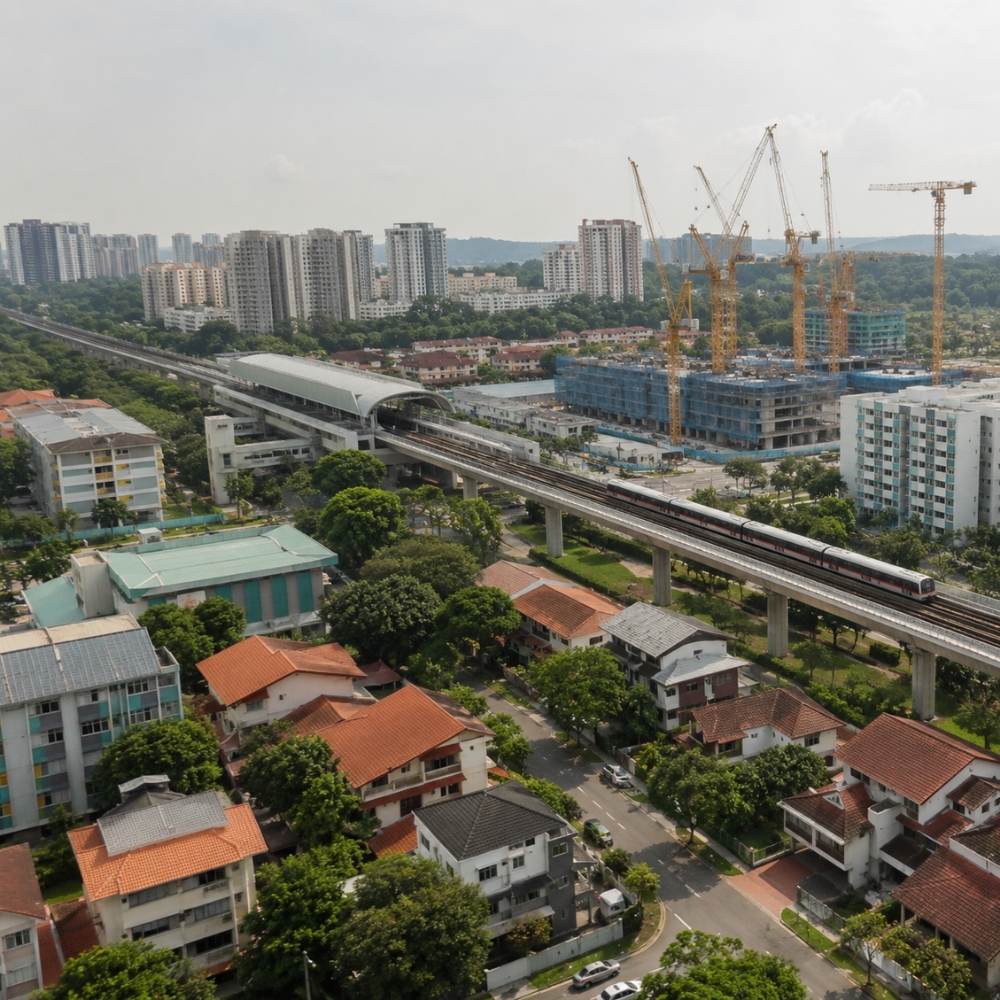
Rick’s take: JLD is important. But don’t treat the “second CBD” line as a shortcut. The number on the price tag still has to be tested against what similar homes are transacting at, and against how long you can hold.
Case study: the Thomson-East Coast Line and the real MRT effect
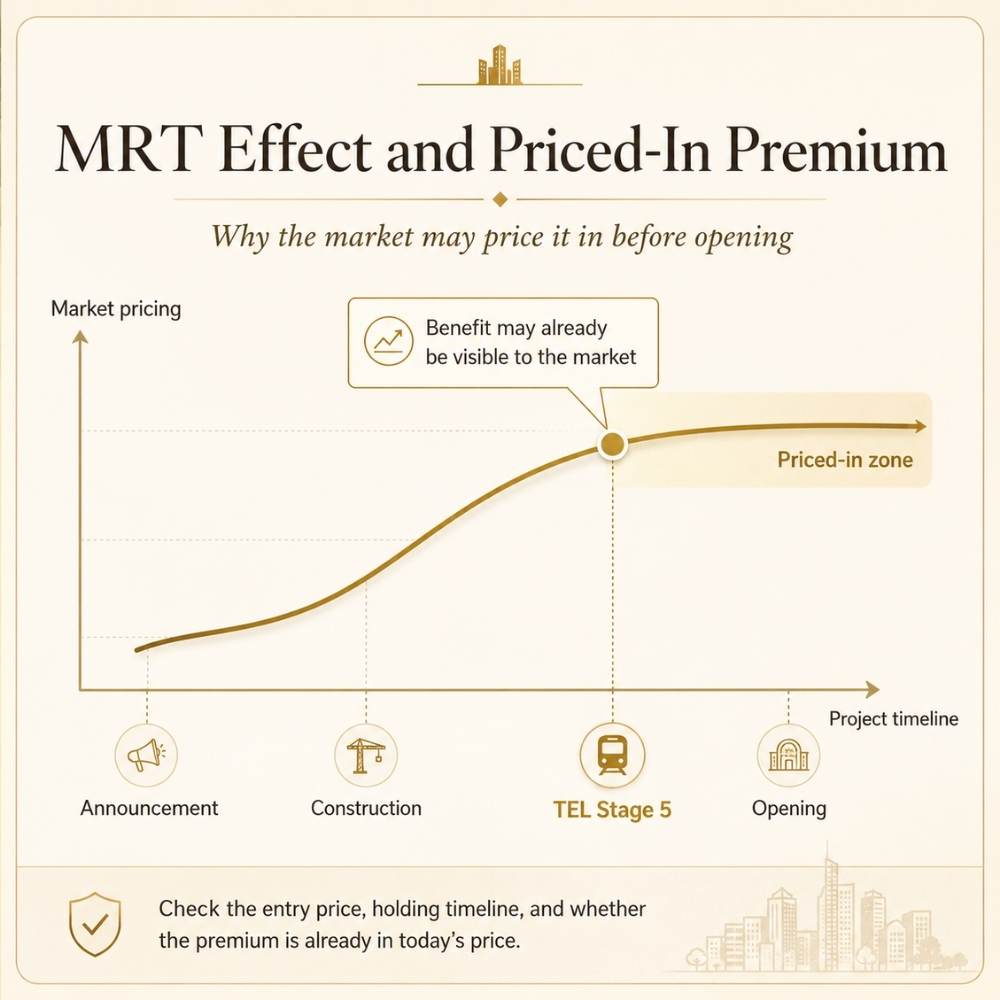
An MRT line can lift convenience and widen a property’s buyer pool, but the effect is real and nuanced, not automatic.
Studies generally place the proximity premium in the high single digits to mid-teens for homes within roughly 400–500m — and it varies by station, neighbourhood, above- or below-ground tracks, supply, and how much is already in the price.
The TEL is the clearest live example. Stage 4 opened in June 2024; Stage 5 (Bedok South and Sungei Bedok) opens in the second half of 2026, the two stations opening together because they share the Sungei Bedok TEL–Downtown Line interchange.
For the Bayshore precinct, the bigger story isn’t one more stop — it’s a second line within walking distance, which historically widens the buyer and tenant pool more than a first line does.
A few honest points on the “MRT effect”:
- The premium is real but modest — research clusters in the high single digits to mid-teens for homes within ~400–500m, not 20–25%.
- It is not uniform. Above-ground vs underground tracks, the income profile of the neighbourhood, nearby supply and the entry price all change the outcome.
One study even found short-term price softness near some stations during construction. - Once a line is confirmed and visible, much of the benefit may already be in the price. As a yardstick: the Bayshore Road government land site was awarded at S$1,388 psf ppr in March 2025 — a record rate for an Outside Central Region site — with the TEL5 story already public.
That land cost tells you roughly what launch pricing in the precinct has to be built on, so you can hold it against transacted psf nearby and decide, on your own numbers and horizon, whether the price works for you. - Convenience itself has lasting value — for your own living and your future buyer — even when the “investment premium” is thin.
These figures are illustrative and from public Government Land Sales records — not a valuation or financial advice. Verify against current data before relying on them.
Case study: Punggol Digital District — a live-work-learn bet
SIT has moved its student body to Punggol, Punggol Coast MRT opened in December 2024, and JTC has reported strong corporate pre-commitment across the district’s tower space, with early occupiers including GovTech, the Cyber Security Agency, OCBC and UOB. Read that as serious corporate anchoring — not as district-wide “investment,” and not as delivered jobs. A job ecosystem fills in over years, not months.
For a buyer, the precinct’s promise is a growing tenant base near home.
The same checks apply as everywhere:
- Entry price relative to what comparable rental demand can support today.
- Rental yield on realistic, not hoped-for, rents.
- Tenant profile — will the jobs that arrive actually rent your unit type?
- Competition and supply — Punggol has had steady new launches and BTO supply.
- Holding power — you’ll be holding while the district matures.
Rick’s take: The live-work-learn idea is genuine. Check the yield on rents you can actually achieve now, make sure you can hold while the district fills in, and the rest takes care of itself.
Which districts and corridors are worth watching?
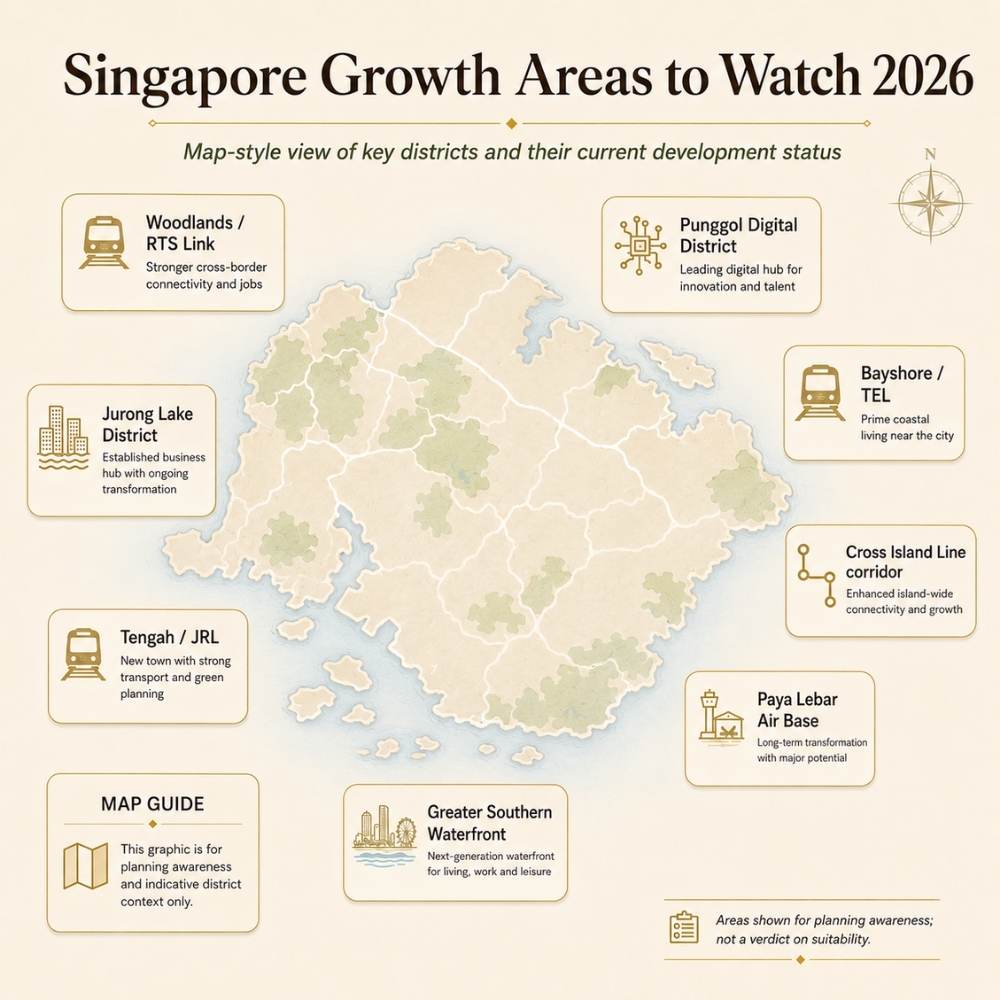
The areas most often cited as growth zones in 2026 include the Cross Island Line corridor, Tengah and the Jurong Region Line, Woodlands and the RTS Link, the Greater Southern Waterfront, Paya Lebar Air Base, Jurong Lake District, Punggol Digital District, Bayshore, and the new Master Plan 2025 housing nodes.
Each is worth watching — and each needs its numbers checked before you commit.
For every area: what’s planned, why it may matter, what to check, and the main caution.
Cross Island Line corridor
Planned: CRL Phase 1 — 12 stations, Aviation Park → Bright Hill — targeted 2030; Phase 2 to Jurong Lake District ~2032; Phase 3 construction from 2027.
Why it may matter: new cross-island links can widen access for established north-eastern and eastern estates.
Check: how close the unit is to a confirmed station, whether 2030 fits your hold, and what the rail story already assumes in the price.
Caution: long timeline — years of holding before any benefit shows.
Jurong Region Line & Tengah
Planned: JRL Stage 1 targeted mid-2028 (delayed from end-2027); Tengah is a real, occupied “forest town” with rail access on the way.
Why it may matter: an occupied new town gaining a line.
Check: until JRL opens, commuting leans on interim buses — confirm what transport you’d actually have on day one.
Caution: the MRT isn’t there yet and the date has already moved once.
Don’t price in 2028 convenience for a 2026 purchase.
Woodlands Regional Centre, RTS Link & JS-SEZ
Planned: Woodlands Regional Centre as the northern economic hub; the RTS Link targeted end-2026; the Johor-Singapore Special Economic Zone progressing under a 2025 blueprint.
Why it may matter: cross-border connectivity and a northern jobs hub.
Check: cross-border demand is harder to underwrite than a domestic MRT stop — treat JS-SEZ claims as forward-looking.
Caution: cross-border policy and timelines are the swing factor; strong headlines aren’t delivered jobs near your unit.
Greater Southern Waterfront
Planned: a multi-decade transformation of the southern coast running to 2050 and beyond; the first GSW BTO launched in October 2025.
Why it may matter: a genuinely large, long-horizon repositioning of central-south Singapore.
Check: does your holding period match a transformation measured in decades?
Caution: very long horizon and high entry prices — not a quick-upside story.
Paya Lebar Air Base
Planned: the air base relocates progressively, freeing a large site for a future town; meaningful redevelopment is a 2030s-and-beyond proposition.
Why it may matter: one of Singapore’s largest future land releases.
Check: almost nothing here is buildable soon — treat it as background context.
Caution: very long gestation; not for short-term speculation.
Jurong Lake District
Planned: Singapore’s largest mixed-use business district outside the centre; future CRL/JRL stations; the master-developer site repackaged into smaller parcels (covered above).
Why it may matter: a second major commercial node in the west, long term.
Check: entry price, project quality, and how long until the district actually fills in.
Caution: pricing and execution are live, as the tender showed.
Bayshore, East Coast & the TEL
Planned: TEL Stage 5 (2H 2026); Bayshore is planned as a new precinct of roughly 10,000 homes (about 30% private, 70% public) with a second line within walking distance.
Why it may matter: a new east-coast precinct with strong rail access.
Check: how much of the rail story is already in launch pricing, against transacted psf nearby.
Caution: leasehold-vs-freehold and entry price matter as much as the line.
Bishan & Dover–Medway (new MP2025 nodes)
Planned: an emerging Bishan business node — some government offices may relocate there, with Bishan Place reworked into a landscaped pedestrian mall with a new polyclinic, hawker centre and upgraded bus interchange — plus new housing at Dover–Medway in Greater one-north.
Why it may matter: established, central locations getting fresh supply and amenities.
Check: new supply can cap short-term upside even in good locations.
Caution: “new housing area” can mean more competing stock, not just more demand.
Kranji, Mandai & the former Racecourse (long-term only)
Planned: the former Singapore Racecourse at Kranji becomes a new housing estate over the next decade, with a consultancy tender for the detailed master plan in 2026 and first homes expected around the mid-2030s.
Why it may matter: a sizeable future estate near Woodlands and the RTS. Check: whether your timeline stretches to the 2030s.
Caution: detailed master planning hasn’t started — strictly long-term.
Orchard, Newton & Paterson — core-central rejuvenation
Planned: Master Plan 2025 sets out a refresh of the Orchard–Newton belt: an urban village of around 5,000 new private homes across Newton Circus, Scotts Road and Monk’s Hill, with a new amenity node and public square beside Newton MRT and Monk’s Hill Road becoming a heritage linear park; around 1,000 new private homes in the Paterson–Orchard cluster, including an integrated development directly above Orchard MRT behind ION; and a new park merging Istana Park, Dhoby Ghaut Green and a ~500m stretch of Orchard Road, with an elevated link to Fort Canning. Several plots near Newton MRT have been rezoned to white site. (Figures are from the 2025 plan, URA — confirm against the gazetted version.)
Why it may matter: prime, well-connected Core Central locations — on the Downtown and North-South lines, minutes from Orchard, Novena and the CBD — gaining new homes, transport-linked integrated developments and upgraded public space; the kind of city-living supply that has historically drawn a deep buyer and tenant pool.
Check: Core Central entry prices are already high, and these clusters add new competing supply over the next decade — so test any launch price against recent transacted psf in the immediate area, and be clear whether you’re buying for city lifestyle, rental demand or capital growth.
An integrated home above Orchard MRT will carry a convenience premium; decide what that premium is worth to you.
Caution: most of this is multi-year and phased — the homes above Orchard MRT and the Newton urban village are plans, not completions.
Sembawang Shipyard & the northern coast (long-term only)
Planned: as Sembawang Shipyard operations wind down from 2028, Master Plan 2025 sets the site for progressive transformation into a mixed-use waterfront lifestyle district with a maritime character — new homes, commercial and recreational space, public sea-front promenades, and the heritage dry dock repurposed for community use.
It’s part of the wider North Coast transformation, alongside Woodlands and the future Kranji estate.
The number and type of homes are still being studied — there is no official home count yet.
Why it may matter: a rare new stretch of waterfront living in the north, with heritage character and long-term government commitment behind it — broadly the northern counterpart to the Greater Southern Waterfront.
Check: a decade-plus, phased transformation with details still forming — so treat it as direction, not a near-term catalyst, and weigh anything you buy nearby on today’s fundamentals (price, rental demand, holding power), not the future waterfront.
Caution: very long horizon and limited specifics; nothing here is buildable soon, and a coastal-living story shouldn’t set today’s price.
If a growth area has you weighing a move, the first question is whether the numbers work for selling your HDB to upgrade to a condo, (For HDB Upgraders) — start there, then let the growth story refine the choice.
When the signal is worth acting on
Discipline isn’t the same as hesitation.
Plenty of growth stories are real, and when the factors line up, slowing down forever is its own mistake.
A growth area is worth moving on when most of these hold true.
- The catalyst is confirmed or under construction, not just announced.
- The timeline fits your hold — you’ll still own it when the benefit lands.
- The price stands up against transacted psf nearby, not just the story.
- The unit works on its own merits — layout, stack, tenure — story aside.
- Your cashflow can hold through a delay without stress.
- There’s a broad future buyer pool when you exit.
When that’s the picture, a real growth story is a reason to move with quiet confidence.
The goal was never to talk yourself out of a good buy — it was to know a good one when you see it.
When a growth area may not be right for you
A growth area is the wrong buy when the entry price is too high, the layout or yield is weak, your holding timeline is short, future supply is heavy, the construction wait is long, or the place doesn’t fit your family or retirement needs.
Be honest about these before you commit.
- Entry price too high for the rent or resale the area can realistically support.
- Weak layout or stack that no Master Plan will fix.
- Thin rental yield once you use achievable rents, not optimistic ones.
- Short holding timeline against a 10–15 year transformation.
- Heavy future supply nearby capping rent and resale.
- Long construction wait you’d be financing with no benefit yet.
- Retirement mismatch — tying up cashflow you’ll need sooner.
- Family-lifestyle mismatch — schools, commute, space.
- Buying because everyone’s talking about it, not because the numbers work.
If a place fails several of these, the growth story isn’t the reason to proceed — your own numbers are.
And when those numbers hold up, a real growth story is a reason to move with quiet confidence, not hesitation.
Rick's practical growth-plan checklist
Before you buy on a growth story, run ten checks. Work through them honestly — if the answer to the last one is “no,” the rest doesn’t save you.
- Is the catalyst confirmed, or still a story?
- What stage is it at — delivered, under construction, or conceptual?
- What’s the realistic timeline, and does it fit your hold?
- What does today’s asking price already assume?
- Who is the future buyer when you exit?
- Who is the future tenant if you rent it out?
- Is there real demand, or only a narrative?
- What holding period does the story actually need?
- Can your cashflow survive delays of a year or more?
- Does the property still make sense without the growth story?
Not sure which box your area falls into?
Send me the district or the listing and I’ll help you check whether the signal is confirmed, what the price already assumes, or whether it’s still too early to rely on.
The Singapore Growth Plan Fit Score
The Growth Plan Fit Score is a short self-check that tells you what kind of buy you’re really looking at — a confirmed catalyst, a long-term watch zone, an already-reflected-in-price area, a numbers-check case, or a lifestyle buy more than an investment buy.
Answer nine quick questions and it sorts your situation into one of five honest outcomes. It’s not a valuation, and it won’t tell you to buy — it tells you what you’re actually deciding, so you can take the right next step.
Use this short self-check to sort a growth-plan purchase into a practical category. It does not tell you to buy or sell. It helps you see whether you are looking at a confirmed catalyst, a long-term watch zone, an already-priced-in story, a numbers-check case, or mainly a lifestyle buy.
The case is not clear yet, or it depends too much on future assumptions. Review the price, affordability, buyer pool and holding timeline before treating the growth story as useful support.
- Compare recent transactions, not just asking prices.
- Check whether the benefit is already reflected in today’s price.
- Make sure the property still works without the future story.
- Strong confirmed catalyst: the benefit is delivered or near delivery, but you still need to test whether it is already in the price.
- Long-term watch zone: the planning support is real, but the useful benefit may take many years.
- Already reflected in price: the story is widely known, so you may be paying today for future convenience or certainty.
- Needs a deeper numbers check: the case depends on affordability, cashflow, yield, buyer pool and hold period.
- Lifestyle buy more than investment: it may still be a good home, but the investment case is not the main reason.
Note: This Fit Score is an illustrative decision guide based on your selected answers. It is opinion-based, not a valuation, investment recommendation or financial advice. Verify rates, rules and timelines against official sources such as URA, LTA, HDB, CPF Board and IRAS before making a decision.
Each result is a starting point for review. It does not make the decision for you, but it helps you see whether the growth story is confirmed, long-term, already priced in, mainly lifestyle-led, or in need of a deeper numbers check.
The signal is delivered or near-delivered, such as a confirmed MRT opening, completed infrastructure, or a clearly usable amenity.
Whether the benefit is already in the price. Compare recent transactions against similar areas without the same catalyst.
Real planning support, but the benefit may take many years.
Match the timeline to your holding power and your fallback if it takes longer than expected.
The story is widely known, so the asking price may already include a convenience or certainty premium.
Decide whether you are buying convenience or expecting upside. Test the price gap, rental demand, layout and exit pool.
The case is not clear yet, or leans too heavily on future assumptions.
Review affordability, CPF, monthly cashflow, yield, buyer pool, and whether you can hold through a delay.
It may be a good home, but the investment case is not the main reason.
Be clear that own-stay comfort is the reason, and that the price still feels acceptable without future upside.

Note: This Fit Score is an illustrative decision guide based on the answers you select. It is opinion-based, not a valuation or financial advice, and does not reflect your full financial position. Verify any rate, rule or timeline against the official source — URA, LTA, HDB, CPF Board or IRAS — and seek independent advice before deciding.

About the author
Rick Long is an Associate Senior Division Director at Huttons Asia.
Through YouHome.sg — Right Property Matters — he shares the frameworks, tools and field experience behind his advisory work, helping Singapore buyers and sellers across HDB, EC and private residential decisions with structured, calm, next-step guidance.
CEA Reg. R026818Z · Huttons Asia · YouHome.sg
Final thoughts: use the plan, don't let it pressure you
Growth plans can guide a decision, but they shouldn’t drive it.
The right property isn’t simply the one near the next big thing — it’s the one that still makes sense when the timeline stretches, the market softens and the numbers are tested.
Singapore plans ahead, and a lot of it lands.
But the plan and the price are two different things, and only one of them is yours to control.
The buyers who do well aren’t the ones who chase every announcement.
They’re the ones who can tell a confirmed catalyst from a story, who know what they’re paying for upside that’s already visible, and who buy a property that works even if the big future arrives late.
That’s the whole skill. Read the signal. Check the fit. Decide on your terms.
Singapore property growth plan FAQ
What do “growth plans” mean for Singapore property?
They refer to Singapore’s forward land-use decisions, including the URA Master Plan, new MRT lines, regional job centres and new housing areas. They signal where homes, jobs and transport may go over the next 10 to 15 years. They describe direction, not a delivery date or a price.
Does buying in a Singapore growth area guarantee profit?
No. A growth area can support future demand, but it does not guarantee profit for every nearby property. The result depends on entry price, layout, tenure, buyer pool, rental demand, interest rates and how long you can hold.
What counts as a confirmed catalyst versus a market story?
A confirmed catalyst is delivered, under construction, or officially announced with a firm plan. A market story is sentiment, such as a rumoured line, a nickname, or “next big thing” language before delivery is visible.
What does it mean if the growth is already in the price?
It means the market may already know the story, so sellers may already ask a premium. You may be paying today for future convenience or certainty. That is not always bad, but you should know what you are paying for.
How do I compare an MRT, Master Plan, GLS and transformation story?
Compare by certainty, distance, timeline and buyer impact. A completed MRT station beside a project is very different from a long-term planning story that may take a decade or more to matter.
How long do growth plans take to show up in property value?
It varies widely. Confirmed infrastructure can be reflected quickly, while long-term transformations can take a decade or more. Your holding power matters because a 10 to 15 year story may not help a buyer who needs to sell in three or four years.
Should own-stay buyers care about growth stories?
Yes, but the story should not override daily living needs. If the home fits your family, commute, schools, space and budget, the growth story is useful support. If the home only feels acceptable because of future upside, review the decision again.
What should I do after getting my Growth Plan Fit Score result?
Treat it as a starting point. Next, review affordability, CPF usage, cash buffer, monthly instalment comfort, likely rental demand, resale competition and exit timeline before making a decision.
This article is Rick Long’s independent research and opinion — general information only, not financial, legal or investment advice.
Plans, timelines and figures come from public and official sources and can change; some details may be outdated or contain errors despite our checks.
Past performance is no guarantee of future results, and no returns are promised. Verify all details with official sources and seek qualified professional advice before deciding. We accept no liability for decisions made in reliance on this article.
What My Clients Say | Genuine Experiences
Real stories, real experiences—because your journey deserves nothing less than the best.


Awards and Accolades


Disclaimer: The case studies and information are for educational use only and i make no representation or guarantees with respect to the accuracy, applicability, or completeness of its contents. There shall be no liability for any loss or expense whatsoever, relating to investment decisions made by the reader.