New Launch vs Resale Condo in Singapore: Which Should You Choose in 2026?

New launch versus resale condo in Singapore — comparing a modern condo tower and an established resale development."

Most buyers who ask me “new launch or resale?” are not actually asking about property types.

They’re asking about time. About space.

About how much cash and CPF they can commit without feeling stretched. About whether they’ll be able to sell well later.

A new launch can give you time, staged payments and room to plan ahead. A resale condo can give you space, certainty and a home you can use right away.

Neither is automatically the better choice.

The better choice is the one that fits your stage of life, holding power, cashflow, timeline and exit plan.

Let’s map it out together.

The short answer (read this first)

Lean towards a new launch if:
You don’t need to move in immediately, you have steady income and holding power, you’re comfortable waiting roughly 3–4 years for TOP, and you value progressive payments and a brand-new unit.

Lean towards a resale condo if:
You need space soon, you want to physically see the exact unit, you’d like immediate occupation or rental income, or you’re rightsizing and want to avoid a long wait.

But before you commit to either, put six things side by side: your budget, CPF position, ABSD exposure, loan eligibility, timeline and exit plan.

The property type is the last decision, not the first.

Table of Contents

What is a new launch condo?

A new launch is a private condo you buy from the developer, usually before or during construction.

Key features:

  • You’re buying off a showflat and floor plans, not the finished unit.
  • There’s a wait to TOP (Temporary Occupation Permit), typically around 3–4 years.
  • You pay in stages under the Progressive Payment Scheme (PPS), tied to construction milestones.
  • You get a brand-new unit, fresh facilities, a developer defects warranty and modern layouts.
  • PSF is usually higher, and unit sizes have trended smaller over the years.
  • It’s often a forward-planning decision — you’re buying time as much as a home.

What is a resale condo?

A resale condo is an existing, completed private condo bought from the current owner.

Key features:

  • You can physically view the actual unit, block, facing and finishing.
  • You can move in or rent it out soon after completion (often 8–12 weeks).
  • Many older projects offer larger layouts than new launches.
  • PSF is usually lower — but because units are bigger, the total price (quantum) can still be high.
  • You take on potential renovation, maintenance, remaining-lease and MCST considerations, and the unit is generally sold “as-is.”

The real difference isn't just price

f you only compare PSF, you’ll miss the decision.

New launch versus resale is really a set of trade-offs:

  • Staged payment vs full loan from completion
  • Future possession vs immediate use
  • Brand-new vs proven, settled location
  • Smaller modern layouts vs larger older layouts
  • Fixed developer pricing vs room to negotiate
  • A forward growth story vs value you can see today

New Launch vs Resale Condo: Side-by-Side

Here’s a simple way to anchor the comparison. The better choice is not always the one with the lower PSF — it is the one that fits your timeline, cashflow, space needs and exit plan.

Factor
New Launch
Resale Condo
What You Should Think About
PSF
New LaunchHigher
Resale CondoLower
What to think aboutPSF alone does not tell you the total cost.
Quantum Total price
New LaunchOften lower because units are smaller
Resale CondoCan be higher because units are larger
What to think aboutThis is what your loan and cash are actually sized against.
Move-in Timeline
New LaunchAround 3–4 years, depending on TOP
Resale CondoSoon after completion
What to think aboutMatch this to your real life timeline.
Cashflow
New LaunchStaged payments under PPS
Resale CondoFull mortgage from completion
What to think aboutLighter early does not mean free. The full loan still arrives.
Renovation
New LaunchUsually minimal because it is new
Resale CondoCan be significant in older units
What to think aboutBudget realistically, not optimistically.
Rental Income
New LaunchOnly after TOP
Resale CondoPossible almost immediately
What to think aboutThis matters a lot for investors.
Layout Certainty
New LaunchFloor plans only
Resale CondoYou see the real unit
What to think aboutResale reduces surprises because the actual space can be viewed.
Defects
New LaunchDeveloper warranty period
Resale CondoBuyer’s responsibility, usually sold as-is
What to think aboutPre-purchase checks matter for resale.
Facilities
New LaunchNew
Resale CondoMay be ageing
What to think aboutCheck sinking fund health for older projects.
Exit Strategy
New LaunchDepends on future supply and demand
Resale CondoDepends on lease age and location
What to think aboutAlways ask: who buys from me later?
ABSD Timing
New LaunchRefund window generally starts at TOP/CSC
Resale CondoRefund window generally starts from purchase completion
What to think aboutNew launch may give eligible upgraders more runway.
SSD Exposure
New Launch4-year clock from purchase date
Resale Condo4-year clock from purchase date
What to think aboutDo not plan a short exit casually.
Floor-area Basis
New LaunchOften excludes the aircon ledge if the project is harmonised
Resale CondoMay include ledge, bay windows or voids in the quoted size
What to think aboutCheck whether the project is harmonised, and compare usable space — not just the number.
Rick’s note: This comparison is not meant to crown one option as better. It is meant to slow the decision down, so you compare the real trade-offs before committing.

PSF, quantum and usable space — what "cheaper" really means

This is where good buyers trip up.

A lower PSF feels cheaper. But a bigger unit at a lower PSF can still cost more in total than a smaller unit at a higher PSF.

A simple illustration:

New launch 3-bedder: 850 sq ft × $2,200 psf = $1,870,000

Resale 3-bedder: 1,150 sq ft × $1,650 psf = $1,897,500

The resale unit has the lower PSF — but the higher total price, because it’s larger.

What this means:

  • Lower PSF doesn’t always mean an easier entry.
    Your loan and stamp duties are sized on quantum, not PSF.
  • Higher PSF doesn’t always mean a higher total price.
    A compact new unit can have a smaller cheque.
  • But size still matters for living and for resale.
    A smaller unit may feel tight for a growing family, and a very compact layout can narrow your future buyer pool.

So the honest question isn’t “which has the lower PSF?” It’s “which quantum fits my loan and cash, and gives my household the space it needs?”

Illustrations above are simplified examples for explanation only, not quotes for any specific project. Actual prices, sizes and PSF vary. Always work from real figures for the units you’re considering.

Not all floor area is equal — check what you're actually paying for

Here’s a layer many buyers miss: the size on paper doesn’t always mean usable space.

Some newer launches are sold under harmonised floor-area rules, where the aircon ledge (and voids) are excluded from the saleable area you pay for.

Not every project is harmonised — it depends on the development — so it’s worth checking whether the specific condo you’re comparing falls under harmonisation before you read too much into its size or PSF.

Where it applies, this matters for a fair comparison:

  • An older resale unit of the same quoted size may include an aircon ledge — often around 4–7% of the quoted area, and larger in some developments — that a harmonised unit does not.
  • So part of what you’d pay for in the older unit sits in space you can’t really furnish.
  • Once you adjust for that, the headline PSF gap between a new launch and an older resale can be narrower than it first looks. The new launch’s area is “leaner,” so its effective price per usable square foot is more favourable than the raw PSF suggests.

To be clear, this doesn’t make a new launch automatically better value — the total quantum can still be similar.

It simply means you’re not always comparing like for like, so check the basis of the floor area before concluding which is “cheaper.”

Bigger on paper isn't always more functional

Floor area and usable space are not the same thing.

Some condos — more often older ones — include features such as bay windows, planter boxes or voids in the quoted area.

They add to the number on paper, but not to the space you can actually live in or furnish.

An odd or irregular layout, a long internal corridor, or a chunky ledge can all inflate the size without improving how the unit lives.

So a larger floor area, or a lower PSF, doesn’t automatically mean the better buy.

A smaller, well-shaped, efficient unit can live larger than a bigger unit full of dead space.

This cuts both ways — even an efficient-on-paper new launch deserves a real look at its layout before you decide.

The honest test isn’t “which is bigger or cheaper per square foot?”

It’s “which gives me more usable, functional, furnishable space for my money?”

Because PSF and size alone can mislead, I don’t judge a unit on showroom feel or the headline number.

On the property side, I score it — which brings us to the next section.

How I compare condos: PrimeKey Analysis (a points-based property tool)

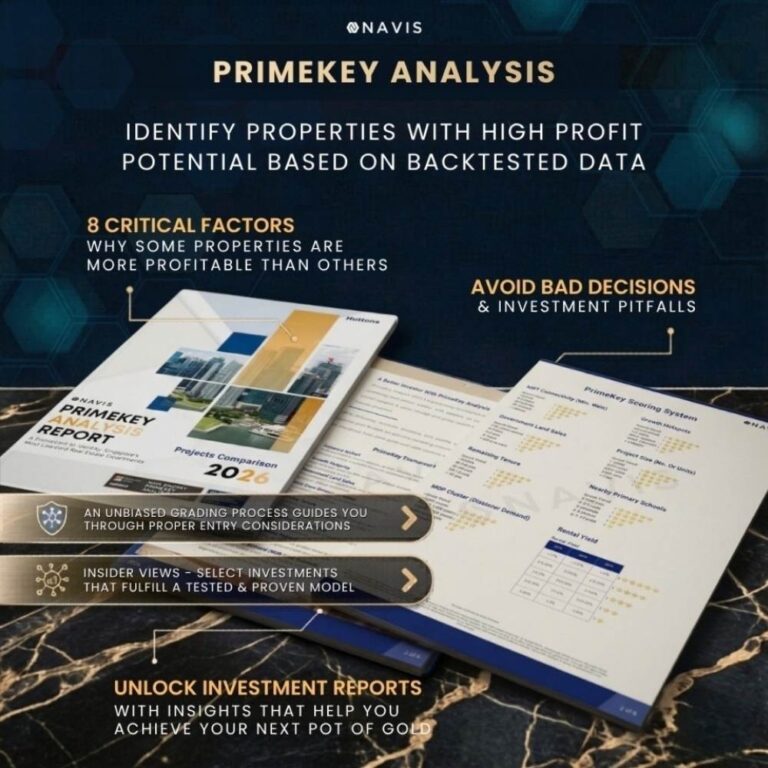
PrimeKey Analysis condo scoring tool showing a Singapore project scoring 36/40 (90%) across eight fundamentals like MRT access, growth hotspots and remaining lease.

When you’re weighing several condos, it’s easy to compare them in a messy way — one looks cheaper, one looks newer, one has a better sales story. A score puts them on the same terms.

On the property side, I run shortlisted projects through PrimeKey Analysis — a structured, points-based scoring approach that reviews each project across eight fundamentals:

  • Distance to MRT
  • Nearby primary schools
  • Project size
  • Rental yield of the area
  • URA growth areas
  • Upcoming Government Land Sales nearby
  • Remaining lease
  • Nearby HDB MOP upgrader demand

Together these signal a project’s livability, rental and holding strength, and future resale demand — the things PSF alone can’t tell you. It turns “this one feels nicer” into “this is what’s driving the difference.”

But here’s the important part: a strong property score is not the same as the right decision for you.

PrimeKey scores the property — it doesn’t read your CPF position, cash comfort, family needs, timeline or exit plan.

A condo can score well and still be the wrong fit if it stretches your budget or doesn’t suit your stage of life.

So I treat the score as one analytical layer, then read it against your own numbers and timeline — which is exactly the six-question approach in my six-question framework Section.

Data helps you compare. Planning helps you decide.

2026 market context — why this feels harder now

A few grounded data points, without drowning you in numbers:

  • Prices are still rising, but more gently.
    The URA private residential price index rose 0.9% in Q1 2026 — its sixth straight quarter of growth, broadly in line with 2025’s pace. This is measured, not a surge.
  • The regions are moving at different speeds.
    Non-landed OCR led at +2.2%, RCR +0.8%, CCR +0.6% in Q1 2026. Suburban, upgrader-driven demand has been the engine.
  • The new launch–resale gap stays wide.
    In like-for-like comparisons, new launches generally carry a meaningful premium over comparable resale in the same area — often in the rough range of 15–30% on PSF, and wider at the headline level.
    Land costs make deeply discounted new launches structurally unlikely.
  • There’s a substantial future supply pipeline
    Around 55,800 private units expected to complete in the coming years, with a heavy wave from Government Land Sales.
    If you’re buying to sell or rent post-TOP, it’s worth stress-testing your exit against this.
  • Buyers are more selective.
    Transaction volume cooled (Q1 2026 was down sharply quarter-on-quarter, partly seasonal and supply-led). People are paying when location, project and entry price line up — not before.

You don’t need to time this market perfectly. You need to know how it interacts with your numbers.

Indicative 2026 PSF Ranges by Region

These ranges give a broad orientation of how new launch and resale condo pricing can differ across CCR, RCR and OCR.

Region
New Launch PSF
Resale PSF
What It Tends to Mean
CCR Core Central Region
New Launch PSF ~$2,800–$3,200+
Resale PSF ~$2,200–$2,800
What it tends to mean Higher entry, more capital-preservation in nature, lower yields, and more sensitive to foreign-buyer rules.
RCR Rest of Central Region
New Launch PSF ~$2,400–$2,800
Resale PSF ~$1,800–$1,900
What it tends to mean The middle ground — popular with professionals and upgraders.
OCR Outside Central Region
New Launch PSF ~$1,800–$2,300
Resale PSF ~$1,200–$1,600
What it tends to mean Most upgrader- and family-driven; quantum-sensitive; check future supply nearby.
Note: Ranges are indicative for 2026 and vary by project, district, tenure and unit. Treat them as orientation, not quotes.

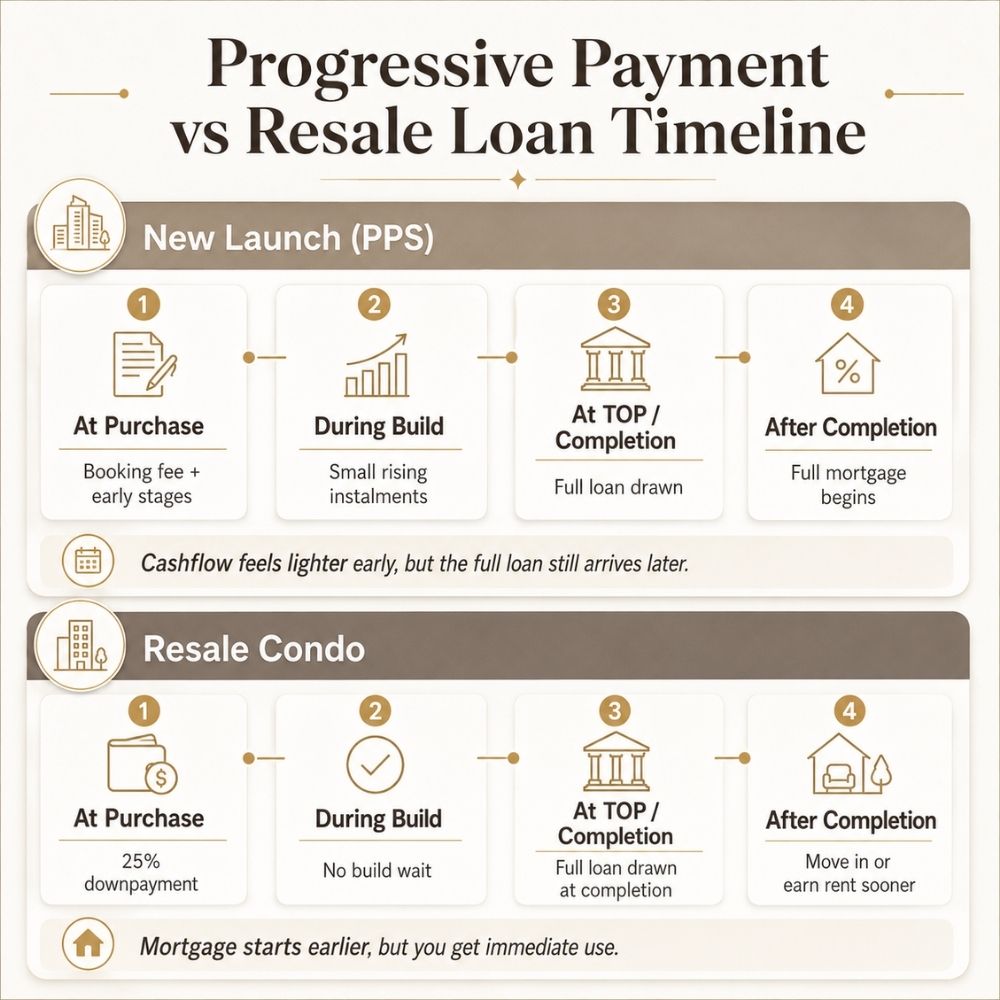
Progressive Payment Scheme vs resale full loan

This is one of the most practical differences, and it’s about cashflow, not just price.

New launch (PPS):

  • You pay in stages as construction hits milestones.
  • The bank disburses the loan progressively, so interest is charged only on what’s drawn so far — early instalments are light.
  • The full mortgage really kicks in around TOP.
  • It eases early cashflow — but if you’ve already sold your previous home, you may be renting in the meantime, which is a real cost on top.

Resale (full loan):

  • The full downpayment and loan kick in at legal completion.
  • Monthly mortgage starts much earlier.
  • In return, you get immediate use — or immediate rental income if investing.
  • No long TOP wait, and no rental-bridge gap.

New Launch vs Resale: Cashflow Timeline

The payment experience can feel very different. New launch payments are staged, while resale buyers usually start the full mortgage much earlier.

Cashflow Stage
New Launch
Resale Condo
At Purchase
New Launch Booking fee and initial stages; generally lighter outlay at the start.
Resale Condo Full 25% downpayment, usually 5% cash and 20% CPF/cash.
During Build / Early Period
New Launch Small, rising instalments. Interest is usually charged only on the drawn amount.
Resale Condo Full monthly mortgage begins from completion.
Around TOP / Move-in
New Launch Full loan is drawn and the full mortgage begins.
Resale Condo Already in full mortgage; may already be occupied or earning rent.
Possible Extra Cost
New Launch Rent elsewhere while waiting, especially if you have already sold your current home.
Resale Condo Renovation may be needed sooner, especially for older units.
Rick’s note: Progressive payment can feel lighter in the early years, but it is not free. The full mortgage still arrives, so the decision should be tested against your cashflow after TOP.

A practical reminder: progressive payment feels lighter, but it isn’t “free.”

You still need to plan for BSD, the downpayment, loan approval, completion, renovation and the full mortgage later.

Lighter today doesn’t remove the bill — it moves it.

ABSD, BSD, SSD, TDSR and LTV — in plain English

These rules shape what you can buy and how you should time it. Here’s the plain-English version. All figures are current as of June 2026 — but rules do change, so confirm with IRAS, MAS, HDB or your banker and lawyer before you act.

BSD — Buyer's Stamp Duty.

Everyone buying property pays this. It’s progressive. As a rough sense: around $44,600 on a $1.5M purchase, and around $69,600 on a $2M purchase.

ABSD — Additional Buyer's Stamp Duty.

Additional Buyer’s Stamp Duty. This is the big one for second-property buyers and HDB upgraders who buy before selling. Current headline rates (unchanged since 27 April 2023).

ABSD Rates by Buyer Profile

ABSD can change the real cost of buying significantly, especially when purchasing a second or subsequent residential property.

Buyer Profile
1st Property
2nd Property
3rd+ Property
Singapore Citizen
1st Property 0%
2nd Property 20%
3rd+ Property 30%
Singapore PR
1st Property 5%
2nd Property 30%
3rd+ Property 35%
Foreigner
1st Property 60%
2nd Property 60%
3rd+ Property 60%
Entity / Trust
1st Property 65%
2nd Property 65%
3rd+ Property 65%
Note: This table is for quick orientation. Always verify the latest ABSD rules and remission conditions before committing to a purchase.

ABSD remission for upgraders (the part that matters most)

An eligible married couple including at least one Singapore Citizen, buying their next home in both names, can pay the 20% ABSD upfront and claim a full refund — if they sell their existing property within the window and meet all conditions.

The timing window is the key insight:

  • If your next home is a completed/resale property: the 6-month sale window starts from the purchase date. That’s tight.
  • If your next home is a new launch (uncompleted at purchase): the 6-month window starts from the TOP/CSC date. That can give upgraders significantly more runway — but you’d be holding (and possibly financing) two properties through the build.

The window is 6 months, and IRAS does not grant extensions — so this is something to plan, not assume. The refund application itself must also be made within 6 months of the sale.

SSD — Seller's Stamp Duty (important 2025 change)

For residential properties purchased on or after 4 July 2025, the holding period was extended from 3 to 4 years, with rates of 16% / 12% / 8% / 4% across years 1 to 4, and 0% after four years. HDB flats are not affected (their MOP already applies).

Why this matters: don’t plan a short exit casually.

If you buy in 2026 and the unit TOPs around 2029, your earliest fully SSD-free sale could be around 2030.

Build that into your plan from day one.

TDSR — Total Debt Servicing Ratio

Your total monthly debt (including the new mortgage) generally can’t exceed 55% of gross monthly income. Banks stress-test at a higher assumed rate, and self-employed income is usually haircut.

This sets your real borrowing ceiling.

LTV — Loan-to-Value

A first housing loan can be up to 75% of value, subject to the bank’s assessment. It drops for a second loan, for very long tenures, or when age plus tenure is high. (Note: the MSR 30% cap applies to HDB flats and ECs, not private condos.)

If this section feels like a lot — that’s exactly why mapping your numbers before falling in love with a unit saves stress later.

Who should consider a new launch?

A new launch may fit you well if:

  • You don’t need to move in immediately.
  • You have steady income and genuine holding power.
  • You’re comfortable waiting around 3–4 years for TOP.
  • You like the staged, lighter early cashflow of PPS.
  • You’re buying with the future in mind.
  • A compact, modern layout works for your household.
  • You’re willing to look honestly at pricing, nearby supply and your future exit.
  • You’re an upgrader who’d benefit from more time before selling (subject to the ABSD/remission rules above).

A new launch may not fit if:

  • You need space now.
  • You can’t comfortably rent during the waiting period.
  • You’d be stretching your budget to enter.
  • The layout is too small for your family’s real needs.
  • The main reason is “everyone says new launch makes money.” That’s not a plan.

Who should consider a resale condo?

A resale condo may fit you well if:

  • You need to move fairly soon.
  • You need more usable space.
  • You want to see the actual unit before committing.
  • You value an established, settled location.
  • You want rental income without a long wait.
  • You’d rather avoid TOP-related uncertainty.
  • You’re rightsizing and want practical convenience now.

A resale condo may not fit if:

  • You underestimate renovation costs (older units can run well into five or six figures once hidden works appear).
  • The MCST sinking fund is weak or special levies loom.
  • You haven’t weighed the remaining lease and lease decay.
  • The bank’s valuation comes in below the asking price (you’d top up the gap in cash).
  • Defects go unchecked.
  • The future exit story is thin

Five buyer scenarios

Real decisions are easier to see through examples. These are illustrative, not advice for any specific person.

A. HDB upgrader with young children. Concerns: school timing, space, ABSD, renovation, a possible rental gap.

How to think: if space and timing matter most, a resale unit — or a new launch that’s close to TOP — often fits better than a project that’s years away.

Sequence the HDB sale carefully around the ABSD window.

B. Young couple, no urgent move-in need. Concerns: budget, PPS, future planning.

How to think: a new launch can suit you well if cashflow and holding power are steady and you’re comfortable waiting.

The staged payments give you breathing room.

C. Investor. Concerns: rental yield, ABSD, vacancy, the TOP wait, future resale liquidity.

How to think: resale can start earning rent immediately, but weigh the 20% ABSD (for a second property), older-building risks and the rising completion pipeline.

A new launch means no rental income until TOP.

D. Rightsizer / downsizer. Concerns: convenience, proximity to family and medical care, low maintenance.

How to think: resale often gives certainty and immediate use, with freedom to pick the exact size.

A near-TOP new project can also work if you don’t need to move right away.

E. Lower-PSF resale vs higher-PSF new launch. Concerns: which is really “cheaper.” How to think: go back to Section 4.

Compare total quantum and liveable layout, not headline PSF.

Red flags before you choose either path

New launch red flags:

  • Buying on showflat emotion rather than the numbers.
  • Ignoring actual liveable space.
  • Not checking competing supply around your TOP date.
  • Assuming every new launch appreciates.
  • Underestimating the rental-bridge cost.
  • Forgetting the 4-year SSD clock.
  • Not stress-testing the full mortgage that arrives at TOP.

Resale red flags:

  • Buying because the PSF “looks cheap.”
  • Ignoring the remaining lease.
  • Underestimating renovation and hidden defects.
  • Skipping the MCST accounts and sinking-fund health.
  • Not checking the bank’s valuation against the asking price.
  • Not thinking about who’ll buy from you later.
  • Forgetting maintenance fees and possible special levies.

Rick's six-question framework

I usually don’t start by asking clients whether they prefer new launch or resale.

I start by asking what the property needs to do — for their life, their numbers and their next stage.

Before you choose, map these six things:

  1. Purpose — Own-stay, investment, rightsizing, upgrading, or family planning?
  2. Timeline — Move now, within 6 months, or in 3–4 years?
  3. Cashflow — Can you handle the downpayment, BSD, ABSD if it applies, renovation, any rent, and the monthly instalment — comfortably, not just barely?
  4. Space — Do you need liveable size now, or can a compact layout work?
  5. Risk — What worries you more: the TOP wait, future supply, older lease, defects, or valuation gaps?
  6. Exit — Who’s likely to buy from you later, and why?

When those six answers are on the table, the new-launch-or-resale question usually answers itself.

The property type is the output of the decision, not the input.

Quick Fit Score

New Launch vs Resale Condo Fit Score

Answer a few simple questions and get a gentle steer. This is not a final recommendation — it helps you see whether your situation leans towards a new launch, a resale condo, or a deeper side-by-side comparison.

0 of 8 answered 0%

1. When do you need to move in?

2. How important is space right now?

3. How comfortable are you with a 3–4 year wait?

4. How is your holding power during the waiting period?

5. What is the main purpose of this purchase?

6. How important is ABSD timing in your move?

7. Which gives you more confidence?

8. Do you need rental income immediately?

Please answer all 8 questions first. The score works better when every part of your situation is considered.

Your gentle steer

Compare Both Carefully

Your answers are mixed, so it is worth comparing both paths with real numbers.

New Launch Fit
0 points
Resale Fit
0 points

Why this result appeared

    This score is a starting point. The next step is to test it against your budget, CPF position, ABSD exposure, loan eligibility, timeline and exit plan.

    WhatsApp Rick to Compare My Options
    Note: This tool gives a broad steer only. It does not replace financial, tax, legal or mortgage advice. Always verify current ABSD, BSD, SSD, TDSR and LTV rules before committing.

    Final thoughts

    There’s no universal winner between new launch and resale.

    A new launch can be a good move when time, holding power and forward planning are on your side.

    A resale condo can be the better move when space, certainty and immediate use matter more.

    The right answer isn’t found in a showroom or a listing alone.

    It shows up when your numbers, CPF, loan, timeline, family needs and exit plan are placed side by side — and you can see, calmly, which path actually fits.

    If you’re unsure which one is right for you, send me your budget, CPF position, timeline and preferred areas.

    I’ll lay both options out against your real numbers — the actual quantum, cashflow and timing for each — and tell you straight which one fits your move and which doesn’t.

    Message me and we’ll work through it together.

    FAQ

    FAQ

    Common questions buyers ask when comparing a new launch and a resale condo in Singapore.

    Is new launch better than resale condo in Singapore?

    Neither is automatically better. A new launch suits buyers with time, holding power and a forward plan; resale suits buyers who need space, certainty or immediate use. The right answer depends on your budget, timeline, CPF, ABSD position and exit plan.

    Is a resale condo cheaper than a new launch?

    On PSF, usually yes. But resale units are often larger, so the total price, or quantum, can still be higher. Compare the full quantum, not just PSF.

    Why is new launch PSF higher?

    New launches reflect current land and construction costs, brand-new condition, full warranty and modern facilities. Land prices in particular make deeply discounted new launches structurally unlikely.

    Does lower PSF mean better value?

    Not on its own. Value depends on quantum, layout, location, remaining lease, condition and your future exit — not PSF in isolation.

    Does a bigger floor area or lower PSF always mean a better buy?

    No. Floor area on paper is not the same as usable space. Some units — more often older ones — include features like bay windows, planter boxes or voids in the quoted size, which add to the number but not to space you can furnish. A smaller, efficient, well-shaped unit can live larger than a bigger one full of dead space. Compare usable, functional area, not just the headline size or PSF.

    What is GFA harmonisation, and why do some new launches exclude the aircon ledge?

    Under harmonised floor-area rules, the saleable area you pay for generally excludes the aircon ledge and voids, so you are charged mainly for usable space. Not every project is harmonised — it depends on the development — so check whether the specific condo you are comparing falls under harmonisation. Where it applies, an older resale unit of the same quoted size may include a ledge, often around 4–7% of the area and sometimes more, that a harmonised unit does not. This means the headline PSF gap can overstate the real difference once you adjust for usable space.

    How does the Progressive Payment Scheme work?

    For an under-construction new launch, you pay in stages tied to construction milestones, and interest is charged only on the amount drawn so far. The full mortgage begins around TOP. It eases early cashflow but does not remove the eventual cost.

    Is resale better for HDB upgraders?

    Sometimes — especially when space and timing matter, since there is no long wait. But a new launch can give upgraders more runway on the ABSD remission window. It depends on your timeline and finances.

    Can I buy a condo before selling my HDB?

    Yes, but as a second property you would pay ABSD, currently 20% for a Singapore Citizen, upfront. Eligible married couples may claim a full refund if they sell the HDB within the qualifying window and meet all conditions. Many upgraders instead sell first to avoid the ABSD outlay entirely. Speak to a banker and a conveyancing lawyer before committing.

    How does ABSD remission work for HDB upgraders?

    An eligible couple with at least one Singapore Citizen, buying the next home in both names, can pay 20% ABSD upfront and claim a refund if the existing property is sold within 6 months — from the purchase date if the new home is completed, or from the TOP/CSC date if it is a new launch. There are no extensions, so the timing must be planned. Confirm current conditions with IRAS.

    What is SSD and why does the 2025 change matter?

    Seller’s Stamp Duty is payable if you sell a private residential property within a set holding period. For properties bought on or after 4 July 2025, that period is now 4 years, with rates of 16%, 12%, 8% and 4%. It matters because a short exit can be costly — plan to hold well past TOP. HDB flats are not affected.

    Should investors buy new launch or resale?

    Resale can earn rent immediately, but weigh the 20% ABSD for a second property, older-building risks, vacancy and the rising completion pipeline. A new launch means no rental income until TOP. The right choice depends on yield targets, holding power and exit liquidity.

    What hidden costs should resale condo buyers watch for?

    Renovation, which is often heavier in older units; maintenance fees; MCST special levies; the cash top-up if the valuation is below the asking price; and the impact of remaining lease on future value.

    What should I check before buying a new launch?

    Check the liveable layout, not just floor area; nearby competing supply around your TOP date; your full-mortgage affordability after TOP; the 4-year SSD clock; and, if you are an upgrader, your ABSD timing.

    Note: Property rules, tax rates and remission conditions can change. Always verify the latest details with the relevant authority, your banker and your conveyancing lawyer before committing.

    What My Clients Say | Genuine Experiences

    Real stories, real experiences—because your journey deserves nothing less than the best.

    Awards and Accolades

    Self Introduction

    blog-pic

    Hi, I’m Rick Long

    With decades of experience in Singapore’s real estate market, I’ve had the privilege of being mentioned in media outlets such as Channel NewsAsia, The Straits Times, and 99.co.

    Over the years, I’ve written extensively on the local property landscape — tackling the real questions buyers and sellers face, and helping them navigate each step with greater clarity and confidence.

    Many of my clients have become long-time friends — their trust and kind reviews continue to inspire me to raise the bar in everything I do. 

    I believe real estate should be strategic, seamless, and deeply aligned with your life’s journey.

    Related Articles:

    Ever wonder if you are suitable for Sell one buy two investment concept? – Read more (Sell one buy two)

    Is buying new launch or resale condo have better returns? – Read more (New Launch vs Resale condo)

    Looking to upgrade from Hdb to condo? – Read more (Sell Hdb buy condo)

    What to take note when selling Hdb resale flat? – Read more (Hdb Resale Process)

    Buying another Hdb flat, and using the fund from current home? – Read more (Hdb contra)

    Why do some Hdb flat price depreciate so much? – Read more (Hdb depreciation curve)

    What is one of the most common reason for property negative sales? – Read more (Cpf accrued interest)

    Financial calculation for selling a Hdb flat? – Read more (Hdb resale calculator)

    Buying EC before selling your HDB? – Read more (Upgrade to EC before selling your HDB)

    Should you sell your EC after 5 years? – Read more (Selling EC)

    This Post Has One Comment

    1. Terry

      You are right, there is always a good friend/bro that likes to give ‘advise’ base on own opinions, LOL. Great that i came across this article. Will be in contact after CB. Thanks

    Leave a Reply