Upgrading From HDB to EC: Costs, Rules and Returns

Quick answer: An EC sits between an HDB flat and a private condo — lower entry price, but HDB-style eligibility and a long hold.

The rules changed on 8 May 2026: new EC sites now carry a 10-year MOP, privatise after 15 years, and no longer offer the Deferred Payment Scheme.

Earlier projects keep the old terms.

Table of Contents

What an EC is, and the two ways to buy one

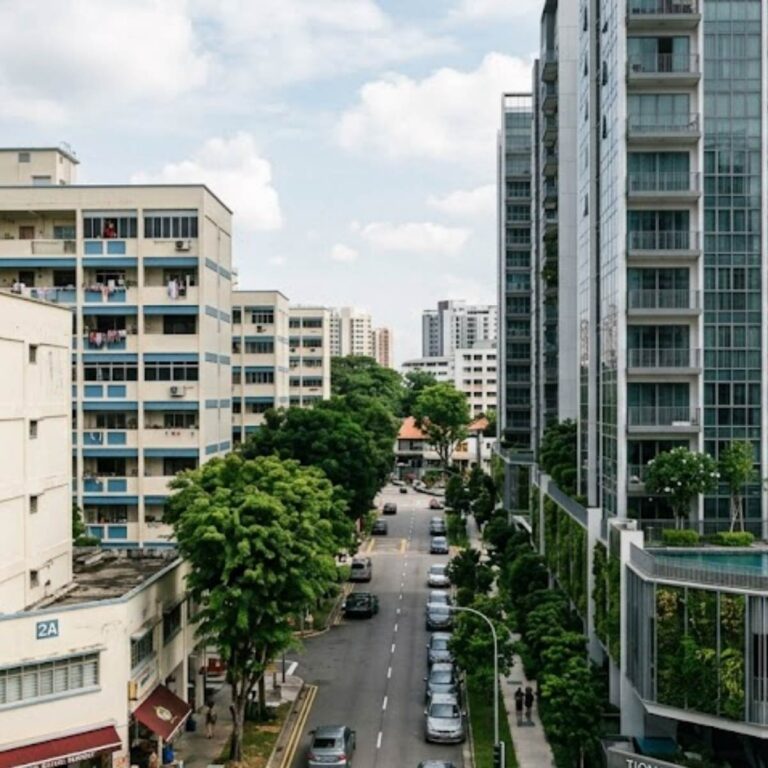
An Executive Condominium is built and sold by private developers on land bought from the state, but it is governed by HDB rules for its first years.

Facilities, layouts and finishes look like a private condo. The rules do not.

There are two routes, and they behave differently enough that they are almost separate decisions.

A new EC from a developer follows HDB eligibility — a family nucleus, an income ceiling, and property-ownership conditions.

It is cheaper per square foot than a comparable new private launch, and it comes with a minimum occupation period.

A resale EC is bought from an owner who has completed that period.

No income ceiling, no HDB eligibility test, financed like private property.

You pay market price rather than launch price, and you skip the construction wait.

What changed on 8 May 2026

This is the largest change to the EC scheme in a decade, and it splits the market in two.

For EC sites sold through Government Land Sales with tender closing dates on or after 8 May 2026:

  • The minimum occupation period doubles from 5 years to 10 years.

  • Full privatisation moves from 10 years after TOP to 15 years.

  • The first-timer quota rises from 70% to 90% of units, and the first-timer priority period extends from one month to two years.

  • Developers can no longer offer the Deferred Payment Scheme.

Projects already launched, and sites tendered before that date, keep the earlier terms.

So for the next few years two kinds of EC will exist side by side, and the difference between them is roughly five years of your flexibility.

If you are looking at a specific project, the only question that matters is which side of 8 May 2026 its land tender closed on.

Ask before you view.

Can you buy one?

For a new EC from a developer, the checks are HDB’s, not the developer’s.

Household structure. You need an eligible family nucleus, including at least one Singapore Citizen and at least one other Singapore Citizen or Permanent Resident. Joint singles routes exist with their own conditions.

Income. The household income ceiling is $16,000 a month, counted across everyone listed in the application.

It has not moved in 2026.

This catches more upgraders than people expect — a promotion between planning and booking can end eligibility.

Property history. Applicants and essential occupiers must not own, or have disposed of, private residential property within the 30 months before the application, and must not acquire any between application and taking possession.

Financing. There is no HDB concessionary loan for an EC.

You borrow from a bank, and CPF can be used subject to CPF housing rules.

If your household is above the ceiling, the new-EC route closes and the resale EC route stays open.

That is not a consolation prize — see below.


What an EC costs beyond the price — new and resale

Three costs catch HDB upgraders, and only one of them is obvious.

The resale levy. If your current flat was subsidised — a BTO, a DBSS unit, or an earlier EC — buying a NEW EC from a developer triggers HDB’s resale levy.

It is a fixed amount between S$15,000 and S$55,000, set by the type of flat you sold, not the home you are buying.

Sell a 4-room and buy a new EC, and the levy is the 4-room figure.

It does not apply to a resale EC, and it does not apply to a private condo.

The loan cap. A NEW EC from a developer is assessed under the Mortgage Servicing Ratio at 30% of gross monthly income, as well as TDSR at 55%.

The tighter of the two binds, and it is usually MSR.

A resale EC past its MOP is assessed under TDSR alone, which typically allows a larger loan at the same income.

Stamp duty. Buyer’s Stamp Duty applies as normal. ABSD is not paid upfront when you book a new EC from a developer even if you still own your flat — but you must dispose of the flat within six months of taking possession of the EC unit.

That condition is the trade, and missing it is expensive.

How the payment works now

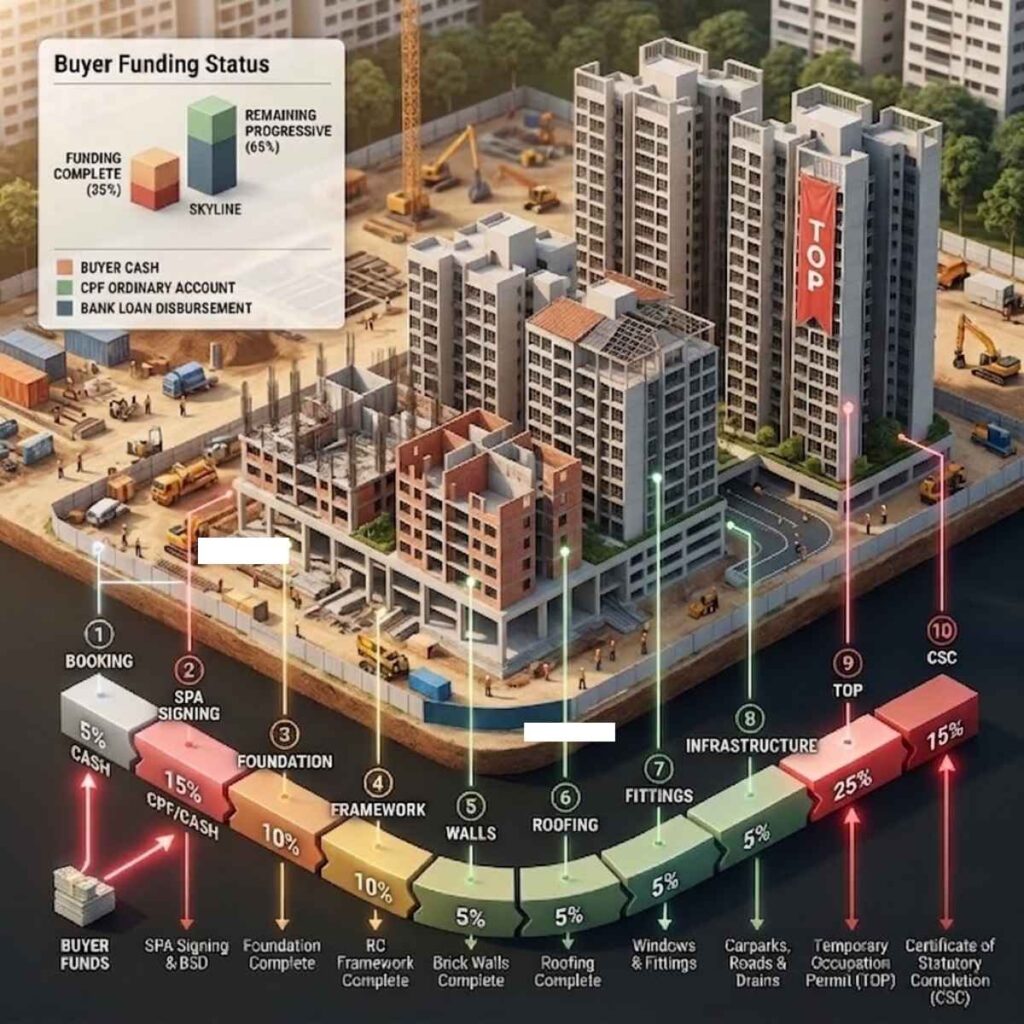
With the Deferred Payment Scheme gone for new sites, one payment structure remains for a new EC: progressive payment.

You pay a booking amount, then the stamp duty, then instalments that step up as construction stages complete, with the bank loan disbursing in stages alongside.

The practical effect is that your monthly commitment starts small and grows over roughly three to four years, reaching its full level around completion.

Under the old Deferred Payment Scheme you could defer almost all of it until keys.

That option no longer exists on new sites, so anyone modelling an EC purchase on a DPS assumption is modelling the wrong product.

The full stage-by-stage breakdown is covered in our progressive payment guide.

The hold, and what it means for your exit

An EC moves through three phases.

Which numbers apply depends on when its site was tendered.

EC rules at a glance — which side of 8 May 2026?

The terms depend on when the project's land tender closed, not on when you buy.

Stage Sites tendered before 8 May 2026 Sites tendered on or after 8 May 2026
Minimum occupation period 5 years 10 years
Can sell to Singapore Citizens and PRs From year 5 From year 10
Full privatisation 10 years after TOP 15 years after TOP
First-timer quota 70% of units 90% of units
First-timer priority period 1 month 2 years
Deferred Payment Scheme May be offered by the developer Not available

Source: Ministry of National Development and HDB, announced 8 May 2026. Applies to Executive Condominium sites sold through Government Land Sales with tender closing dates on or after that date. Position as of August 2026 — confirm the terms of your specific project before committing.

The point of the table is the middle column. Under the old terms you could sell to Singapore Citizens and PRs from year 5.

Under the new terms that first door opens at year 10, and the foreign buyer pool at year 15.

What EC resales have actually done

Now the part most upgraders want, stated as fact rather than promise.

What EC owners realised on resale

Average gross gain on EC resale transactions completed in each year, with the average time the sellers held the unit. Read the holding period alongside the gain — it is what the gain was earned over.

Year of sale Average gain Sales with a gain above S$1m Average holding period
2021 S$287,538 4 9.3 years
2022 S$412,683 6 8.7 years
2023 S$521,960 16 8.6 years
2024 S$584,674 42 9.1 years
2025 S$659,366 162 9.5 years
2026 year to date S$653,617 43 9.6 years

Source: Huttons Data Analytics, based on URA data, as at May 2026. These figures describe completed transactions under the EC rules in force at the time — a 5-year minimum occupation period with privatisation 10 years after TOP. Units bought on sites tendered from 8 May 2026 are held under different terms. Past transactions are not a forecast of future prices.

Note: These figures are illustrative and opinion-based, produced with calculation tools — not a valuation or financial advice. Human error is possible; verify against official sources before relying on them.

Across the broader dataset, 13,781 EC resale transactions were profitable against 278 that were not, with an average gross profit of S$450,042 and an average holding period of 9.3 years — an annualised return of about 5.1%.

Three of the stronger recent performers, measured on a typical 1,206 sq ft unit: OLA moved from S$1,134 psf at launch to S$1,760 psf, Provence Residence from S$1,153 to S$1,616, and Piermont Grand from S$1,100 to S$1,548.

Two things in that data deserve equal weight.

The first is that the record is genuinely strong. A 98% profitable rate across nearly 14,000 transactions is not a selection of winners; it is the population.

The second is the holding period.

Those gains took an average of 9.3 years to earn, and the annualised figure of about 5.1% is a more honest description of the return than the headline profit.

An EC has been a slow, reliable performer, not a quick one.

And here is the part that matters for anyone buying now: every one of those transactions was earned under a 5-year MOP with privatisation at 10 years.

An EC bought on a site tendered from 8 May 2026 carries a 10-year MOP and 15-year privatisation.

The historical record was made by a product that had roughly half the lock-in of the one being sold today.

That does not make the new one a bad buy.

It makes it a different one, and it should be modelled as such.

Which projects still carry the earlier rules?

Because the change applies by land tender date rather than by launch date, a handful of projects coming to market over the next year or so are still on the earlier terms.

EC projects understood to sit on the earlier rules

These projects are on Government Land Sales sites tendered before 8 May 2026, so they are expected to keep the 5-year minimum occupation period and privatisation 10 years after TOP. Confirm the position of any specific project with the developer before you commit.

Project or site Location Units Status
Coastal Cabana Jalan Loyang Besar, D18 748 Launched Jan 2026
Rivelle Tampines Tampines Street 95, D18 572 Launched Feb/Mar 2026
Senja Close Bukit Panjang, D23 295–306 Estimated Q4 2026
Woodlands Drive 17 Woodlands, D25 420 Estimated Q4 2026
Sembawang Road Sembawang, D27 265 Estimated Q4 2026
Miltonia Close Yishun, D27 To be announced Estimated 2027

Source: NAVIS Research and Huttons Data Analytics 2026 launch pipeline, and Huttons market commentary of 22 May 2026. Launch dates are estimates and change without notice. Unit counts for projects that have not launched are provisional and have been reported differently across sources; the developer’s figure at launch is the one that stands. This list reflects the position as at August 2026 and is not a complete record of every EC site. Verify the applicable rules for any specific project with the developer and against HDB before committing.

Note: These figures are illustrative and opinion-based, produced with calculation tools — not a valuation or financial advice. Human error is possible; verify against official sources before relying on them.

Two of those have already launched.

The rest are expected through late 2026 and into 2027, and after them, every new EC will carry the 10-year hold.

It is worth being plain about what that does and does not mean.

A shorter minimum occupation period is only an advantage if there is a realistic chance you would want to sell earlier.

If you are buying a family home you expect to live in for a decade regardless, the difference costs you nothing, and choosing a project you like less in order to catch the earlier rules would be a poor trade.

The rules should narrow your shortlist, not write it.

How a specific project gets assessed

The rules tell you what you are allowed to buy. They say nothing about whether a particular project is worth buying, and that is a separate piece of work.

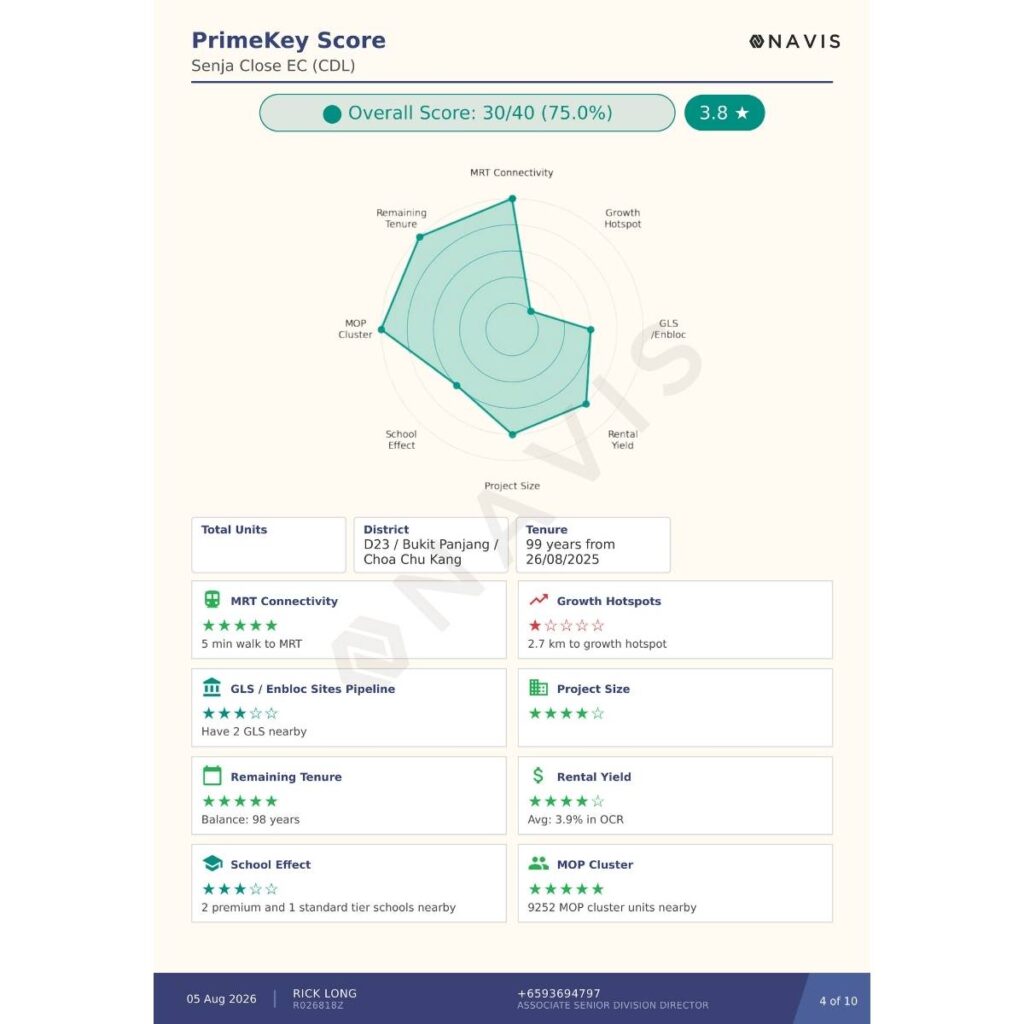
One of the tools I use for it is PrimeKey Analysis, a scoring framework within the Navis platform that reads a project across eight property-level factors — MRT access, remaining tenure, project size, rental yield in the area, nearby primary schools, the Government Land Sales pipeline, URA growth areas, and the pool of nearby HDB flats reaching MOP.

It produces a profile rather than a verdict.

Here is one of the pipeline projects above, run through it.

PrimeKey Analysis score page for Senja Close EC, scoring eight property factors: five stars for MRT access, remaining tenure and nearby MOP cluster, one star for growth hotspot proximity

One caveat before reading it.

Details for projects that have not launched are provisional — Senja Close has been reported at both 295 and 306 units, and the developer’s own figure at launch is the one that will stand.

That matters more than it looks: where a factor is scored off a number that is still moving, the score that depends on it moves with it.

Treat the profile as a starting point, and confirm project details before relying on them.

Read it honestly and it says something useful.

The project scores full marks on transport, lease runway and the size of the nearby upgrader pool, which are the factors that tend to support demand when it is eventually resold.

It scores one out of five on proximity to a designated growth area.

That single weak score is the reason a framework is worth using.

A scoring tool that never returns an inconvenient number is a brochure.

This one flags a real trade-off: strong fundamentals for daily living and future demand, limited direct exposure to government-led transformation.

Whether that trade-off matters depends entirely on why you are buying.

And that is the limit of any score. It compares properties. It does not know your CPF position, your monthly comfort, your family timeline, or how long you can hold.

The full explanation of what the framework covers and what it deliberately does not sits in our PrimeKey Analysis guide.

Why resale EC deserves a serious look now

The May 2026 change has made the resale EC route more relevant, not less.

If your horizon is shorter than a decade, a new EC now locks you in for ten years before you can sell to anyone.

A resale EC from an earlier project sits on the old timeline — its MOP is already served, and privatisation arrives at year 10 from its TOP rather than year 15.

You buy at market price instead of launch price, but you buy time back.

It also removes two gates.

There is no income ceiling on a resale EC, so a household above S$16,000 stays in the market.

And there is no resale levy on the purchase.

Affordability data supports the comparison being closer than it looks.

New EC prices have fallen relative to incomes over the past fifteen years, from around 10.5 times annual household income to about 8.3. Resale EC has moved the other way, from about 8.9 to 9.1.

The entry-price advantage of a new EC is real but narrower than it once was — and the flexibility gap now runs the other way.

Neither route is automatically better.

A longer hold is not a problem if you were staying anyway.

When an EC fits, and when it does not

An EC tends to fit when your household is comfortably inside the income ceiling, the monthly commitment sits well within your income at the stress-tested rate, you have somewhere to live during construction if buying new, and your plans are stable for the length of the hold.

It tends not to fit when the income ceiling is close enough that a raise could end eligibility, when the resale levy and stamp duty are not already budgeted, when you may need to move or sell inside the MOP, or when the plan depends on the historical returns repeating on a product with double the lock-in.

If the numbers are the open question rather than the rules, work through the full affordability guide first.

Frequently asked questions about upgrading from HDB to an EC

Do I pay ABSD when upgrading from HDB to a new EC?

ABSD remission is granted automatically when HDB approves an eligible purchase of a new EC and at least one purchaser is a Singapore Citizen. HDB also requires the existing flat to be disposed of within its stipulated period, generally within six months of taking possession of the EC unit. Confirm the conditions for your household before booking.

Can I still get the Deferred Payment Scheme?

Not for an EC on a Government Land Sales site whose tender closed on or after 8 May 2026. Earlier sites remain under the previous framework, so check the tender closing date for the project rather than relying only on its launch date.

How much is the resale levy?

For a subsidised flat sold on or after 3 March 2006, the family resale levy ranges from S$15,000 for a 2-room flat to S$55,000 for an EC. The applicable amount follows the first subsidised home sold. Check HDB’s resale-levy table for your exact case.

My household earns more than S$16,000. Can I still buy an EC?

You cannot buy a new EC from a developer if the household income in the application exceeds S$16,000 a month. A resale EC has no new-EC income ceiling, although financing, buyer eligibility and stamp duty still depend on your profile and the project’s privatisation stage.


How long before I can sell an EC?

Under the old terms, 5 years to sell to Singapore Citizens and PRs and 10 years to full privatisation. On sites tendered from 8 May 2026, 10 years and 15 years respectively. Project-specific conditions should be confirmed before purchase.

Is an EC a good investment?

Huttons Data Analytics recorded 13,781 profitable EC resale transactions against 278 that were not, at an average gross gain of S$450,042 over an average holding period of 9.3 years — roughly 5.1% a year. Those gains were recorded under the earlier EC framework. A longer MOP changes the flexibility and holding assumptions. Buy only when the home, monthly commitment and full holding period fit your household; future returns cannot be promised.

Official references: HDB EC eligibility, HDB conditions after buying an EC, IRAS ABSD remission, and MND’s 8 May 2026 announcement.

Your next step

The rules changed, the products split, and the right answer now depends on which project you are looking at and how long you intend to stay.

If you would like to work through your eligibility, your numbers and the hold before you commit, I am happy to go through them with you.

Article read: 20% complete.

What's left is the part no article can do — your eligibility, your numbers, your timeline against the hold. One session with Rick closes that gap.

YOUR PROGRESS 20%

Article read — you've done the groundwork.

2. How much time shall we set aside?
3. Pick a day to meet Rick
4. What time of day?
Request sent — 100% ✓
Rick will confirm the session with you directly on WhatsApp.
If WhatsApp didn't open, tap here

This sends a session request via your own WhatsApp — Rick confirms the timing and meeting place with you personally. Nothing is stored on this page.

Disclaimer: The case studies and information are for educational use only and i make no representation or guarantees with respect to the accuracy, applicability, or completeness of its contents. There shall be no liability for any loss or expense whatsoever, relating to investment decisions made by the reader.

About the author

Rick Long is an Associate Senior Division Director at Huttons Asia.

Through YouHome.sg — Right Property Matters — he shares the frameworks, tools and field experience behind his advisory work, helping Singapore buyers and sellers across HDB, EC and private residential decisions with structured, calm, next-step guidance.

CEA Reg. R026818Z · Huttons Asia · YouHome.sg

What My Clients Say | Genuine Experiences

Real stories, real experiences—because your journey deserves nothing less than the best.

Awards and Accolades

Leave a Reply