How to Upgrade From HDB to Condo: The Step-by-Step Process

Quick answer: An HDB-to-condo upgrade runs in one of two sequences.

Sell first and you know your proceeds, keep ABSD out of the purchase, and stay on the 75% loan tier — but you need somewhere to live in between.

Buy first and you pay 20% ABSD upfront against a six-month clock.

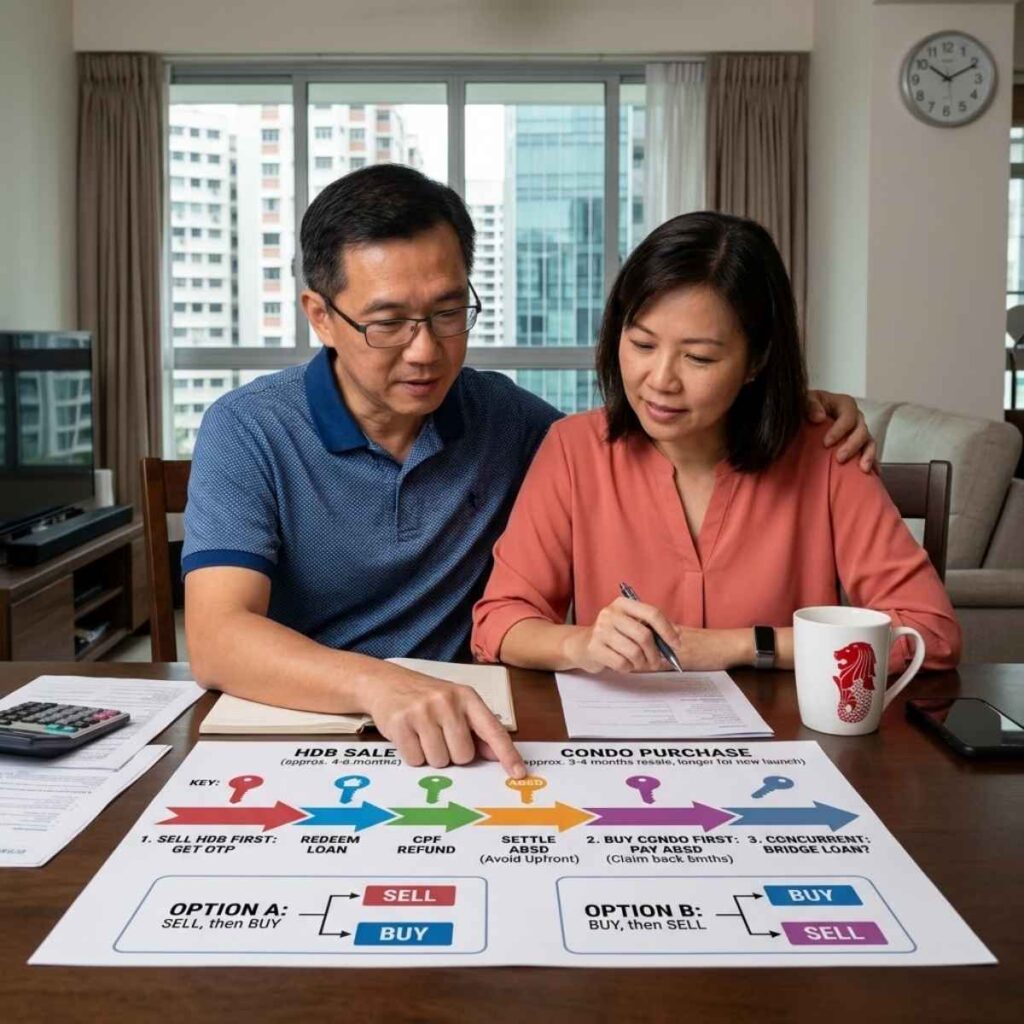
Singapore couple reviewing HDB sale and condo purchase timelines before choosing an upgrade sequence

Table of Contents

The upgrade in six steps

  1. Confirm the flat can be sold — check your MOP and eligibility with HDB.

  2. Work out what the sale actually returns after the loan is redeemed and your CPF is refunded.

  3. Set the budget under TDSR at the 4% stress floor, and confirm which LTV tier you fall into.

  4. Choose the sequence — sell first, or buy first and fund ABSD upfront.

  5. Run the sale and the purchase in order, with the accommodation gap planned before you sign.

  6. Complete, let the CPF refund land, and move.

Most upgrades come apart at steps 3 and 4, not step 6.

The money and the deadlines are the hard part; the moving is the easy part.

Key deadlines and windows

An HDB-to-condo upgrade is governed by four fixed clocks: 21 calendar days on the HDB option, 14 days to pay stamp duty, six months to sell the first home for ABSD remission, and up to 15 working days for the CPF refund to be credited. Put all four on one calendar before signing.

Key timing points for an HDB-to-condo upgrade in Singapore
Stage Window or convention Authority or basis
HDB resale OTP 21 calendar days, including weekends and public holidays, expiring at 4pm on the 21st calendar day. HDB — Option to Purchase
HDB option fees Option Fee: S$1 to S$1,000. Option Fee plus Option Exercise Fee: up to S$5,000 in total. Neither fee can be S$0. HDB — Option to Purchase
Private resale OTP Often 14 days, with 1% option money and 4% on exercise. Market convention, not a statutory rule. Confirm the actual contract.
BSD and ABSD payment Within 14 days after the signed contract or agreement; 30 days where signed overseas and received in Singapore later. IRAS — ABSD
ABSD remission sale timeline For eligible married couples: within 6 months after purchase for a completed property, or within 6 months after TOP or CSC, whichever is earlier, for an uncompleted property. IRAS does not extend it. IRAS — remission
ABSD refund application Within 6 months after the sale date of the first residential property, where an application is required. IRAS — remission
CPF refund crediting Within 15 working days of CPF Board receiving the funds, including the time taken to clear the cheque or cashier's order. CPF Board

Note: Rules and processing times can change. Verify the current position on the linked official portals and align the actual dates with your banker and conveyancing lawyer. This is not financial or legal advice.

Before you start: three gates

Can the flat be sold yet?

Most flats can only be sold after the Minimum Occupation Period.

It is five years for most standard flats and generally ten years for Plus and Prime flats, whether bought new or resale.

Your own position depends on flat type and purchase scheme, so confirm it with HDB rather than from memory.

If the date is still ahead, that window is preparation time, not dead time.

What does the sale actually return?

Your selling price is not your budget.

At completion the proceeds settle the outstanding housing loan first, then refund the CPF you used plus accrued interest, then the selling and legal costs.

Only the remainder reaches you as cash.

Estimating what your own sale returns is worth doing before you plan around it.

The CPF portion is not lost. It is your retirement money being restored to your Ordinary Account, and it becomes available again for the next purchase — but it is CPF, not cash, and some costs only accept cash.
Which loan tier are you in?

A private condo is assessed under TDSR at 55% of gross monthly income, stress-tested at a 4% floor rather than your actual package rate. MSR does not apply to a private purchase.

The tier that matters more is LTV. A first housing loan can go to 75% with a minimum 5% in cash.
If a housing loan is still outstanding when you buy, the tier drops to 45% with 25% in cash — which is what makes buying first expensive, more than ABSD does.

Should you sell your HDB first or buy the condo first?

Both sequences work.

They fail differently, and the failure modes are what should decide it.

Upgrade sequence check
Which path should you review first?

This router does not approve a loan or determine tax treatment. It helps you identify whether a sell-first or buy-first discussion deserves priority.

1. Do you still own the HDB flat?
2. Do you need the actual sale proceeds before committing?
3. Can you comfortably fund a buy-first structure upfront?
4. Is interim accommodation workable?
Suggested discussion starting point

Sell first
  • Sale proceeds and the CPF refund are known before you commit.
  • No ABSD on the purchase when the flat is sold and no longer owned at the date of the new purchase.
  • The loan sits on the first-loan tier: up to 75% LTV, with a minimum 5% in cash.
  • Main planning issue: the accommodation gap.
Buy first
  • May preserve continuity of housing.
  • ABSD of 20% applies for a Singapore Citizen buying a second residential property, on the price or market value, whichever is higher, and is due within 14 days of the signed contract.
  • While the HDB loan is outstanding, LTV drops to 45% or 25%, with a minimum 25% cash downpayment.

Whether the numbers work at all is a separate question from which sequence to run, and it has its own guide.

The sell-first sequence, step by step

Sell the flat

The selling leg has its own timeline — intent to sell, the cooling period, granting the option, the resale application and completion.

It is covered end to end in our HDB resale process guide, so it is not repeated here.

What matters for the upgrade is the completion date, because that is when your cash and CPF actually arrive.

Negotiate where you will live

HDB allows a temporary extension of stay after completion by agreement between buyer and seller, capped at three months.

Ask for it during price negotiation, not after — it is worth more than a small price concession if your next home is not ready.

The alternatives are a short rental, family, or storage plus a gap.

All three cost money and none of them appear in a sale-price calculation.

Buy with your numbers known

Once the sale is firm, you know the proceeds, the restored CPF and the loan you qualify for.

Choose the property against that, not against the maximum a banker will approve.

If you are buying a new launch, the payment runs in construction stages rather than at once — that changes the monthly picture substantially and is worth reading separately.

The buy-first sequence, step by step

Fund the ABSD before you sign anything

For a Singapore Citizen buying a second residential property, ABSD is 20% of the purchase price or market value, whichever is higher, and it is due within 14 days of the signed contract. On a S$1.5 million condo that is S$300,000 in cash or approved funding.

Married couples with at least one Singapore Citizen spouse may apply for remission afterwards, provided the property is bought in both names only and the first home is sold inside the window in the table above.

Accept the lower loan tier

While the HDB loan is outstanding, the purchase sits on the second-loan LTV tier. The cash requirement rises with it. Model this before viewing, because the gap is often six figures.

Sell inside the window, not near it

The six-month clock runs from the purchase of a completed property, or from TOP or CSC for one still being built.

Market the flat early — ideally before the purchase completes — rather than starting after.

Where the money moves, and when

Sequence is the whole subject of this page, and money is where it bites. In rough order for a sell-first upgrade:

  • Option fee on the new home, in cash.

  • BSD, and ABSD if applicable, within 14 days of the signed contract.

  • The 5% minimum cash portion of the downpayment.

  • The CPF portion of the downpayment, once the refund from your sale has been credited.

  • Loan disbursement at completion, or in stages for a new launch.

The trap is timing rather than total.

A CPF refund that arrives after your next CPF payment is due leaves you funding the difference in cash, even though the money exists.

What breaks a sequence

  • The sale slips past the remission window.
    The ABSD stays paid. This is the most expensive failure on the page.

  • The loan comes back smaller than planned.
    Banks lend against the lower of price or valuation, and the difference is cash.

  • The CPF refund lands late.
    Build the crediting window into the payment schedule with your conveyancing lawyer.

  • A new launch TOP moves.
    Rental runs longer than budgeted; that is a cash line, not a paper one.

  • The accommodation gap was never priced.
    Three years of interim rental on a sell-first new-launch plan is a six-figure line item.

Is it true that…?

“ABSD is waived when you upgrade.”
No. On a private purchase while you still own the flat, it is paid first and refunded only if every IRAS condition is met. Waived and refundable are different things.

“Selling first means I lose the market.”
It means you buy with known numbers. Whether that is a loss depends on your cash buffer, not on the market.

“The CPF refund is a penalty.”
No. It is your own retirement money being restored to your Ordinary Account, and it is immediately usable for the next home.
That is how most upgrades end up funded from the sale rather than fresh savings.

Frequently asked questions

How long does an HDB-to-condo upgrade take?

Plan for several months on a resale-to-resale move. The HDB option period alone runs 21 calendar days, and the sale and the purchase each carry their own option, application and completion dates. A new launch extends the timeline to the project's completion, which is typically years rather than months.

Can I use the sale proceeds for the condo downpayment?

Yes, subject to timing. Cash proceeds can fund the 5% minimum cash portion under a 75% LTV structure and the stamp duty. CPF refunded from the sale is credited within three working days when the funds and refund details are transmitted electronically, or up to 15 working days when submitted manually by cheque or cashier's order — and may be reused for the next home subject to CPF housing rules.

What happens if my HDB does not sell in time under a buy-first plan?

The ABSD you paid upfront is not refunded. Married-couple remission requires the first home sold within 6 months of buying a completed property, or within 6 months of TOP or CSC, whichever is earlier. IRAS does not grant extensions, so market the flat early rather than starting after completion.

Do I pay ABSD if I sell my flat first?

Not on the purchase, provided the sale has completed and you no longer own the flat at the date of the new purchase. IRAS counts the residential properties you own at that date, so a sale that is contracted but not yet completed still counts. BSD applies either way.

How much cash do I need instead of CPF?

On a first housing loan at 75% LTV, at least 5% of the price or value must be in cash. If an HDB loan is still outstanding, LTV drops to 45% or 25% and the minimum cash downpayment rises to 25%. Stamp duty, valuation gaps and interim housing are extra.

Should I buy a resale condo or a new launch?

A resale condo offers an earlier move-in and certainty over the physical unit. A new launch spreads payments across construction stages but creates a longer housing and cashflow timeline. One timing difference matters for upgraders: the ABSD remission clock starts at purchase for a completed property, or at TOP or CSC for one still being built.

Compare new launch and resale condo choices.

Note: This FAQ is general education, not financial, legal or tax advice. Verify current rules with HDB, CPF Board, IRAS, MAS, your banker and your conveyancing lawyer.

Your next step

If you are still weighing why people upgrade and which path fits, start with the main upgrading guide — and if an Executive Condominium is on your list, the EC route has its own guide.

Every upgrade is a sequence problem before it is a property problem.

If you would like a second pair of eyes on your dates and your numbers before you commit to one, I am happy to walk through them with you.


Article read: 20% complete.

What's left is the part no article can do — your dates, your numbers, your sequence. One session with Rick closes that gap.

YOUR PROGRESS 20%

Article read — you've done the groundwork.

2. How much time shall we set aside?
3. Pick a day to meet Rick
4. What time of day?
Request sent — 100% ✓
Rick will confirm the session with you directly on WhatsApp.
If WhatsApp didn't open, tap here

This sends a session request via your own WhatsApp — Rick confirms the timing and meeting place with you personally. Nothing is stored on this page.

Disclaimer: The case studies and information are for educational use only, and I make no representations or guarantees with respect to the accuracy, applicability, or completeness of the contents.

There shall be no liability for any loss or expense whatsoever relating to property or investment decisions made by the reader.

What My Clients Say | Genuine Experiences

Real stories, real experiences—because your journey deserves nothing less than the best.

About the author

Rick Long is an Associate Senior Division Director at Huttons Asia.

Through YouHome.sg — Right Property Matters — he shares the frameworks, tools and field experience behind his advisory work, helping Singapore buyers and sellers across HDB, EC and private residential decisions with structured, calm, next-step guidance.

CEA Reg. R026818Z · Huttons Asia · YouHome.sg