Progressive Payment Scheme Singapore: New-Launch Guide 2026

The Progressive Payment Scheme (PPS) is Singapore’s legislated payment structure for new-launch condos and ECs still under construction. Instead of paying the full price at once, you pay in stages tied to construction milestones — 5% at booking, 15% at signing, then the balance drawn progressively through to TOP and CSC. Your bank loan disburses the same way, so your early instalments stay small and grow as the building goes up.

Enter your unit price and buyer profile below for your full schedule and monthly instalments — or read the full guide beneath the tool.

New-launch condo & EC

Progressive Payment Calculator

See your full payment schedule stage by stage, your cash-and-CPF split, and your estimated stamp duties.

Enter your unit's price in S$.

Sets the ABSD rate. Confirm the current rate on the IRAS ABSD page.

Max 75% for a first housing loan. Confirm on the MAS LTV page.

Up to 35 years (private). Longer tenures or an older borrower can lower the max LTV.

An editable estimate for illustration — check current bank packages.

Purchase price

Loan amount (75%)

Downpayment

5% cash + balance cash/CPF

Cash at OTP (5%)

Booking fee, cash only

Est. monthly after CSC

Full instalment, once fully drawn

Total stamp duty

BSD + ABSD

Your payment schedule
Progressive payment milestone schedule for a new-launch condo or EC in Singapore. Percentages are set by the Housing Developers Rules; amounts shown for a S$2,000,000 example.
Stage%Amount
Booking fee (OTP) · Cash5%S$100,000
Signing S&P (within 8 weeks) · Cash / CPF15%S$300,000
Foundation completed · Cash/CPF → loan10%S$200,000
Reinforced-concrete framework · Bank loan10%S$200,000
Partition walls · Bank loan5%S$100,000
Roofing / ceiling · Bank loan5%S$100,000
Doors, windows, wiring, plastering · Bank loan5%S$100,000
Car parks, roads & drains · Bank loan5%S$100,000
TOP — keys handed over · Bank loan25%S$500,000
CSC — legal completion · Bank loan15%S$300,000
Total100%S$2,000,000

Milestone percentages are set by the Housing Developers Rules and are the same for every licensed developer. Confirm the exact schedule in your Sale & Purchase Agreement.

Your monthly instalment during construction
Estimated monthly instalment as the housing loan draws down through construction, based on your inputs.
StageLoan drawnMonthly instalment*

*The instalment on the loan drawn so far, spread over your chosen tenure — it steps up each time a milestone is certified and more of the loan is released, reaching its full amount after CSC. You do not service the full loan from day one. Some construction-period packages charge interest only on the amount drawn, which would be lower; confirm your package.

Estimate only. Verify exact figures with the IRAS, MAS and CPF portals.

These figures are illustrative and opinion-based, produced with calculation tools — not a valuation or financial advice. Human error is possible; verify against official sources before relying on them. Stamp duties and loan limits are set by the authorities and can change. Actual loan quantum is subject to bank approval and TDSR assessment.

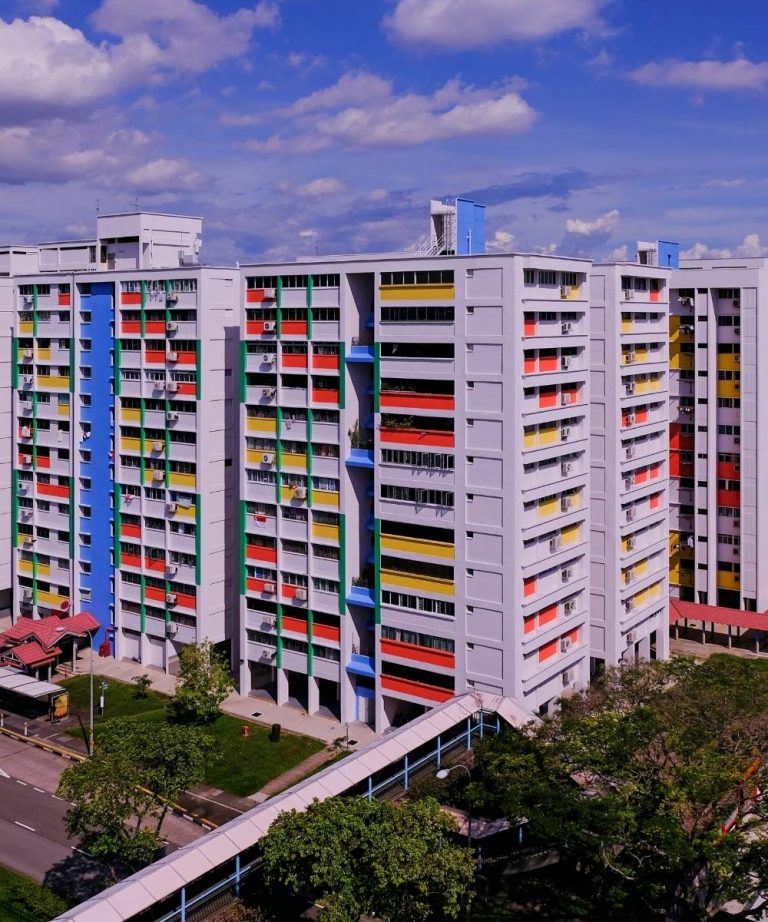
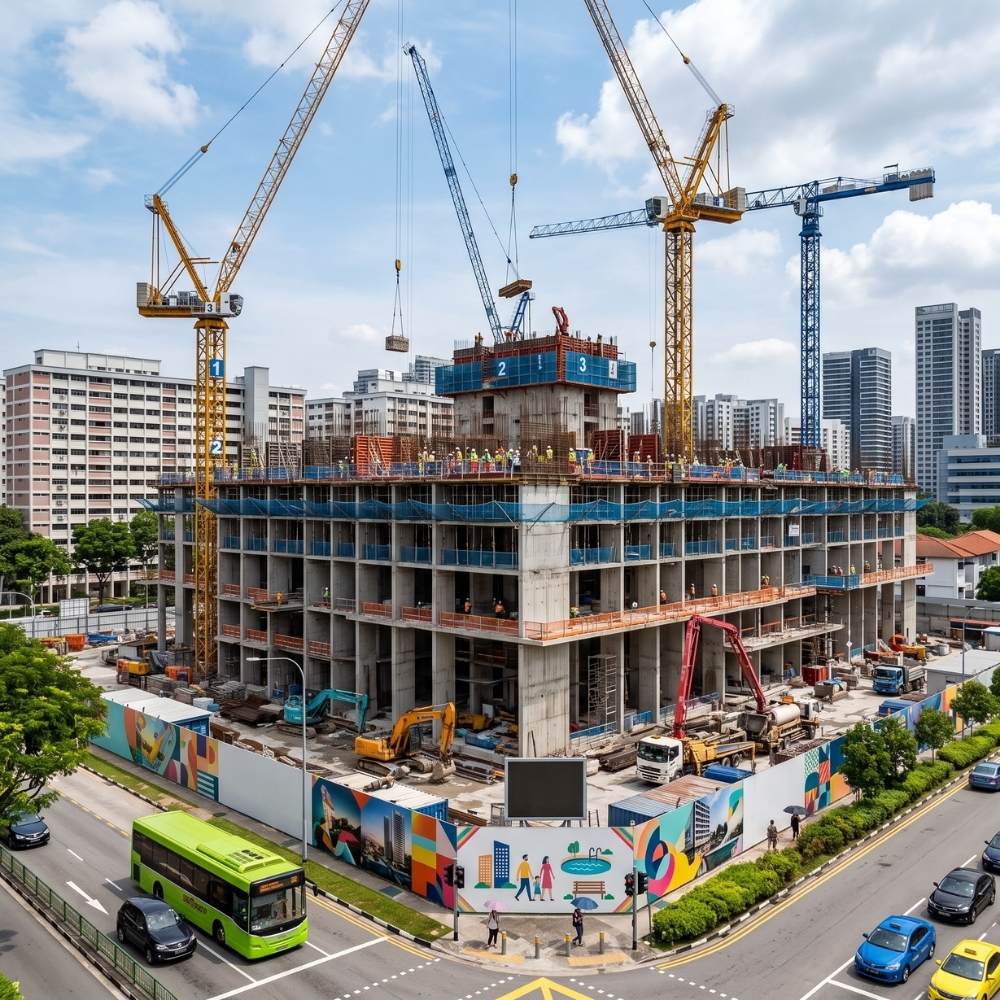
New-launch condominium under construction in Singapore, illustrating the progressive payment scheme milestones
A new launch is paid for in stages as it is built.

The numbers that matter

Here is the whole scheme in one glance. Every figure is linked to an official source or marked for final live verification before publishing.

The key point for first-time buyers is timing. The purchase price may be spread across progressive payment stages, but stamp duty sits outside that staged schedule and falls due early. Your cash, CPF timing, loan approval and conveyancing timeline should be reviewed before you commit.

Key payment, loan and stamp duty numbers for a Singapore new launch purchase
What Figure Official source / publish check
Booking fee at OTP Figure 5%, usually cash only Official source Housing Developers Rules
On signing the S&P Figure 15%, cash or CPF, within 8 weeks Official source Housing Developers Rules
Minimum downpayment for a 75% loan Figure 25% — 5% cash + 20% cash/CPF, subject to lender and CPF rules Official source MAS: LTV limits
Maximum loan for a first housing loan Figure Up to 75% LTV, subject to loan tenure, age and lender assessment Official source MAS: LTV limits
Total Debt Servicing Ratio cap Figure 55% of gross monthly income Official source MAS: TDSR
Stamp duty: BSD + any ABSD Figure Due within 14 days after the Contract or Agreement is signed in Singapore. A longer window applies if signed overseas. CPF usage depends on CPF rules and property status. Official source IRAS: Stamp Duty
CPF Board: Property-related fees
Progressive payment milestones Figure 10 stages, with percentages fixed by law Official source Housing Developers Rules

Note: Stamp duty is separate from the progressive payment schedule. It is an early payment item and should be checked with IRAS, CPF Board, your banker and your conveyancing lawyer before you exercise the Option to Purchase.

Table of Contents

How does the progressive payment scheme work in Singapore? (H2)

Under PPS, you pay for an uncompleted home in tranches as construction is certified, not in one lump sum on signing day. The scheme is set out in the Housing Developers (Control and Licensing) Act and its rules, so the milestone percentages are fixed by law and identical across every licensed developer — there is no negotiating which milestone triggers which percentage.

The standard progressive payment schedule

The standard progressive payment schedule for a Singapore new launch condo — each construction stage, the percentage of purchase price due, and the typical funding source.
Stage % of price Funding
Booking fee (grant of OTP)% of price5%FundingCash
Signing the Sale & Purchase Agreement% of price15%FundingCash / CPF
Foundation completed% of price10%FundingCash / CPF / loan
Reinforced-concrete framework completed% of price10%FundingCash / CPF / loan
Partition walls completed% of price5%FundingCash / CPF / loan
Roofing / ceiling completed% of price5%FundingCash / CPF / loan
Door & window frames, wiring, plastering, plumbing% of price5%FundingCash / CPF / loan
Car parks, roads and drains completed% of price5%FundingCash / CPF / loan
Temporary Occupation Permit (TOP)% of price25%FundingCash / CPF / loan
Certificate of Statutory Completion (CSC)% of price15%FundingCash / CPF / loan

Stage percentages are prescribed under the Housing Developers Rules. Confirm the current schedule with your conveyancing lawyer before committing.

Each stage is triggered when its construction milestone is certified — the developer issues a payment notice to your lawyer, and payment is due within 14 days of it.

The exact calendar timing therefore varies by project.

You fund the first 25% yourself (at least 5% in cash, the rest cash or CPF); from there, your bank disburses its slice of the loan directly to the developer at each milestone.

How much of each later stage comes from the loan rather than your own cash or CPF depends on how much you borrow — a smaller loan, or a strong CPF or cash position, shifts more of it away from the loan.

What happens to my monthly instalment during construction?

Because the loan is released in stages, your monthly instalment starts small and climbs.

Early on, only a small slice of the loan has been drawn, so you are servicing a small balance.

As each milestone draws more of the loan, the instalment steps up, reaching its full amount only after the keys are handed over.

Two things catch buyers out here.

First, you must still qualify for the full loan amount up front (75%) — the staged drawdown lowers your early cash outflow, not the size of the loan you need approved.

Second, you generally cannot refinance a Building-Under-Construction (BUC) loan to another bank before TOP; you can usually only reprice within the same bank until the property is completed.

Plan the package you start with as the one you will hold through construction.

Can I use CPF for progressive payments?

Yes. You can use your CPF Ordinary Account (OA) for the part of the downpayment above the 5% cash minimum, and for the progressive stages from the S&P onwards — subject to the CPF Valuation Limit.

The Valuation Limit is generally based on the lower of the purchase price or the property’s valuation price at the time of purchase.

Where the remaining lease covers the youngest buyer using CPF to age 95, CPF OA use is generally allowed up to this limit.

To use CPF beyond that point, you must first set aside the applicable Basic Retirement Sum.

For a purchase financed with a bank loan, this further CPF use is capped at the Withdrawal Limit — 120% of the lower of the purchase price or valuation price.

For an uncompleted property, CPF releases the relevant amount from your OA at each milestone — provided the withdrawal application is in before the milestone is triggered, so apply early through your conveyancing lawyer rather than after the notice arrives.

The mechanics are set out by the CPF Board.

One point worth keeping in view, not as a penalty but as planning: any CPF OA you use is tracked with accrued interest at the OA rate, and that amount — the money plus the interest it would have earned — returns to your CPF when you eventually sell.

It is your own retirement savings being restored to you, and it is first in line ahead of your cash proceeds at completion.

When do I pay BSD and ABSD — and can I use CPF for them?

Buyer’s Stamp Duty (BSD), and Additional Buyer’s Stamp Duty (ABSD) where it applies, are not part of the progressive schedule.

Both fall due within 14 days of signing the S&P, in a single lump sum, not spread across milestones. Since the February 2023 Budget, the top marginal BSD rate on residential property is 6% (on the portion above S$3 million), per the IRAS: Stamp Duty.

BSD on a residential purchase (2026 bands)

Buyer’s Stamp Duty is calculated on the higher of the purchase price or market value. For residential property, the rate is tiered by price portion, not charged as one flat rate on the whole amount.

Residential Buyer’s Stamp Duty bands in Singapore
Portion of price BSD rate
First S$180,000 BSD rate1%
Next S$180,000 BSD rate2%
Next S$640,000 BSD rate3%
Next S$500,000, up to S$1.5 million BSD rate4%
Next S$1.5 million, up to S$3 million BSD rate5%
Amount above S$3 million BSD rate6%

Source: IRAS Buyer’s Stamp Duty. Rates are set by IRAS and may change — always confirm the current bands on the IRAS page before committing to a purchase.

Worked out, BSD is roughly S$24,600 at S$1M, S$44,600 at S$1.5M, S$69,600 at S$2M, S$109,600 at S$2.8M, and S$119,600 at S$3M — confirm the exact figure on the IRAS BSD calculator for your price.

ABSD depends on your profile and how many residential properties you hold. Rates have been unchanged since 27 April 2023, per the IRAS: ABSD:

ABSD by buyer profile (residential)

Additional Buyer’s Stamp Duty is charged on top of BSD, on the higher of purchase price or market value. The rate rises with each additional residential property you already hold, and differs by buyer profile.

Additional Buyer’s Stamp Duty rates for residential property in Singapore, by buyer profile and property count.
Buyer profile 1st property 2nd 3rd or more
Singapore Citizen0%20%30%
Permanent Resident5%30%35%
Foreigner60%60%60%

Source: IRAS — Additional Buyer’s Stamp Duty. Confirm current rates on the live IRAS page before relying on them.

On a S$2M purchase that counts as a Singapore Citizen’s second property, ABSD is 20% — S$400,000 — due in cash at the same time as BSD.

Can CPF cover stamp duty?

This is where a common belief is wrong. CPF OA can be used for both BSD and ABSD, per the CPF Board — the catch is timing, not eligibility.

Because a CPF charge often can only be lodged after the sale completes, most buyers pay the stamp duty in cash within the 14 days and then claim reimbursement from CPF.

For a new launch, if the CPF paperwork is lodged within that window you may be able to pay from CPF directly, subject to approval.

Either way: have the cash ready by day 14, and treat CPF as reimbursement rather than assuming it will arrive in time. (Foreigners, who are not CPF members, pay stamp duty in cash.)

HDB upgraders: buy first, or sell first?

If you are upgrading from an HDB flat, the scheme forces one real decision: sell your flat before you buy, or buy the new condo first and sell later.

Neither is “correct” — the right answer depends on your cash, your CPF, and how much disruption you can absorb.

Here are the factors, not a verdict.

Sell first, then buy. You avoid ABSD entirely, since the new condo is your only property when you buy.

The cost is where you live for the three to four years of construction — most upgraders rent in that window.

Cleaner on tax and cash; more disruptive on living arrangements.

Buy first, then sell. You pay the 20% ABSD upfront in cash on the new purchase — on a S$2M unit, that is S$400,000 within 14 days.

A married couple with at least one Singapore Citizen can then reclaim that ABSD, but only by selling the HDB within the qualifying window.

And here is the point that is widely misunderstood: for an uncompleted new launch, the six-month clock runs from the issue date of the new condo’s TOP or CSC (whichever is earlier), not from the day you buy — per the IRAS: ABSD remission for a married couple.

IRAS does not extend that window, so if you go this route, plan the sale to land inside it.

The steadiest way to weigh these is against your own numbers — the flat’s likely proceeds, your CPF position, and the cash you would need to float ABSD.

That is a short conversation, and worth having before you commit either way.
Worked example: cash flow on a S$2M new launch

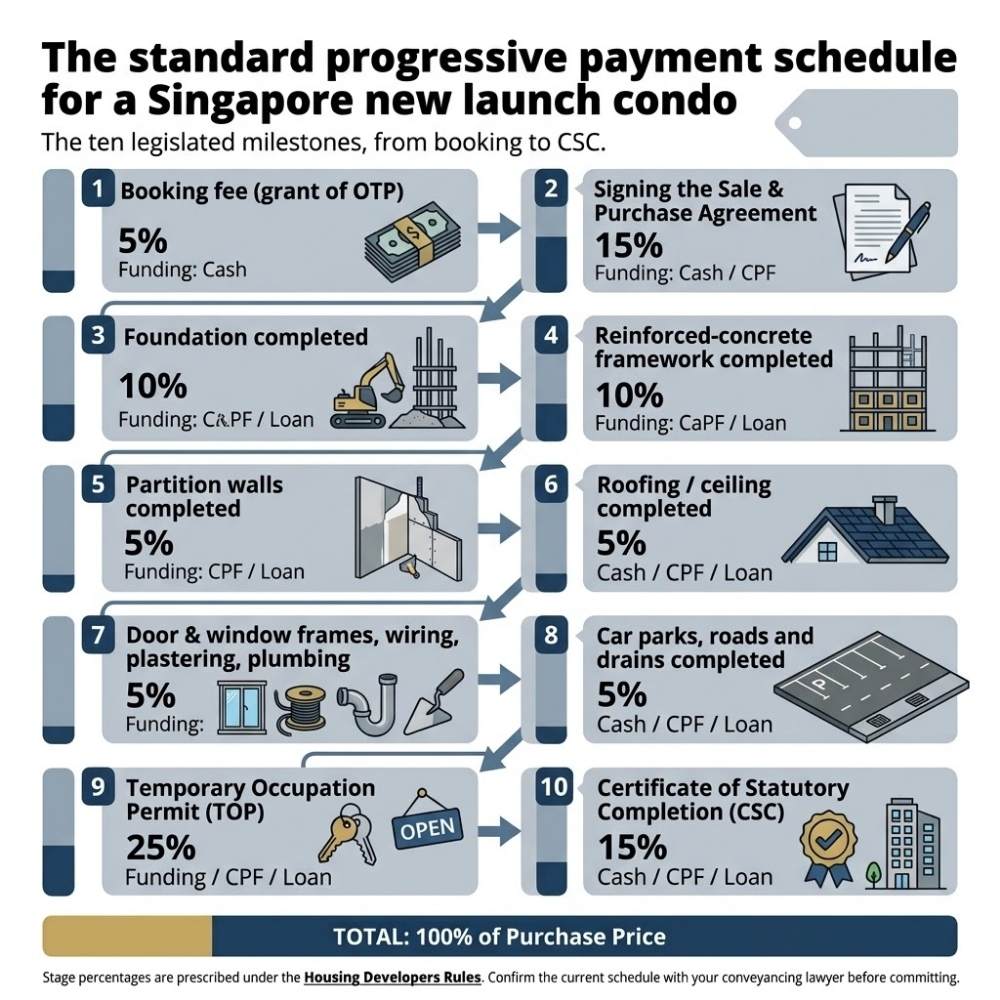
Diagram of the 10 progressive payment scheme stages from OTP booking fee to CSC
The ten legislated milestones, from booking to CSC.

Take a Singapore Citizen buying a S$2M new launch as their first property, with a 75% loan over 25 years.

  • At OTP (booking): 5% = S$100,000, cash

  • At S&P (within 8 weeks): 15% = S$300,000, cash or CPF

  • BSD (within 14 days of S&P): ~S$69,600, cash; ABSD nil (first property)

  • Foundation to roads (through construction): ~S$600,000 total, mostly bank-loan drawdowns

  • At TOP: 25% = S$500,000, bank loan; keys handed over, loan moves to full repayment

  • At CSC (6–12 months later): 15% = S$300,000, bank loan

Your monthly instalment on the S$1.5M loan is small in year one, because only a fraction of the loan has drawn, and steps up at each milestone to its full figure after CSC.

The calculator on this page maps your own numbers stage by stage.

Frequently asked questions

What is the Progressive Payment Scheme?

It is Singapore's legislated payment structure for uncompleted (Building-Under-Construction) private homes. You pay the price in stages tied to certified construction milestones — from a 5% booking fee to the final 15% at CSC — rather than in one lump sum. It applies to new-launch condos and ECs, not to resale or completed properties.

Can I sell my unit before TOP under PPS?

Yes, subject to the standard private-property rules. You can sell an uncompleted unit to another buyer through a sub-sale, with your obligations transferred to them. Seller's Stamp Duty may apply if you sell within the holding period — it is charged on the sale price or market value, not on your profit — and the new buyer pays ABSD on the sub-sale price, not your original price.

What happens if I miss a progressive payment?

The payment is due within 14 days of the developer's notice. Late payment attracts interest and other consequences set out in your Sale & Purchase Agreement, and sustained default can put the purchase at risk. If you foresee a timing gap, speak to your lawyer and bank before the deadline, not after.

How long does it take from OTP to CSC?

For a mid-sized project, typically three to four years from OTP to TOP — a couple of months from OTP to S&P, then roughly two to three years of construction — and a further 6 to 12 months to CSC. Your keys come at TOP; the final 15% follows at CSC.

Is it true I can't use CPF for stamp duty on a new launch?

No. CPF OA can be used for both BSD and ABSD. The practical constraint is timing: because a CPF charge often lodges only after completion, most buyers pay the stamp duty in cash within 14 days and then reimburse from CPF. Plan to have the cash on hand by the deadline.

Does the staged loan mean I need a smaller loan approved?

No. You must still qualify for the full loan amount up front. The progressive drawdown reduces how much you pay early in construction; it does not reduce the loan you need the bank to approve.

Can I refinance during construction?

Generally not to another bank before TOP. You can usually only reprice within your existing bank until the property is completed, after which normal refinancing options open up.

Sources: URA / Controller of Housing — progressive payment scheme · IRAS — stamp duty · CPF Board — using CPF for property. Confirm current rules and figures on the official pages before relying on them.


About the author

Rick Long is an Associate Senior Division Director at Huttons Asia.

Through YouHome.sg — Right Property Matters — he shares the frameworks, tools and field experience behind his advisory work, helping Singapore buyers and sellers across HDB, EC and private residential decisions with structured, calm, next-step guidance.

CEA Reg. R026818Z · Huttons Asia · YouHome.sg

Where to go next

Rick Long, Huttons Asia property advisor (CEA R026818Z), who helps buyers weigh a Jurong Lake District purchase

Map your own numbers with the progressive payment calculator on this page. Then, if you are upgrading, the sell-HDB-buy-condo guide and the HDB sales-proceeds calculator will show your net cash position.

For total budget including duties, use the affordability calculator article.

If you would like to walk your specific timing and cash flow through together — buy-first versus sell-first, CPF headroom, the ABSD window — that is exactly the kind of thing worth a conversation before you commit.

Message me directly and we will map it to your numbers.

This article is Rick Long’s independent research and opinion — general information only, not financial, legal or investment advice.

Plans, timelines and figures come from public and official sources and can change; some details may be outdated or contain errors despite our checks.

Past performance is no guarantee of future results, and no returns are promised. Verify all details with official sources and seek qualified professional advice before deciding. We accept no liability for decisions made in reliance on this article.

What My Clients Say | Genuine Experiences

Real stories, real experiences—because your journey deserves nothing less than the best.

Awards and Accolades

Disclaimer: The case studies and information are for educational use only and i make no representation or guarantees with respect to the accuracy, applicability, or completeness of its contents. There shall be no liability for any loss or expense whatsoever, relating to investment decisions made by the reader.

Leave a Reply