Jurong Lake District Property: A Buyer's Reality Check

Jurong Lake District is Singapore’s largest mixed-use business district outside the city centre — a major commercial hub the government has gazetted in the Master Plan 2025. “Second CBD” is shorthand for that ambition: not URA’s official term, and an outcome still being built.

For buyers, the question is whether the runway ahead matches how long you’ll hold.

If you’ve looked at a new launch in Jurong East or by the lake, you’ve probably heard the pitch: “Buy now, before the second CBD arrives.” It’s a good story. Parts of it are even true.

But a six- or seven-figure decision deserves more than a story — it deserves a calm look at what is actually confirmed, what is still being built, what is only announced, and what is simply marketing.

This guide expands the Jurong Lake District case study in our pillar, Singapore Property Growth Plans: How to Read the Master Plan Before You Buy.

The honest headline from that piece holds: strong plan, real execution risk. Here’s the full picture.

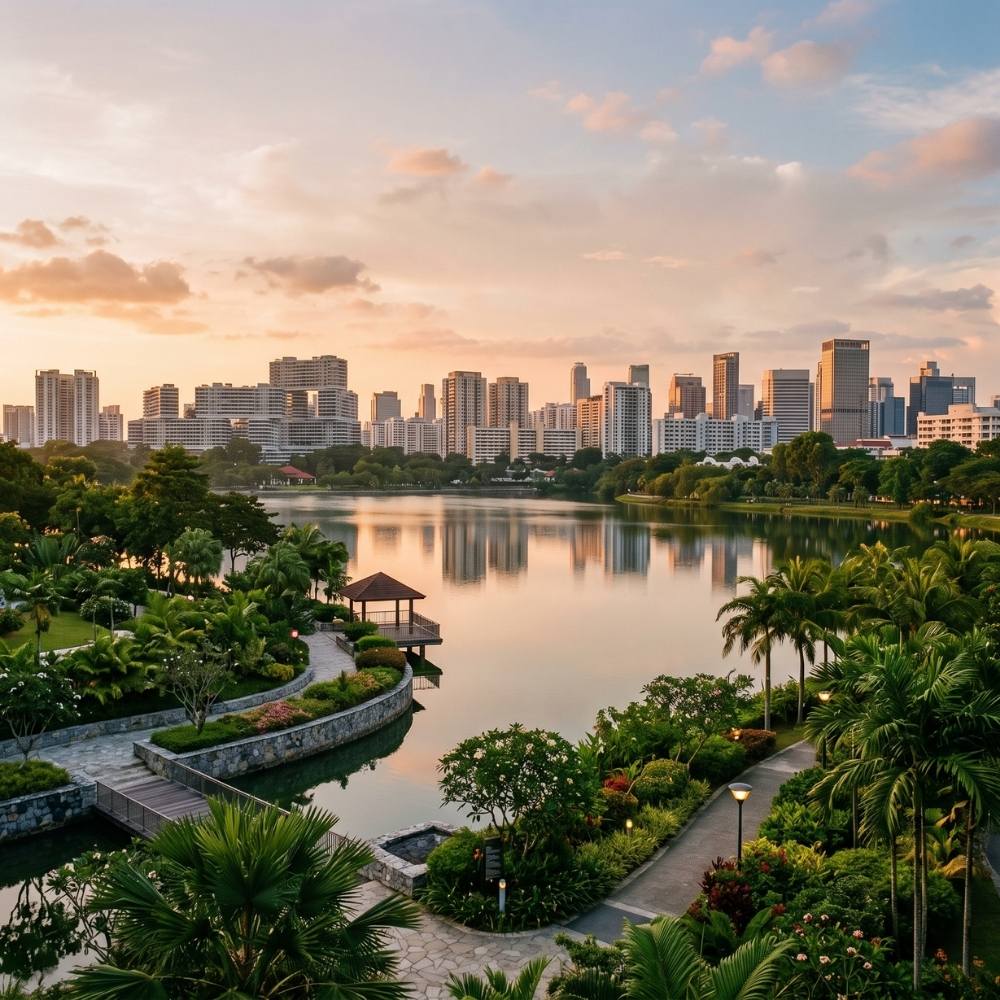
Jurong Lake District lakeside view with gardens and distant towers at golden hour

Table of Contents

The 60-second version

If you read nothing else, read this. The figures below are sorted by how solid they are — from confirmed-and-built to marketing narrative.

Buyer’s shortcut: Jurong Lake District has real, confirmed strengths today — particularly transport access and lifestyle infrastructure. The longer “second CBD” story may still matter over time, but it should be treated as a longer-term, not-yet-delivered factor rather than the single reason to buy. Weigh what is already built against what is only planned.
JLD at a glance — sorted by certainty
What you’re told Signal The honest status
Jurong East is a major MRT interchange today 1 · Confirmed Already a North–South + East–West Line interchange. Good access exists now.
Jurong Lake Gardens on your doorstep 1 · Confirmed A ~90ha national garden; the Lakeside section has been open since 2019.
A dedicated JLD MRT station on the Cross Island Line 2 · Under construction Part of CRL Phase 2, targeted to open by 2032.
Jurong Region Line opens and serves the west 2 · Under construction Stage 1 now targeted around mid-2028, delayed from the earlier end-2027 timeline.
~100,000 new jobs and ~20,000 new homes 3 · Announced long-term A planning target stretching into the 2040s–2050s, not a near-term promise.
The “second CBD” 4 · Market story Useful shorthand — but not URA’s official designation. Treat it as a story until it’s delivered.

Official references to verify before publish: LTA Cross Island Line, LTA Jurong Region Line, NParks Jurong Lake Gardens, and Jurong Lake District official planning page.

What is Jurong Lake District, really?

Jurong Lake District (JLD) is a roughly 360-hectare area in the west that URA has planned as the largest mixed-use business district outside the city centre.

It sits across four precincts — Jurong Gateway, Jurong Lake Central, Jurong Lake Gardens and the International Business Park — and it’s a centrepiece of Singapore’s long-running plan to spread jobs out of the central core.

That plan is now statutory, not speculative.

The Master Plan 2025 was gazetted on 1 December 2025 — the legal land-use blueprint guiding development for the next 10 to 15 years.

So when someone tells you JLD is “in the Master Plan,” that part is real and binding.

What is not official is the phrase “second CBD.”

You’ll see it on brochures and portals, and it captures the ambition well.

But URA’s own gazette and planning circulars consistently use “largest mixed-use business district outside the city centre.”

The difference matters, because a CBD is something a district becomes once the offices, the jobs and the tenants actually arrive — not something a master plan declares on day one.

Rick’s take: I bring clients to JLD for both what it is today and what it could become — buying into a district’s future is the whole point of a growth area. What I won’t do is let a label like “second CBD” set the price.

Weigh the future by how funded and how near it is, match it to your hold, and you’re buying the upside with your eyes open.

The four-signal test: what’s real, what’s a story?

The pillar’s core tool is to sort every claim about a growth area into four buckets.

Applied to JLD, here’s where things land.

Signal 1 — Confirmed & delivered (on the ground today)

Jurong East already functions as a North–South and East–West Line interchange, with Lakeside and Chinese Garden stations on the East–West Line nearby. 

Jurong Lake Gardens is a national garden of around 90 hectares — its Lakeside section has been open since 2019.

The retail cluster (IMM, Jem and Westgate) is mature, and the International Business Park has operated for years.

This is the part you can walk through this weekend.

Signal 2 — Under construction (funded and building now)

A dedicated Jurong Lake District MRT station is being built as the western end of Cross Island Line Phase 2, targeted for completion by 2032.

The Jurong Region Line’s Stage 1 is now targeted to open around mid-2028, about six months later than the original end-2027 plan.

The new Singapore Science Centre is under construction next to Chinese Garden MRT, and the Jurong Gateway transport hub is progressing.

These are real, but they are years from done.

Signal 3 — Announced long-term (planned, not yet realised)

The headline figures of roughly 100,000 new jobs and 20,000 new homes are a long-horizon planning target that stretches well into the 2040s and beyond.

The commercial build-out of the district — the offices that would make JLD a true work hub — is staged and demand-led, which is exactly why the land sale played out the way it did (more on that next).

Signal 4 — Market story (narrative, not delivered)

“Second CBD,” “guaranteed tenant pool,” “get in before prices run” — these are sales narratives, and some may well prove right.

The move isn’t to dismiss them; it’s to price them for what they are — a story still being written, weighed by how funded and how near it is, not banked as a confirmed fact.

You can buy the trajectory; just don’t pay for the slogan as if it’s already delivered.

Rick’s take: sort each claim into its bucket — then notice you’re genuinely paying for Signals 3 and 4 to arrive. The test isn’t whether they will; it’s whether Signals 1 and 2 already make this somewhere you’re glad to own while you wait.

With that floor under you, the future is upside you’ve bought sensibly — not a gamble you’re hostage to.

What happened to the master-developer site — and why it matters to you

This is the single most useful piece of evidence about JLD’s pace and pricing, and most buyers never hear it properly.

In 2023, URA launched a 6.5-hectare white site to a master developer to kickstart the next phase of JLD.

When the tender closed in March 2024, it drew a single bid — from a heavyweight consortium of CapitaLand, City Developments, Frasers Property, Mitsubishi Estate and Mitsui Fudosan.

In September 2024, URA declined to award the site, calling the shortlisted bid of $6,888.90 per square metre of gross floor area too low.

Market reports put that at roughly $640 per square foot per plot ratio, implying a total of around $2.5 billion — a figure analysts read as conservative for a site of that scale.

Then the government changed tack.

In December 2025, alongside the 1H2026 Government Land Sales programme, the former master site was split into three smaller parcels.

The first, a 3.7-hectare white site at Town Hall Link, was released on the 1H2026 Reserve List.

It can yield around 2 million square feet of gross floor area — up to 1,200 private homes, a minimum of about 40,000 sqm of office space, and the rest for retail, hotel or community uses.

Two details in there are worth their weight.

First, it’s on the Reserve List — meaning it only goes to tender if a developer commits to a price the government finds acceptable.

Second, the minimum office requirement was cut from the original site’s 70,000 sqm to about 40,000 sqm on this parcel — a quieter acknowledgement that office demand is the uncertain piece.

What the land story signals for a buyer

The JLD land story is useful because it shows pace, pricing discipline and commercial-demand risk. It does not mean the district is weak. It means a buyer should price the purchase for a staged, multi-year runway rather than a quick transformation — judging the unit on what is already built, and treating the larger commercial vision as a slower, separate question.

Three JLD land-sale signals and what each one tells a buyer
Government did not award the earlier ~$2.5b master developer bid
What it tells you The state was not prepared to release the large catalyst site at a price it considered too low. Read that as pricing discipline and deliberate pacing — not as proof that JLD is weak, and not as a simple forecast of where future launch prices will land.
One bidder, then the site was split into smaller parcels
What it tells you Even major developers appeared cautious about taking on a very large, long-horizon commitment. The later move into smaller parcels lowers development risk and suggests the pace of transformation is likely to be staged, not instant.
Office requirement reduced; site moved from Reserve List to 2H2026 Confirmed List
What it tells you The commercial story is still the part to watch. A lower office requirement makes the site more manageable, and the later Confirmed List move shows government intent to proceed. But office demand, tenant take-up and the full “second CBD” outcome should still be treated as longer-term variables.
Rick’s take: the earlier non-award is not bad news. It is honest news. It tells you JLD is likely to be built carefully and in stages, so the unit should still make sense even if the bigger office story takes longer.

Official and supporting references: JLD official release on the Town Hall Link White Site, EdgeProp report on the carved-out JLD GLS site, and The Edge Singapore report on the 2H2026 Confirmed List update.

The transport reality: very good today, transformational later

Transport is where the JLD story is strongest — and where it’s most often oversold by collapsing “2032” and “now” into one breath.

Today, the area already has genuinely strong access. Jurong East is a North–South and East–West Line interchange; Lakeside and Chinese Garden sit on the East–West Line.

From a practical standpoint, you don’t need to wait for anything to commute well from JLD.

Coming, the upgrades are real and funded: Jurong Region Line Stage 1 around mid-2028, then a dedicated Jurong Lake District station on Cross Island Line Phase 2 by 2032, with the Jurong Gateway hub knitting bus, MRT and the new lines together.

URA expects JLD to be served by four MRT lines in time.

So the honest framing is two-part: access is already a reason to like the area, and the step-change — the part that could re-rate the district — is six to ten years out. Both can be true.

What can you actually buy in JLD right now?

The vision is district-scale; your decision is one unit. Here’s the realistic menu in and around JLD. All are 99-year leasehold. The prices below are market figures drawn from recent caveats and listing portals — useful for orientation, not official valuations, and they move.

JLD-area residential options (illustrative market figures, 2026)
Project Type / location Indicative psf* Note
J’den Mixed-use, Jurong East (former JCube) ~S$2,390–2,465 Closest to the Jurong East interchange; completing around 2027.
Sora Residential, Yuan Ching Rd ~S$2,160–2,220 Lakeside setting; residential-only.
The LakeGarden Residences Residential, Yuan Ching Rd ~S$2,120–2,155 Waterfront-facing; residential-only.
CDL Lakeside Drive launch (marketed as Lucerne Grand) Mixed-use, beside Lakeside MRT ~S$2,400 (projected) Upcoming launch; land bid was S$1,132 psf ppr. Price is an analyst projection, not confirmed.
Older resale (e.g. J Gateway, Lake Grande, Lakeville, The Lakefront) Resale, around Lakeside / Jurong East Varies — generally lower entry The value-buyer route; check remaining lease and condition.

*Indicative only, from recent caveats/portal data; confirm current transacted prices for the specific project and stack before relying on any figure.

The pattern is clear: new launches in JLD are already transacting in the low-to-mid S$2,000s psf, and the next launch is projected higher still.

For a Jurong upgrader, the practical choice is often new-launch-versus-resale — a decision with its own trade-offs we cover in new launch vs resale condo.

Is JLD cheap or expensive? How to judge the price

This is the real question behind “is it priced in” — and the honest answer is that no one can hand you a verdict, because whether a price is fair depends on the specific unit and what you compare it against.

What I can do is line up the factors that tell you whether a price stacks up, so you reach the call with your eyes open.

Five things tell you most of what you need.

What to look at when assessing a JLD launch or resale unit
Factor What to look at
Recent land bids nearby What developers actually paid for land is a yardstick for what launch prices are built on. The Lakeside Drive site was awarded at S$1,132 psf ppr; the earlier master site’s ~$640 psf ppr was passed over as too low. A launch priced far above its land basis is worth a closer look; one near it has more support.
Comparable transacted psf Check the unit against recent caveats for J’den, Sora, The LakeGarden Residences and older resale nearby. Above, at, or below the comparable set?
Layout & efficiency Two units at the same psf aren’t equal if one has more usable space. A higher psf on an efficient layout can be better value than a lower psf on a wasteful one.


Tenure, floor, view, stack Every JLD site is 99-year leasehold; remaining lease, floor height and outlook explain much of the price gap between units in the same project.

Runway vs your horizon What’s funded and coming — the rail, the gardens, the build-out — against how long you’ll actually hold. A forward-priced unit rewards the holder who’s there when the runway delivers.

The “priced in” question, done properly

“Priced in” isn’t a yes or no — it’s a way of asking what future a price already assumes.

At today’s psf, a project is effectively pricing in some of the plan landing. So the sharper question isn’t “is it priced in?” but “is the growth this price assumes reasonable to me, given the runway and how long I’ll hold?”

That’s a judgment you make with the factors above — not a verdict anyone should hand you.

Working out the ROI — together, on real numbers

If you’re planning your exit, projecting a return is a normal, sensible part of it — done on numbers you and your advisor actually agree on, not a figure on a brochure.

A sound projection is honest about its assumptions, so three questions keep it grounded:

  • Whose assumptions, and what are they? Rental growth, a cap rate, a completion date — each one named and sourced.

  • What would have to be true for it to land? One assumption is a plan; a stack of them moving together is a hope.

  • Does the runway match how long you’ll hold?

This is the work we’d do side by side — not a number to take on faith, but a model you can stand behind because you built it.

Rick’s take: a forward price isn’t a red flag, and “priced in” isn’t a verdict — both are just inputs. Judge the price on the factors, build any ROI on numbers you trust, and match it to your horizon. Do that and you can decide on JLD with confidence — whichever way you land.

The rental and tenant question

The investor pitch leans hard on one idea: JLD’s offices will create a deep pool of professional tenants.

It’s a reasonable long-term thesis. It’s also mostly a future condition, not a present one.

The reason is the land story above — the master site wasn’t awarded, and the Town Hall Link parcel that carries the office space sits on the Reserve List, not yet triggered. So the bulk of the “JLD office tenant” demand hasn’t been built.

Today’s rental demand in the area comes from existing drivers: the International Business Park, the wider Jurong innovation and industrial base, Ng Teng Fong General Hospital, schools, and families. Those are real, but they’re not the “CBD-grade tenant” story.

Singapore condo gross rental yields broadly sit in the region of 3–4% — a rough market range, not a JLD-specific guarantee — so test any rental number against current data for the actual project before you buy.

The strongest position is when the numbers already work on today’s tenant demand, with the future office pool as upside rather than the thing holding the case up.

How to test a JLD purchase with the Right Fit lens

Before any growth-area purchase, I run it through four layers — Property, Numbers, Life, Exit. Here’s JLD through that lens.

Property

The unit itself, not the district. Lake view or not?

Walking minutes to which MRT? Mixed-use convenience or a quieter residential block? What’s the stack, the layout, the floor?

With every JLD site on a 99-year lease, the clock is already running — a newer launch buys you more lease, an older resale buys you a lower entry.

There’s no free option; just the trade you choose with open eyes.

Numbers

Entry psf against comparable projects, total quantum, your loan and TDSR headroom, ABSD if it’s a second property, CPF usage and the accrued interest that rebuilds your retirement account, holding costs, and a realistic — not hoped-for — yield.

Start with what you can carry, not what you wish for: see can I afford to upgrade to a condo or EC and our indicative valuation guide, and understand how CPF accrued interest works before you commit.

Life

Does it fit the life you’re living now — commute, schools, family stage, the way you’d actually use the gardens and the area — and not just the 2032 brochure?

A home you enjoy for a decade is rarely a bad decision, even if the macro story takes its time.

Exit

Who buys this from you in 10–15 years, and at what point on the lease?

Remember there’s more supply still to come from the other two JLD parcels, which can compete with your unit later.

Plan the way out before you walk in — our guide on what a property exit strategy is walks through it, and if you’re funding this by selling an HDB, read selling your HDB to buy a condo first.

For a structured score, run JLD through the Growth Plan Fit Score in the pillar guide — it turns this lens into a quick read of whether a growth area genuinely fits your plan.


Before you commit: your JLD checklist

If you take JLD seriously, here’s what to actually verify before you sign anything.

  • Confirm the specific unit’s remaining lease and tenure — every JLD site is 99-year leasehold.

  • Walk the real MRT distance and time, in your own shoes, at your own commute hour.

  • Check whether the view and surroundings are permanent or could be built out by the parcels still to come.

  • Be honest about your holding horizon — JLD rewards 7+ years, not 3.

  • Map your ABSD and Seller’s Stamp Duty exposure with current IRAS rates.

  • Understand how CPF accrued interest affects your eventual cash proceeds.

  • Compare the asking psf against recent caveats for the same project and stack — not the launch headline.

  • Use recent land bids as a yardstick — what developers paid for land nearby (e.g. the Lakeside Drive site) anchors what launch prices are built on.

  • Weigh layout efficiency, floor, view and tenure — they explain most of the psf gap between two units in the same project.

  • Factor in upcoming supply: two more JLD parcels can add competing units down the line.

The main factors to weigh, in one line each: the timeline (key catalysts 2028–2030s, matched to your hold); the execution stage (the catalyst land sale is still finding its price); how the price compares on the factors above; and upcoming supply from the other parcels still to come.

Frequently asked questions

Is Jurong Lake District a good investment?

It can be, for the right buyer and horizon — but “good investment” isn’t a yes-or-no anyone can stamp for you. JLD pairs strong existing transport and amenities with a long, funded plan whose biggest catalysts land between 2028 and the 2030s. Judge a specific unit on the value factors — land bids, comparable psf, layout, tenure, runway versus your hold — rather than the headline. It is not a guaranteed return.

When does the Jurong Lake District MRT station open?

The dedicated JLD station is part of Cross Island Line Phase 2, targeted for completion by 2032. Separately, Jurong Region Line Stage 1 is now targeted around mid-2028 (delayed from end-2027). The area already has strong access today via the Jurong East North–South and East–West Line interchange.

What happened to the JLD master-developer site?

URA declined to award the 6.5-hectare master site in September 2024 after its sole bid was assessed as too low. In December 2025 the site was split into three smaller parcels; the first, a 3.7-hectare white site at Town Hall Link, was released on the 1H2026 Reserve List with up to 1,200 homes and a reduced office minimum.

Is the upside in JLD already priced in?

There’s no single yes or no — whether a price is fair depends on the unit and what you compare it against. Judge it on the factors: recent land bids nearby, comparable transacted psf, layout efficiency, tenure and floor, and the funded runway versus your holding horizon. The sharper question isn’t “is it priced in?” but “what growth does this price assume, and is that reasonable for me?”

Should I buy in JLD for own-stay or investment?

Own-stay is the more forgiving case: if the home fits your life now, a long hold tends to work out even if the macro story is slow. Pure investment is harder — today’s rental demand rests on existing drivers, not the future office tenants, so the yield case must stand on current numbers, not the brochure.

How long should I plan to hold a JLD property?

Plan for at least 10 years. The major value catalysts — the Cross Island Line station and the commercial build-out — land between 2028 and the 2030s. Selling within four years also triggers Seller’s Stamp Duty. JLD is structurally a long-horizon hold, not a short-term trade.

Is JLD really Singapore’s “second CBD”?

It’s the ambition, not the official label. The plan to grow JLD into a major business district is backed by the government — “second CBD” is just the popular shorthand for it, while URA’s own term is “largest mixed-use business district outside the city centre.” Reasonable as a vision — but a true second CBD is something JLD still has to earn by drawing the offices, jobs and tenants over time.

About the author

Rick Long is an Associate Senior Division Director at Huttons Asia.

Through YouHome.sg — Right Property Matters — he shares the frameworks, tools and field experience behind his advisory work, helping Singapore buyers and sellers across HDB, EC and private residential decisions with structured, calm, next-step guidance.

CEA Reg. R026818Z · Huttons Asia · YouHome.sg

Talk it through before you commit

Rick Long, Huttons Asia property advisor (CEA R026818Z), who helps buyers weigh a Jurong Lake District purchase

Weighing a Jurong Lake District purchase?

Whether JLD is right for you comes down to the unit, your numbers, and your horizon — not the headline.

If you’d like a calm second opinion that separates the plan from the promise, I’m happy to walk through your specific situation.

This article is Rick Long’s independent research and opinion — general information only, not financial, legal or investment advice.

Plans, timelines and figures come from public and official sources and can change; some details may be outdated or contain errors despite our checks.

Past performance is no guarantee of future results, and no returns are promised. Verify all details with official sources and seek qualified professional advice before deciding. We accept no liability for decisions made in reliance on this article.

What My Clients Say | Genuine Experiences

Real stories, real experiences—because your journey deserves nothing less than the best.

Awards and Accolades

Disclaimer: The case studies and information are for educational use only and i make no representation or guarantees with respect to the accuracy, applicability, or completeness of its contents. There shall be no liability for any loss or expense whatsoever, relating to investment decisions made by the reader.

Leave a Reply