The Silent Threat of CPF Accrued Interest: Why Your Cash Proceeds May Be Lower Than Expected

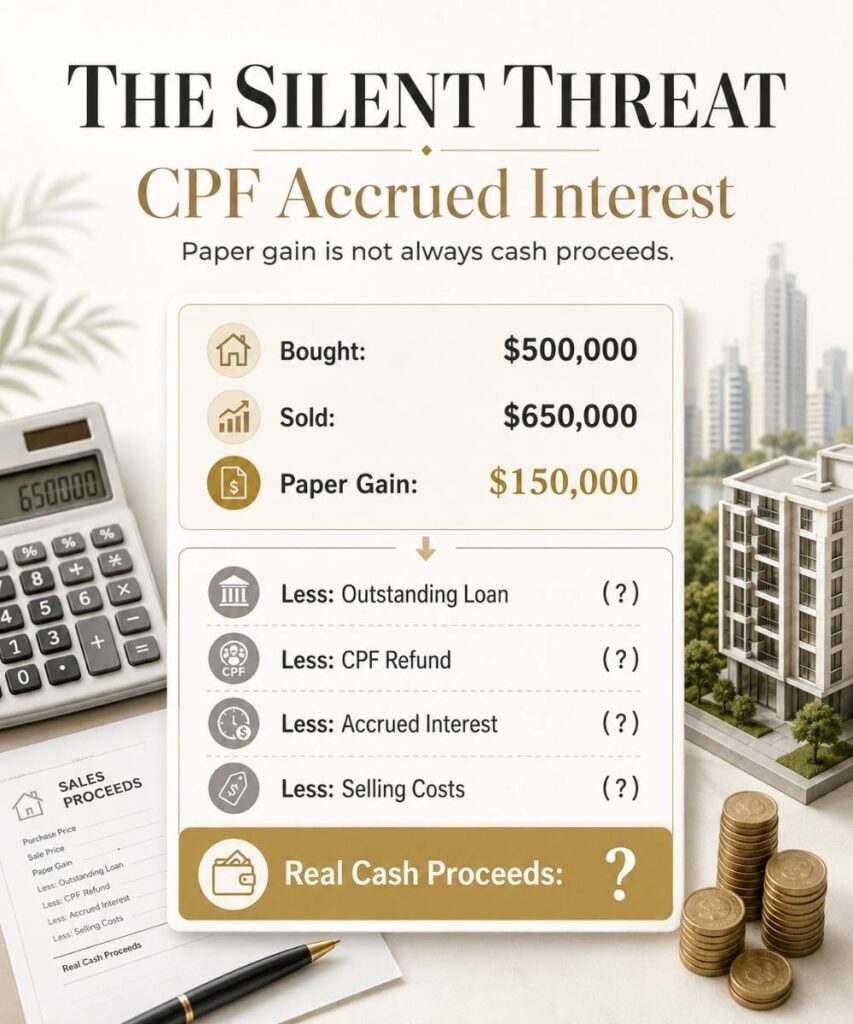
Singapore property sale illustration showing how CPF accrued interest, CPF refund, outstanding loan and selling costs can reduce real cash proceeds after selling a HDB flat, EC or private property.

Most people picture the gain before they picture the move.

Buy at $500,000, sell at $650,000, and it feels like $150,000 is already yours.

Then the completion statement arrives.

And the figure that lands in your bank account is smaller than the number you had been carrying in your head.

That gap is the silent threat.

Not CPF itself.

The quieter threat is assuming your gain on paper is the same as the money you can actually use for your next move.

Paper Gain vs Real Cash

The Selling Price Is Not Always The Cash You Keep

A property can look profitable on paper, but the real cash position may change after the loan, CPF refund, accrued interest and selling costs are settled.

Amount What Owners Often Assume What Still Has To Be Settled
Bought: $500,000 Starting point
Sold: $650,000 “I made $150,000” Loan, CPF refund, accrued interest, selling costs
Paper Gain: $150,000 Cash in the pocket Not the same as the cash you keep
Key takeaway: The selling price tells you what the buyer pays. It does not tell you what you can actually use after the sale.
```

Table of Contents

This Is Not Only an HDB Issue

Most people link CPF accrued interest with HDB flats.

That makes sense.

For many Singaporeans, the first home is a HDB flat, and CPF is often used for the downpayment, monthly instalments, stamp duty, legal fees, and sometimes housing grants.

But CPF accrued interest is not only an HDB issue.

It can affect anyone who used CPF Ordinary Account savings for a home, including HDB flats, Executive Condominiums, private condos, apartments and landed property.

Generally, wherever CPF OA was used, the CPF principal and its accrued interest have to be refunded when the property is sold, subject to CPF rules.

CPF also explains that housing grants and their accrued interest form part of the CPF refund when you sell your home: CPF sales proceeds after selling your home.

So even a private condo can look profitable on paper and still return less cash than expected once the loan, CPF refund, accrued interest and selling costs are settled.

What CPF Accrued Interest Actually Means

Your CPF Ordinary Account earns interest while the money sits in it. When you use those savings for a home, they stop earning.

Accrued interest is the interest they would have earned had they stayed put.

When you sell, you generally refund the CPF principal used, the accrued interest on it, and any housing grants used plus the interest on those grants (CPF sales proceeds).

Here’s the part many owners miss: that refund goes back into your own CPF. It isn’t a fine and it isn’t money disappearing — it rebuilds the retirement savings you drew down to buy your home.

From a planning view it still matters, though. The more CPF you use, and the longer you use it, the more accrued interest builds — and that quietly shrinks the cash slice of what you walk away with.

The Number That Really Matters

A simple way to estimate your cash proceeds is:

Estimated Cash Proceeds = Selling Price − Outstanding Loan − CPF Refund − Selling Costs

That cash is what funds the next step.

The deposit on your next home.

Stamp duties.

Renovation.

Moving costs.

Emergency buffer.

Retirement needs.

So the better question is not:

“How much can I sell for?”

The better question is:

“After everything is settled, how much cash and usable CPF do I really have?”

Simplified Illustration

A Simple HDB Sale Proceeds Example

A couple bought a HDB flat for $400,000 and later sold it for $650,000. At first glance, it may look like a $250,000 gain — but the actual cash proceeds depend on the loan, CPF refund, accrued interest and selling costs.

Over the years, they used CPF for the downpayment, monthly instalments, stamp duty, legal fees and part of their purchase supported by housing grants.

Item Amount
Selling Price $650,000
Less: Outstanding Loan $180,000
Less: CPF Principal Used $230,000
Less: CPF Accrued Interest $45,000
Less: Estimated Selling Costs $15,000
Estimated Cash Proceeds $180,000
Key takeaway: The flat may have grown from $400,000 to $650,000, but the estimated cash proceeds are not the same as the paper gain. The CPF refund is not lost — it goes back into the owners’ CPF account. But the cash available for the next move may be lower than expected.

At first glance, it looks like:

“Bought at $400,000, sold at $650,000, so we made $250,000.”

But the cash in hand is closer to $180,000.

That does not mean the flat did badly.

It also does not mean CPF accrued interest “ate the gain”.

The $275,000 returned to CPF, made up of CPF principal used and accrued interest, goes back into their own account. It may support the next home or retirement, subject to CPF rules.

Their real position is not just cash.

It is:

$180,000 in estimated cash proceeds + $275,000 restored to CPF

That is a very different story from looking at paper gain alone.

This is why it pays to run the numbers before finding a buyer, not only after accepting an offer.
Simplified Illustration

A Simple Private Property Sale Example

A condo owner bought a private property at $1,200,000 and later sold it for $1,500,000. On paper, it may look like a $300,000 gain — but the actual cash position depends on the bank loan, CPF refund and accrued interest.

Over the years, the owner used CPF for part of the downpayment, monthly instalments, stamp duty and legal fees.

Item Amount
Selling Price $1,500,000
Less: Outstanding Bank Loan $700,000
Less: CPF Principal Used $300,000
Less: CPF Accrued Interest $65,000
Estimated Balance Before Selling Costs $435,000
Key takeaway: The property may have grown from $1,200,000 to $1,500,000, but the sale outcome is not measured by capital gain alone. After the bank loan and CPF refund are settled, about $435,000 may remain before selling costs, while $365,000 is restored to CPF.

On paper, the property gained $300,000.

But the sale outcome is not measured by gain alone.

After the bank loan and CPF refund are settled, around $435,000 may remain before selling costs, while $365,000 is restored to CPF.

Both are part of the owner’s overall position.

But only the cash portion is immediately spendable.

For private owners who have used CPF heavily over many years, this is the gap that can affect the next purchase, right-sizing plan, or retirement move.

What About Housing Grants?

For HDB buyers, housing grants can be very helpful.

They reduce the amount needed upfront and make the first home more affordable.

But grants are credited into CPF and used towards the flat.

That means when the flat is sold, the grants used and their accrued interest generally have to be refunded to CPF too.

CPF explains this here: CPF housing grant refund upon sale.

This is why two owners with similar selling prices can walk away with different cash proceeds.

One may have used more CPF.

One may have received more grants.

One may have a higher outstanding loan.

The selling price may look similar, but the final cash position can be very different.

Grants are not a bad deal.

They simply belong in the calculation.

When Sale Proceeds Fall Short

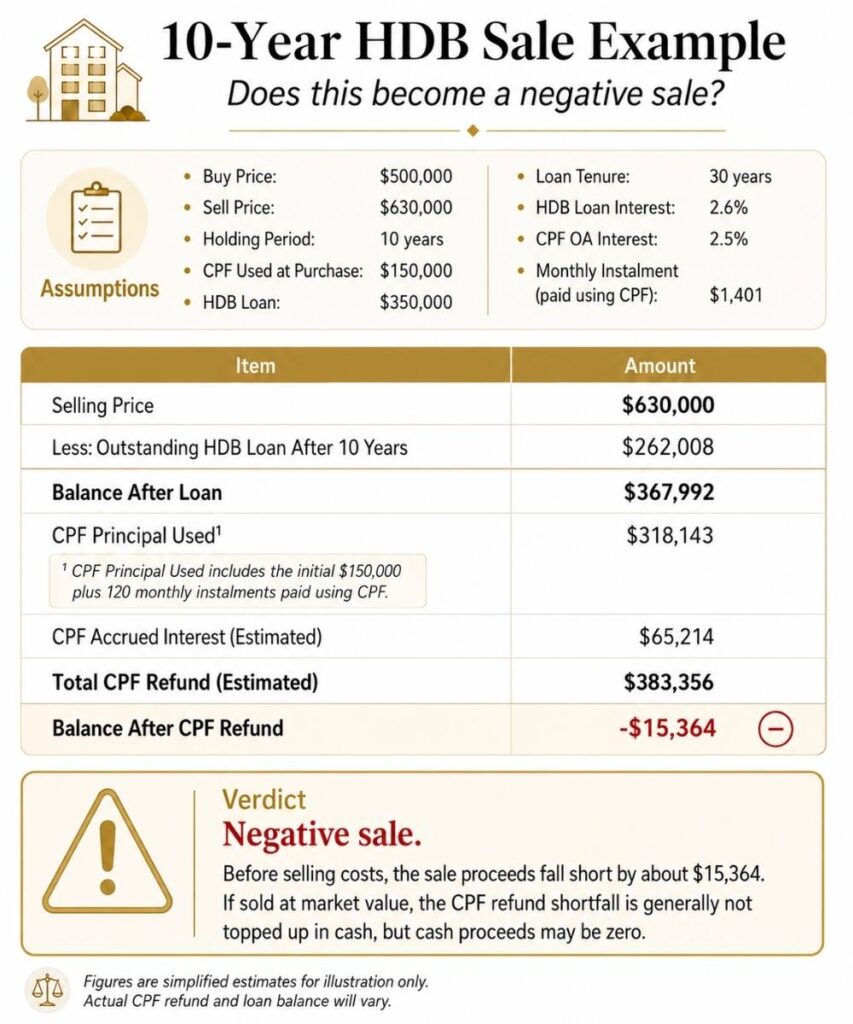
10-year HDB sale example showing how CPF accrued interest, monthly CPF mortgage payments, HDB loan balance and CPF refund can lead to a negative sale when selling a Singapore HDB flat.

Sometimes the price can’t cover both the loan and the full CPF refund. This is often called a negative sale, and it happens most when accrued interest has compounded over many years, the loan is still high, or the market is soft.

Two points surprise people, and both are general CPF rules — not HDB-only:

  • Sold at or above market value: if the proceeds can’t fully cover the refund, the shortfall is generally waived — you don’t top it up in cash (CPF refund on sale).
  • Sold below market value: you may be required to refund the full amount, including accrued interest, even if that means topping up in cash (CPF refund if selling below market value).

Note: any option money you receive counts as part of the selling price and generally has to be refunded to CPF before completion — so don’t bank on it as spending money.

A negative sale isn’t always a disaster, but if you were counting on cash for the next step, it changes the plan.

For private property, bank-loan and legal-completion details add moving parts, so check your lawyer’s completion statement.

The Age 55 Checkpoint

CPF refund treatment changes at age 55.

Below 55, the housing refund is generally credited back to your Ordinary Account, where it may be used for another property or other CPF schemes, subject to CPF rules.

At 55 and above, the refund is generally used first to top up your Retirement Account to your Full Retirement Sum, with the balance retained in your Ordinary Account.

CPF explains this here: CPF home buying guide for members above 55.

This matters for anyone right-sizing or selling near retirement.

An owner may assume the full CPF refund can be reused immediately for the next home.

But depending on the owner’s retirement sum position, part of that refund may go towards retirement first.

That is why this checkpoint should be reviewed before committing to the sale or next purchase.

Reusing CPF For Your Next Home

In many cases, refunded CPF can be used for the next property — but not every dollar, and not automatically.

As a guide, full CPF usage generally needs the next home’s remaining lease to cover the youngest buyer until age 95; if the lease is at least 20 years but doesn’t reach that, usage is usually pro-rated (CPF usage and remaining lease).

A home can look affordable on today’s sale price yet need more cash if CPF on the next one is capped.

Selling and buying aren’t two decisions — they’re one move.

A Quick Note On Older HDB Flats And Lease

An older flat does not drop in value overnight.

Location, amenities, MRT access, school demand, size, scarcity and buyer preference still matter.

But as the lease shortens, future buyers may face CPF and loan limits that narrow the buyer pool.

At the same time, your own accrued interest may keep building if CPF continues to be used for the flat.

If you are holding long-term, review the remaining lease and CPF accrued interest together.

The flat may still be valuable.

But the question is whether the future sale can still give you the options you need.

For a deeper explanation, you can read our guide on HDB lease and value over time: HDB depreciation curve article.

Before You Sell: Get Your Real Numbers

Before selling any property, whether HDB or private, check these numbers first.

Before You Sell

One Simple Checklist

Before selling any property, whether HDB or private, check these numbers first. The selling price is only the starting point — not the final cash you can use.

Number To Check Why It Matters
Estimated Selling Price Starting point, but not your final cash
Outstanding Loan Must be redeemed upon sale
CPF Principal Used Generally refunded to CPF
CPF Accrued Interest Can reduce cash proceeds
Housing Grants Used Relevant for HDB owners
Grant Accrued Interest Adds to the CPF refund
Selling Costs Agent fee, legal fee, admin costs
SSD, If Applicable Relevant for private property sold within the holding period
Estimated Cash Proceeds Cash you can actually use
Reusable CPF For the next home, subject to CPF rules
Next Property Costs BSD, ABSD if applicable, renovation and moving
Emergency Buffer Helps avoid over-stretching
Key takeaway: The selling price tells you what the buyer pays. The proceeds calculation tells you what you can actually use. They are not the same number.

You can retrieve most of the CPF-related figures from your CPF Home Ownership Dashboard.

CPF Home Ownership Dashboard: Link

The selling price tells you what the buyer pays.

This checklist tells you what you can use.

They are rarely the same number.

The Real Silent Threat

CPF was never the enemy.

It helped a generation own homes earlier, and the refund on sale quietly rebuilds what you drew down for housing.

The real risk is timing.

By the time most people sit down with their true numbers, they’ve already fallen for the next home and the loan is already moving.
And the longer you wait, the more the pieces shift together — a growing refund, a shorter lease, a changing buyer pool, a tighter next-home budget.

So the question stops being how much cash will I get? It becomes what options do I still have?

Can you upgrade with a real buffer? Right-size without straining retirement? Hold without weakening your next exit?

CPF accrued interest is not the problem. Waiting too long to understand it can be.

A home that gives you options today may not give you the same options later.

Conclusion: Review Your Sale Proceeds Before You Decide

Not sure where your real numbers stand?

A sale proceeds review can help you estimate your CPF refund, accrued interest, cash proceeds, and what may realistically be reusable for your next move.

Before you decide whether to sell, hold, upgrade or right-size, know the numbers that shape your options.

FAQ

FAQ

CPF Accrued Interest Questions Before Selling

Short answers to common questions on CPF refund, accrued interest, sale proceeds and planning your next property move.

Does CPF accrued interest apply to private property and ECs, or only HDB flats?

It applies to any home bought using CPF Ordinary Account savings. This can include HDB flats, Executive Condominiums, private condominiums, apartments and landed property.

The CPF principal used and its accrued interest are generally refunded when the property is sold, subject to CPF rules.

CPF refund when selling property

Is CPF accrued interest a penalty?

No. CPF accrued interest is not a penalty or fine.

It is the interest your CPF savings would have earned if they had stayed in your CPF Ordinary Account. When you sell your property, the refund restores this amount back into your CPF.

Do HDB housing grants need to be refunded to CPF when I sell?

Generally, yes. CPF housing grants used for the flat, together with accrued interest on those grants, need to be refunded to CPF when the flat is sold.

CPF housing grant refund upon sale

Do I have to top up CPF in cash if my sale proceeds are not enough?

Generally, if your property is sold at or above market value and the proceeds are not enough to cover the full CPF refund, the CPF refund shortfall is usually not topped up in cash, subject to CPF’s rules and assessment.

If the property is sold below market value, a cash top-up may be required.

CPF refund when sale proceeds are insufficient

CPF refund if selling below market value

What happens to my CPF refund when I sell after age 55?

For owners aged 55 and above, the CPF refund is generally used first to top up the Retirement Account to the Full Retirement Sum, with the balance retained in the Ordinary Account.

The amount that can be reused for the next property depends on your CPF position and CPF rules.

CPF home buying guide for members above 55

Can I reuse my refunded CPF for my next home?

Often, yes, but not always automatically.

It depends on your age, retirement sum position, and the remaining lease of the next property. If the next home has a shorter remaining lease, CPF usage may be limited.

CPF usage and remaining lease

How do I check how much CPF I used and the accrued interest?

You can log in to CPF and check your Home Ownership Dashboard.

It can help you view your CPF housing usage and the estimated refund amount when selling.

CPF Home Ownership Dashboard

Should I use CPF or cash for my home loan?

There is no single right answer.

Using CPF can ease monthly cashflow. Paying more in cash can reduce the future CPF refund and may leave more spendable proceeds when you sell.

The right mix depends on your income, cash reserves, CPF balance, property plan and timeline.

Should I sell my property before CPF accrued interest grows too much?

Not necessarily.

CPF accrued interest is only one part of the decision. You should also consider market value, outstanding loan, remaining lease, buyer demand, next-home affordability, retirement planning and timing.

Sometimes selling makes sense. Sometimes holding makes sense. The key is to review the numbers before the decision becomes urgent.

Note: CPF rules and property circumstances can change. Before making a decision, check your actual CPF usage, accrued interest, outstanding loan and estimated sale proceeds.
```

Disclaimer: The figures and examples in this article are simplified illustrations for general education only. They are not personalised financial, legal, tax or retirement advice. CPF, HDB, IRAS, MAS and bank rules can change. Property values, interest rates, loan eligibility, CPF usage and sale proceeds vary by individual case. Please verify your actual CPF housing usage, accrued interest, outstanding loan and sale proceeds with CPF, HDB and your conveyancing lawyer before making any property decision.

What My Clients Say | Genuine Experiences

Real stories, real experiences—because your journey deserves nothing less than the best.

Media Mention

Sharing my vision on MoneyFM 89.3 — how technology and empathy can work together so buyers, sellers, and even agents stay in sync from first thought to final handover.

This isn’t just about the property you choose. It’s about how you move through the decision.

Listen to the conversation below if you want to see how I guide clients through big property moves with structure, calm, and accountability.

Awards and Accolades

Self Introduction

blog-pic

Hi, I’m Rick Long

With decades of experience in Singapore’s real estate market, I’ve had the privilege of being mentioned in media outlets such as Channel NewsAsia, The Straits Times, and 99.co.

Over the years, I’ve written extensively on the local property landscape — tackling the real questions buyers and sellers face, and helping them navigate each step with greater clarity and confidence.

Many of my clients have become long-time friends — their trust and kind reviews continue to inspire me to raise the bar in everything I do. 

I believe real estate should be strategic, seamless, and deeply aligned with your life’s journey.

This Post Has 2 Comments

  1. Pauline

    Can i check how do i know if i can afford to upgrade even i find that my flat is depreciating?

    1. Rick Huang

      Hi Pauline, thanks for reading our article. The key is by doing an in-depth financial calculation. If upgrading is your priority, we will assess the options available after calculation. And we will provide proven methods and steps on how to go about it. Keep in touch, already send you an email. Thanks

Leave a Reply