A proper exit strategy should include a realistic return calculation.
But ROI should always be read in the right context.
An own-stay property and an investment property are not the same.
If you live in the property yourself, there is usually no rental income coming in. The return may look more modest on paper, but you also had the use of the home during the holding period, reduced part of the loan, restored CPF used back into CPF OA with accrued interest, and may still have funds available for your next move.
If the property is rented out, the calculation changes.
Rental income can improve the cash position over time, especially if the monthly mortgage is assumed to be serviced through CPF OA. This is why investment-property ROI can look much stronger than an own-stay example.
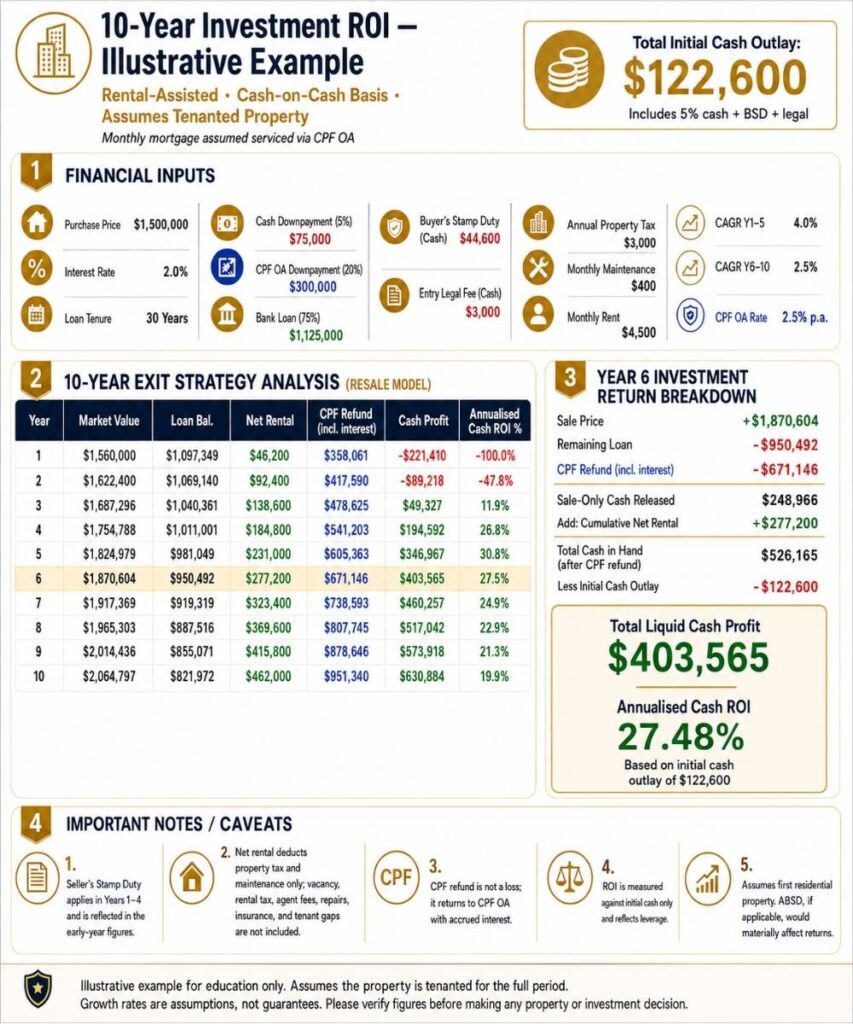
For example, in an illustrative investment scenario, a buyer purchases a $1.5 million property, rents it out, and holds it for several years.
The model assumes:
5% cash down payment
20% CPF OA down payment
75% bank loan
Buyer’s Stamp Duty and legal costs paid in cash
Monthly mortgage serviced through CPF OA
Rental income collected during the holding period
CPF refunded with accrued interest upon sale
By Year 6, using the assumptions in the illustration, the model shows a total initial cash outlay of about $122,600.
If the property is sold at around $1.87 million, after repaying the outstanding loan and refunding CPF with accrued interest, the sale releases cash.
On top of that, the model also includes cumulative net rental collected over the holding period.
In this illustration, the projected total liquid cash profit is about $403,565, with an annualised cash ROI of about 27.48% based on the initial cash outlay.
This looks attractive.
But the reason is important.
The return is stronger because rental income is part of the calculation, and the model assumes the property is tenanted during the holding period.
This should not be compared directly with an own-stay property.
For own-stay, there is no rental income. For investment, there may be rental support, but there are also additional risks and assumptions.
These may include vacancy, tenant changes, rental income tax, agent fees, repairs, insurance, higher property tax, interest-rate changes, Seller’s Stamp Duty for early exits, ABSD if applicable, and whether the assumed future selling price is achieved.
So the better question is not only:
“How high is the ROI?”
The better question is:
“What role is this property meant to play — own stay, investment, or stepping stone — and do the numbers still support that plan?”
That is why I prefer to model ROI before buying.
Not to predict the future perfectly.
But to understand the possible outcomes, the assumptions behind the return, and whether the exit still makes sense if circumstances change.