Second HDB Loan: Eligibility and the 50% Cash Proceeds Rule

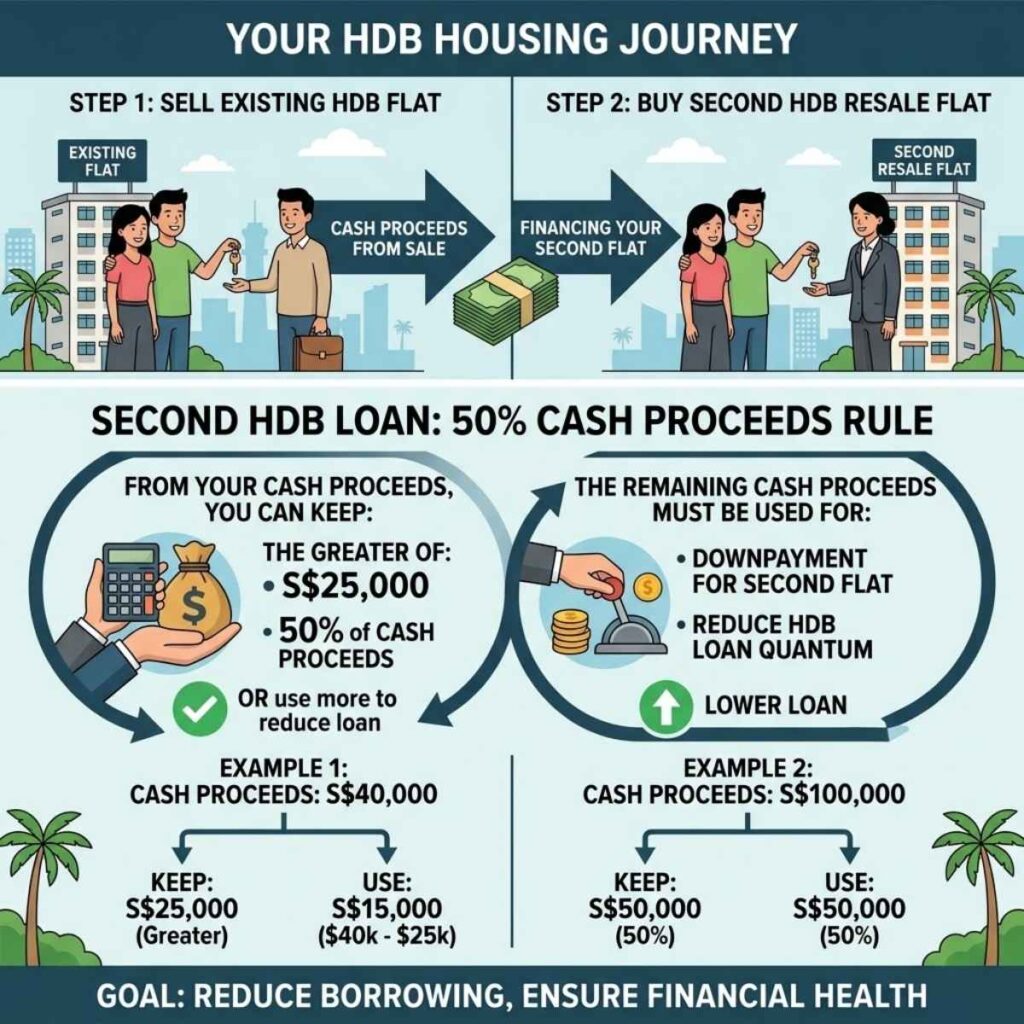
Quick answer: If you take a second HDB concessionary loan, HDB right-sizes it: you keep the higher of S$25,000 or 50% of your cash proceeds from the flat you sold — including the deposit you received — and the rest goes into the next purchase to reduce your loan.

Each household can take at most two HDB loans. Here is how the numbers actually land.

Buying a condo or EC next instead of an HDB flat? This rule doesn’t apply to you — start with the sell HDB, buy condo guide.

Selling procedure questions belong in the HDB resale process guide.

second-hdb-loan-cash-proceeds

Table of Contents

What is a second HDB loan?

A second HDB loan is a concessionary housing loan from HDB taken by a household that has already used one — typically when selling one flat and buying the next.

The loan itself works like the first: pegged 0.10% above the prevailing CPF OA interest rate, reviewed quarterly, with a tenure capped at the shortest of 25 years, 65 minus the average buyer age, or the remaining lease minus 20 years.

What changes is the sizing. HDB reduces the second loan by your full CPF refund and part of your cash proceeds from the flat you disposed of — the stated aim is preventing over-borrowing.

The eligibility gates are the same set as the first loan: at least one Singapore Citizen applicant, the S$14,000 household income ceiling (S$7,000 for singles, S$21,000 for extended families), no private property owned or disposed of in the 30 months before your HFE application, and not having already taken two HDB loans.

How much cash can I keep if I take a second HDB loan?

You keep the higher of S$25,000 or 50% of your cash proceeds — and HDB’s stated wording counts the cash deposit you received from your buyer as part of those proceeds.

The remaining proceeds, together with your CPF refund, are applied to the new flat and reduce the loan HDB grants you.

Two things people consistently get wrong here.

The money is not “returned to HDB.”

The other half doesn’t vanish — it goes into your own purchase, shrinking your loan and your monthly instalment.

It’s your money buying your flat; what you lose is the choice to hold it as cash.

The deposit counts.

This one produces real miscalculations — including by people who should know better.

Cash proceeds for this rule means what’s left of your sale price after the outstanding loan and full CPF refund, with the deposit you already collected counted in.

Worked properly: sale S$580,000, outstanding loan S$71,000, CPF refund with accrued interest S$377,000, resale levy S$45,000 (if one applies — see below).

Proceeds = S$87,000, and the deposit already in your pocket is part of that figure, not a further deduction.

You keep S$43,500.

Deduct the deposit first and you’d wrongly plan around S$41,000 — a S$2,500 error that compounds into every downstream number.
Note: These figures are illustrative and opinion-based — not a valuation or financial advice. Human error is possible; verify against official sources before relying on them.

The S$50,000 crossover

Because the rule is the higher of two arms, they meet at exactly S$50,000 of cash proceeds. Below S$50,000, the S$25,000 floor protects you — modest proceeds stay mostly or wholly yours.

From S$50,000 up, the 50% arm takes over, and every additional dollar of proceeds splits evenly between your pocket and your purchase.

Knowing which side of the crossover you sit on is the first thing to establish, because it decides whether this rule barely touches you or reshapes your plan.

How much of your cash proceeds do you keep?

For a second HDB concessionary loan, HDB allows you to keep the higher of S$25,000 or 50% of your cash proceeds. Where your cash proceeds are below S$25,000, you keep all of them — the floor cannot pay out more than the sale produced.

S$

Use the total cash proceeds figure for this rule. The cash deposit you already received from your buyer is counted inside cash proceeds — do not subtract it a second time.

Estimated cash you keep
S$43,500
Estimated cash applied to purchase
S$43,500
Why S$50,000 matters: at S$50,000 of cash proceeds, S$25,000 and 50% give the same answer. Above that point, the 50% arm normally determines how much you retain.

Two things this tool does not do. Where your next purchase is subsidised, the resale levy comes off your proceeds before the 50% split — enter the post-levy figure. And Cash Over Valuation is paid from the half you keep, not the half applied to the purchase.

Note: These figures are illustrative and opinion-based — not a valuation or financial advice. Human error is possible; verify against official sources before relying on them. HDB will consider the remaining cash proceeds when determining the second HDB loan amount.

Estimate your HDB sale proceeds first

How much CPF can you keep?

Up to S$20,000 per buyer stays in your CPF OA — everything else goes into the purchase. The refund from your sale is your full CPF principal plus accrued interest, restored to your retirement savings, and under a second HDB loan the available balance beyond S$20,000 each must be used for the flat before the loan is disbursed.

That’s not money lost — it’s your retirement money going back to work in your next home, and the S$20,000 you retain is a deliberate buffer worth keeping for emergencies rather than spending into the purchase voluntarily.

Four worked cases: what you keep at different proceeds levels

Each case assumes a couple taking a second HDB concessionary loan, both below 55.

All four tables: these figures are illustrative and opinion-based — not a valuation or financial advice. Human error is possible; verify against official sources before relying on them.

Illustrative examples of how the second HDB loan cash-retention rule changes at different proceeds levels.
Case Starting position Estimated amount kept Estimated amount applied Planning point
A — below S$25,000 Starting positionS$18,000 cash proceeds Estimated amount keptS$18,000 Estimated amount appliedS$0 Planning pointThe S$25,000 retention floor is higher than the proceeds available, so this example retains all S$18,000.
B — crossover Starting positionS$50,000 cash proceeds Estimated amount keptS$25,000 Estimated amount appliedS$25,000 Planning pointS$25,000 and 50% produce the same result.
C1 — resale with COV Starting positionS$240,000 cash proceeds; illustrative S$30,000 COV Estimated amount keptS$120,000 before other cash commitments Estimated amount appliedS$120,000 Planning pointCOV is a separate cash requirement. Do not treat all retained proceeds as unrestricted spending money.
C2 — subsidised next flat Starting positionIllustrative S$230,000 proceeds before S$40,000 levy Estimated amount keptS$95,000 after the illustrative levy deduction and split Estimated amount appliedS$95,000 Planning pointA resale levy can reduce the proceeds available before the second-loan cash-proceeds treatment is applied.

Note: These figures are illustrative and opinion-based — not a valuation or financial advice. Human error is possible; verify against official sources before relying on them. Actual sale proceeds, CPF refunds, resale levy, COV and HDB loan sizing depend on the transaction and HDB's assessment.

How the resale levy fits — and when it doesn't apply at all

The resale levy only exists when your next purchase is subsidised — a new BTO, SBF unit, or new EC from a developer.

Buying a resale flat on the open market carries no levy, whatever your first flat’s history.

So the two journeys separate cleanly: resale-to-resale movers including everyone using the HDB contra scheme face COV risk but no levy; movers into a new flat face the levy but no COV.

You never face both in one transaction.

Where it applies, the amount is fixed by the first subsidised flat you sold — not what you’re buying: S$15,000 (2-room), S$30,000 (3-room), S$40,000 (4-room), S$45,000 (5-room), S$50,000 (Executive), S$55,000 (EC); halved under the singles grant.

It’s payable in cash or from your sale proceeds — not CPF, not your loan. Selling a Plus or Prime flat adds a separate subsidy recovery on top.

What if you buy before you sell?

You’ll be charged the commercial rate first — pegged to the average non-promotional HDB-flat rates of the three local banks — and the rate converts to concessionary only after you’ve disposed of the existing flat and used the CPF refund plus 50% of the cash proceeds to reduce the second loan. Until then you’re paying bank-level interest on an HDB loan.

Sequencing matters: sell-first (or a coordinated contra move) keeps you at the concessionary rate from day one.

Second HDB loan or bank loan? What each route costs you

An EC moves through three phases.

Which numbers apply depends on when its site was tendered.

EC rules at a glance — which side of 8 May 2026?

The terms depend on when the project's land tender closed, not on when you buy.

Stage Sites tendered before 8 May 2026 Sites tendered on or after 8 May 2026
Minimum occupation period 5 years 10 years
Can sell to Singapore Citizens and PRs From year 5 From year 10
Full privatisation 10 years after TOP 15 years after TOP
First-timer quota 70% of units 90% of units
First-timer priority period 1 month 2 years
Deferred Payment Scheme May be offered by the developer Not available

Source: Ministry of National Development and HDB, announced 8 May 2026. Applies to Executive Condominium sites sold through Government Land Sales with tender closing dates on or after that date. Position as of August 2026 — confirm the terms of your specific project before committing.

The bank route frees your proceeds — but read the last row twice if you’re planning a contra move: escaping the 50% rule can cost you the routing that made the move affordable, and it swaps rate stability for market exposure.

Run your own sale-side numbers first through the HDB sales proceeds calculator.

Common misconceptions about the 50% rule

Planning your second loan before you commit

A second HDB loan reshapes your cash position in ways the headline rule doesn’t show. One session maps your retained cash, your applied funds, and your next steps.

Plan before you commit

Check your second-loan numbers with Rick

The rule is the same for everyone — how it lands on your numbers isn't. Bring your figures and we'll work out your real cash position before you commit to anything.

What would you like to work through?

Check my numbers with Rick

Opens WhatsApp with your topic pre-filled. No obligation — a steady look at your numbers first.

Frequently asked questions about a second HDB loan

What is the 50% cash proceeds rule?

When HDB determines an eligible second concessionary loan, the required CPF refund and part of the cash proceeds from the property disposed of are used toward the next HDB flat. HDB states that applicants can generally keep the higher of S$25,000 or 50% of their cash proceeds, including the cash deposit received.

How are cash proceeds calculated for a second HDB loan?

Your sale completion figures first account for items such as the outstanding housing loan, CPF refund and other amounts payable. HDB then applies its second-loan treatment to the relevant cash proceeds. Do not deduct the buyer's cash deposit a second time when applying the retention rule, because HDB states that the deposit received is included in cash proceeds.

Can I use the retained cash proceeds to pay COV?

COV is a cash-only part of a resale-flat purchase because it sits above HDB's valuation. When planning your retained proceeds, keep any COV requirement as a separate cash commitment rather than assuming every retained dollar is available for other spending.

Is the other 50% returned to HDB?

No. It is not a fee paid away to HDB. The required cash proceeds are taken into account toward your own next flat and reduce the amount of second HDB concessionary loan required.

What happens if I buy the next HDB flat before I sell?

HDB states that a commercial interest rate applies to the housing loan first. The rate can be converted to the concessionary rate after you dispose of the existing flat within HDB's required timeframe and use the required CPF refund and cash proceeds to reduce the loan.

How long does the commercial-rate period last?

It is not simply a fixed number of months of interest. HDB currently requires disposal of the existing flat within six months from legal completion of the next flat purchase, followed by the required use of CPF refund and cash proceeds before conversion to the concessionary rate. Check the conditions stated in your HDB documentation.

How does a second HDB loan compare with a bank loan?

A second HDB loan has HDB's CPF and cash-proceeds conditions, while a financial-institution loan follows the lender's prevailing financing package and regulatory requirements. The practical comparison should include cashflow, interest structure, applicable LTV, repayment period and whether you need HDB's Enhanced Contra Facility.

Disclaimer: The case studies and information are for educational use only and i make no representation or guarantees with respect to the accuracy, applicability, or completeness of its contents. There shall be no liability for any loss or expense whatsoever, relating to investment decisions made by the reader.

About the author

Rick Long is an Associate Senior Division Director at Huttons Asia.

Through YouHome.sg — Right Property Matters — he shares the frameworks, tools and field experience behind his advisory work, helping Singapore buyers and sellers across HDB, EC and private residential decisions with structured, calm, next-step guidance.

CEA Reg. R026818Z · Huttons Asia · YouHome.sg

For more Singapore property planning tips, follow me on Instagram.

@agent_rick_long

Your support means a lot.

What My Clients Say | Genuine Experiences

Real stories, real experiences—because your journey deserves nothing less than the best.

Awards and Accolades

Rick Long · Associate Senior Division Director, Huttons Asia · CEA R026818Z

Rick Long is an Associate Senior Division Director at Huttons Asia (CEA Reg. R026818Z). Through YouHome.sg — Right Property Matters — he shares the frameworks, tools and field experience behind his advisory work, helping Singapore buyers and sellers across HDB, EC and private residential decisions with structured, calm, next-step guidance.

Leave a Reply