• Post author:

Bigger Older HDB or Smaller Newer HDB? A Practical Singapore Buyer's Guide

A Singapore family comparing an older bigger 5-room HDB with a newer smaller 4-room HDB, showing the choice between more space, mature estate living, longer lease and future resale flexibility.

One flat gives you more space. The other gives you more lease.

That is usually the real choice behind this question.

Most buyers think they are choosing between cheap and expensive. They are not.

They are usually choosing between space today and lease runway tomorrow — and between mature-estate convenience and a cleaner future exit.

A bigger older flat can be the kinder choice for daily living. A smaller newer flat can give you an easier sale later.

Neither is automatically the right answer.

The right answer is the one that still feels steady once your age, lease, CPF, renovation budget, and future plan are mapped out.

Older vs Newer HDB: The Short Answer

It depends on four things — the youngest buyer’s age, the flat’s remaining lease, your intended holding period, and your renovation budget.

A bigger older HDB gives more space per dollar but can carry CPF and loan limits if the remaining lease is short.

A smaller newer HDB costs more per square metre but offers a longer lease, fuller CPF use, and a wider future buyer pool. Neither is automatically better — the right choice is the one that fits your lease horizon, family stage, and finances.

Let’s walk through it calmly.

Table of Contents

The Real Question Is Not Old or New

“Old or new” is the wrong frame. It turns a personal decision into a debate with no winner.

The better question is simple:

“What kind of flat still fits my family, my numbers, my lease horizon, and my future plan?”

A 1990s 5-room in a mature estate and a recent 4-room in a newer town are not competing for the same title. They solve different problems.

One buys you room and location now.

The other buys you time and flexibility later.

Start from your situation, not from the flat’s age. The flat that fits is the one that wins.

Why Bigger Older HDB Flats Still Attract Buyers

There is a reason older flats keep selling, even with shorter leases.

  • More floor area.
    Older 4-room and 5-room layouts were often built larger than today’s equivalents.
  • Mature estate convenience.
    MRT, hawker centres, schools, clinics, and parents living nearby — these are usually in the older towns.
  • Bigger living rooms and bedrooms.
    Easier for a study corner, a helper’s room, a third bedroom that fits a real bed.
  • Better for real family life.
    Multi-generation living, working from home, a growing family — space stops being a nice-to-have and becomes the whole point.
  • Some older 4-room flats feel close to a 5-room today.
    A 1990s Model A 4-room (around 105–110 sqm) is roughly the size of a current 5-room BTO (around 110 sqm). You can sometimes get 5-room-equivalent space at a 4-room price point.
  • Executive apartments and maisonettes are no longer built.
    Their space — often 139–155 sqm, sometimes across two storeys — is fixed and slowly shrinking in supply. That scarcity is real.

For the right buyer, this space is not a luxury. It is the reason to buy.

The Trade-Offs of Buying Bigger and Older

Space comes with a clock. Be honest about it.

  • Shorter remaining lease.
    This is the central trade — and the start of what’s often called HDB lease decay. Less runway, fewer years.
  • Possible CPF and loan restrictions.
    If the lease does not cover the youngest buyer to age 95, CPF usage can be pro-rated, and the loan amount may be affected (more on this below).
  • A future buyer pool that can shrink.
    As the lease shortens, fewer buyers can use full CPF or take the full loan — which can soften demand later.
  • Higher renovation cost.
    A bigger, older flat usually needs more work, and more area costs more to renovate.
  • Condition varies a lot.
    Two flats of the same age can be worlds apart.

Before you fall for the floor plan, walk the flat with open eyes: lifts and lift access, piping and water pressure, electrical and DB box, windows, flooring, toilets, the cost of hacking, and any layout that cannot be changed.

These quietly decide your renovation bill.

Why Smaller Newer HDB Flats Feel Safer to Some Buyers

Newer flats trade space for time. For some buyers, that trade feels safer — and sometimes it is the right one.

  • Longer lease runway.
    More years left means fewer lease-related worries for now.
  • A wider future buyer pool.
    A longer lease keeps more buyers eligible for full CPF and full financing when you sell.
  • Usually fewer CPF lease concerns.
    With a long lease, the age-95 check is rarely a problem.
  • Often a lighter renovation scope.
    Newer flats may need less structural work.
  • An easier exit.
    If you plan to sell and upgrade in a few years, a cleaner lease story can make that step smoother.

“Safer” here means simpler planning, not a guaranteed gain. That distinction matters.

The Trade-Offs of Buying Smaller and Newer

Newer is not a free win either.

  • Less space.
    Today’s 4-room is around 90 sqm — meaningfully tighter than an older 4-room or 5-room.
  • Higher price per square foot.
    You pay more for each metre of floor you get.
  • Often newer, non-mature locations.
    Tengah, Tampines North, and similar towns are maturing, but the amenities and connectivity take time.
  • It may not fit a growing family.
    Two children, storage, a helper, parents staying over, a real work-from-home corner — small flats fill up fast.
  • Newer does not automatically mean a better investment.
    A newer flat in a quieter location is not guaranteed to outperform a well-located older one. Location and layout still carry weight.

If the space genuinely does not fit your life, a longer lease will not fix that.

CPF and Remaining Lease: The Age 95 Check

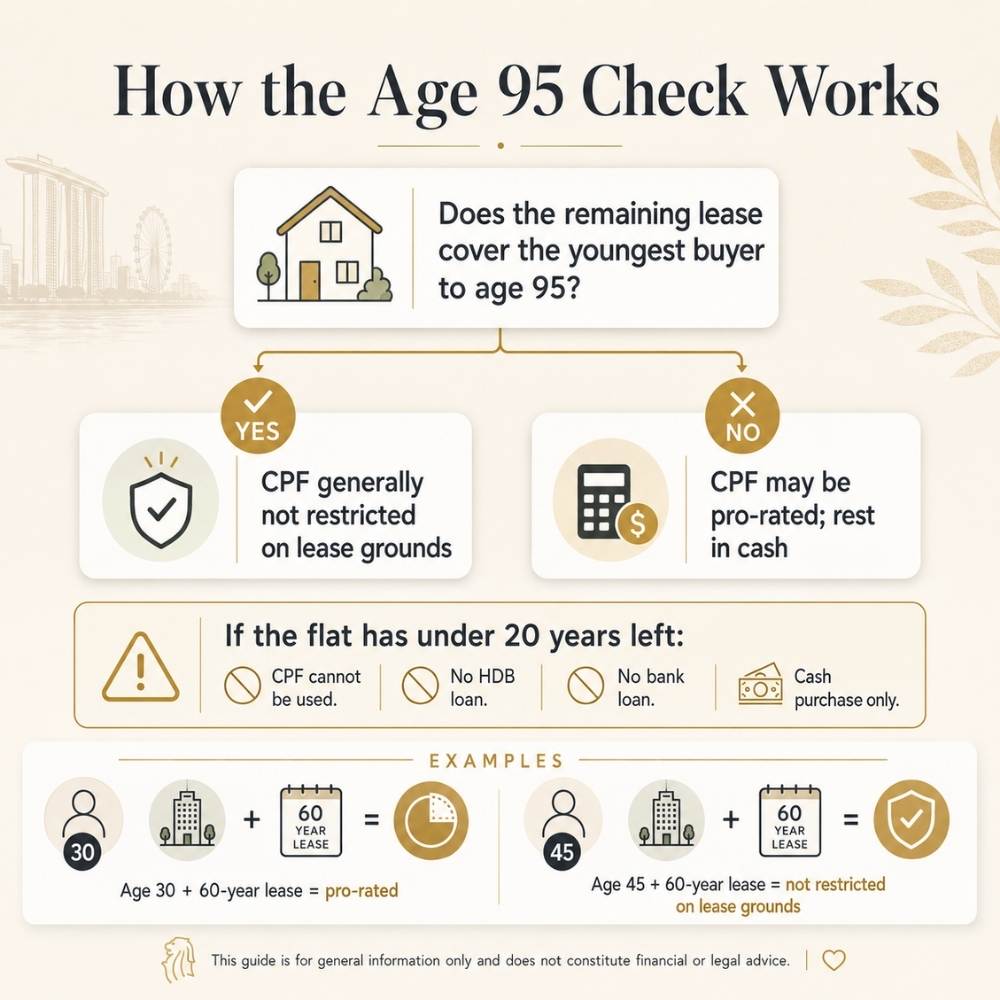
Infographic explaining how the CPF Age 95 check affects HDB resale buyers in Singapore, including full CPF usage when the lease covers the youngest buyer to age 95, pro-rated CPF when it falls short, and no CPF or housing loan when the flat has under 20 years of lease remaining.

This is the part that confuses most buyers, so let’s keep it plain.

The key number is not just the flat’s age. It is whether the remaining lease covers the youngest buyer until age 95.

  • If the lease covers the youngest buyer to 95:
    CPF usage is generally not restricted on lease grounds — subject to the normal CPF valuation limits that apply to any flat. (Source: CPF Board.)
  • If the lease does not cover the youngest buyer to 95:
    CPF usage may be pro-rated. You can still use CPF — just a proportion, not the full amount — and you fund the rest in cash.
  • If the flat has under 20 years of remaining lease:
    CPF cannot be used at all. No HDB loan, no bank loan either. It becomes a cash purchase, and that makes the flat hard to sell for most buyers. (Source: CPF Board / HDB.)

So 20 years remaining is the floor for CPF use at all — but clearing that floor does not mean you get full CPF.

The age-95 check is what decides “full” versus “pro-rated.”

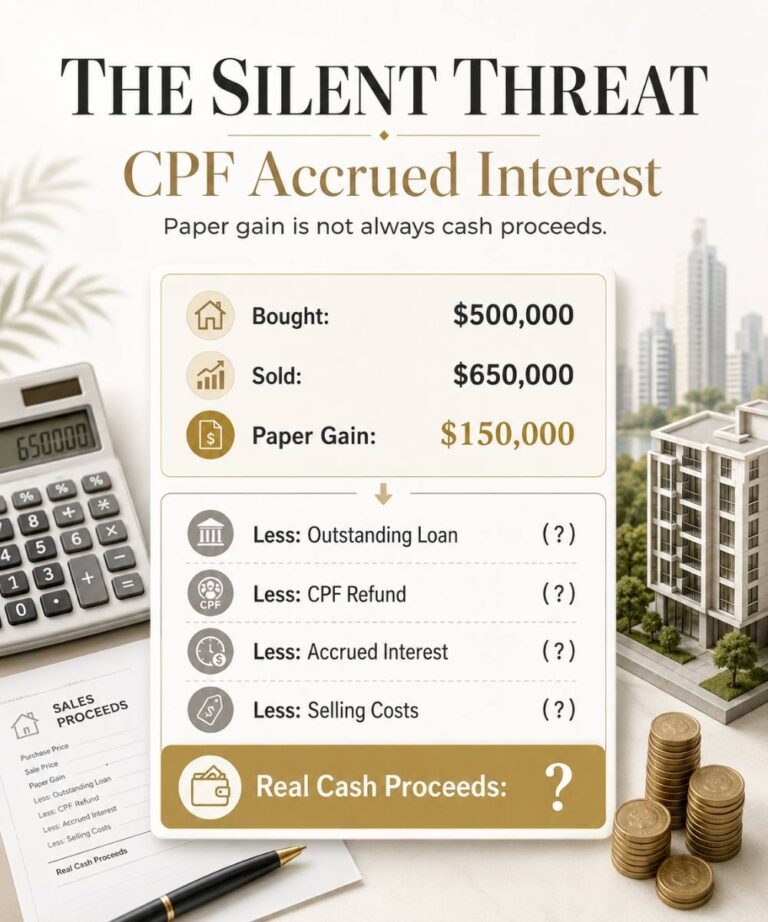
If CPF accrued interest is also on your mind, our CPF accrued interest guide pairs well with this section.

Why the same flat behaves differently for two buyers:

Buyer A — 30 years old, looking at a 60-year lease.

The lease covers them to age 90. That is five years short of 95.

So CPF usage would be pro-rated — usable, just not at the full valuation limit, with the gap covered in cash.

Buyer B — 45 years old, looking at the same 60-year lease.

The lease covers them to age 105 — well past 95.

So on lease grounds, CPF usage is not restricted.

Same flat. Same lease. Two very different financial pictures — because the younger buyer needs more years from the lease to reach 95.

This is why a flat that is “no problem” for one couple can be a stretch for another.

Renovation Cost: Bigger Space Is Not Always Cheaper Space

Older and bigger can mean a heavier renovation bill, and this catches buyers off guard.

As a rough 2026 guide for a fuller resale renovation:

  • Older 4-room: around S$42,000–S$85,000
  • Older 5-room: around S$70,000–S$100,000+
  • Executive apartment or maisonette: around S$83,000–S$135,000

Two things to hold onto:

  1. More area and older systems cost more to fix.
    Re-wiring, re-piping, hacking, and replacing flooring and toilets add up quickly in a big old flat.
  2. CPF Ordinary Account cannot be used for renovation.
    This comes out of cash, or a renovation loan — not your CPF.

So renovation is not a “later” cost.

Build it into your total affordability from the start.

A flat that looks cheaper on price can become the pricier one once renovation is added.

Future Resale: Who Will Buy From You Next Time?

The honest resale question is not “will this flat appreciate?” Nobody can promise that.

The better question is: “Who can buy this flat from me in 8, 10, or 15 years?”

That reframe is more useful, because your future sale depends on your future buyer’s ability to finance the purchase.

  • As a lease shortens, future buyers may face more CPF pro-ration and tighter loan tenures — which can narrow your buyer pool and put pressure on price.
  • A strong mature-estate location can support demand and soften that effect.
  • But location does not erase the lease.
    As the lease falls below the comfortable zone (broadly around 60 years and lower), lease decay starts to matter more in the conversation.
    If you want the deeper picture, our HDB lease decay and depreciation guide breaks down how value moves over time.

You are not pricing in a windfall.

You are simply checking that someone will be able to buy it from you on reasonable terms when it is your turn to sell.

VERS, SERS, and the Question Mark After 2030

For years, some buyers quietly paid a little extra for an older flat in a mature estate, half-hoping for SERS — the scheme where the government buys back your flat and hands you a fresh 99-year lease.

It was the closest thing the HDB market had to a lottery ticket.

That hope has narrowed. SERS was always rare — only around 5% of flats were ever considered suitable — and as of 2025 the government has said it has no new SERS projects planned, since most sites with strong redevelopment potential have already been selected.

In its place is VERS (Voluntary Early Redevelopment Scheme), updated in August 2025.

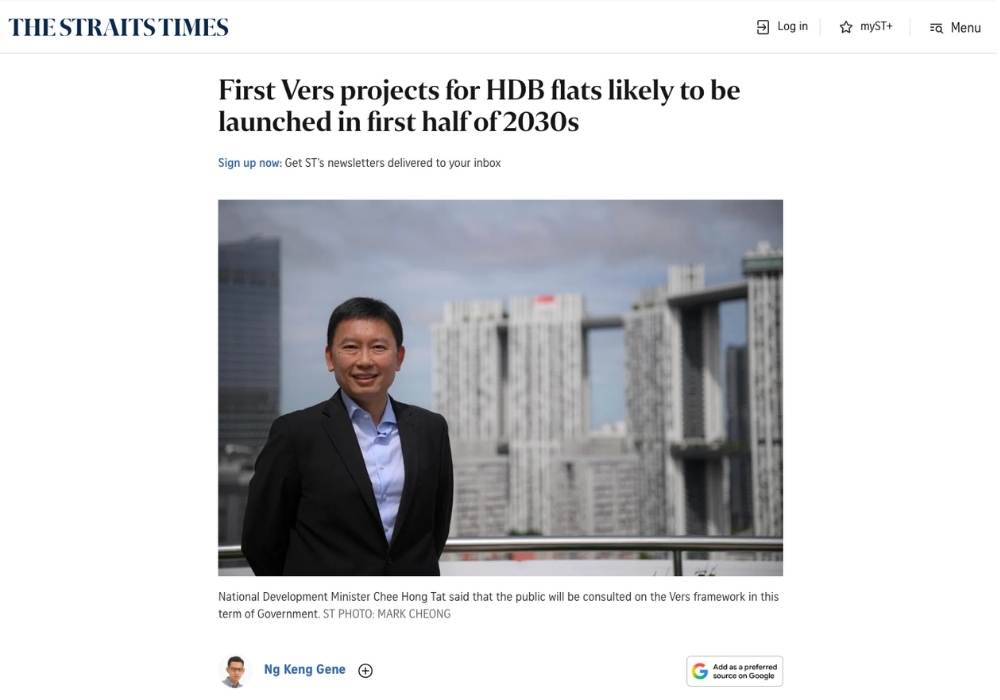
It applies to estates around the 70-year mark, depends on a residents’ vote, and rolls out gradually from the 2030s.

The important part: it is built as a managed exit, not a windfall. Compensation is tied to the remaining — by then, already short — lease, and is expected to be more modest than SERS.

What this means for your decision is steady and simple.

The “hope premium” that some older flats once carried is fading. From here, an older flat’s value sits more plainly on its remaining lease, location, and condition — not on the chance of a redevelopment jackpot.

It also raises a fair question about demand after 2030.

As more of the housing stock ages and the SERS safety-net story fades, future buyers of older flats may weigh lease, CPF limits, and financing more carefully.

That does not make older flats a poor choice — well-located, spacious flats still attract genuine buyers who want to live in them.

It simply means you should choose an older flat because it fits your life now, not because you are counting on a future buyback.

If you want the fuller picture of how VERS works and what it could mean for ageing estates,

I’ve broken it down here: Singapore HDB VERS — what it means for older flats.

Simple Comparison: Older 5-Room vs Newer 4-Room

A clean side-by-side, using illustrative leases for shape, not precision:

Older 5-Room vs Newer 4-Room HDB

A clean side-by-side comparison using illustrative leases for shape, not precision.

What you’re weighing Older 5-Room
e.g. ~55-year lease
Newer 4-Room
e.g. ~80-year lease
Space More — roughly 120 sqm range Less — around 90 sqm
Remaining lease Shorter Longer
Renovation risk Higher — more area, older systems Lower — smaller, newer
CPF / loan flexibility May be pro-rated for younger buyers Usually full, with fewer lease limits
Future buyer pool Narrows as lease shortens Stays wider for longer
Family comfort now Strong Comfortable for smaller households
Location Often mature estate Often newer or non-mature estate
Exit flexibility Lower over time Higher
Note: This comparison is only a guide. The actual decision depends on the specific flat, remaining lease, buyer age, CPF usage, loan structure, renovation budget and future exit plan.

Read it as a trade map, not a scoreboard. The “right” column is the one whose trade-offs you can live with.

When the Bigger Older HDB May Make More Sense

  • You need the space now — children, multi-gen living, a real work-from-home setup, or a helper.
  • Mature-estate location matters to you (near parents, schools, work, MRT).
  • You plan to stay long term, not flip in a few years.
  • The remaining lease still works for your age and your holding period.
  • Your renovation budget is ready and counted in.
  • You are buying for family comfort, not a short-term exit.

When the Smaller Newer HDB May Make More Sense

  • You are younger, and your plans may change.
  • You may sell and upgrade in the future.
  • Future resale flexibility matters more to you than maximum space today.
  • You want fewer CPF and loan complications.
  • You prefer lower renovation risk and something closer to move-in ready.
  • Your family can live comfortably with a smaller footprint.

When You Need to Compare Both Carefully

Some buyers sit right in the middle. If this sounds like you, slow down and run both properly:

  • The older flat is big, but the lease is near the concern zone.
  • The newer flat is small, but expensive for what you get.
  • Your monthly repayment is starting to feel stretched.
  • Your renovation budget is still uncertain.
  • Your family may grow within the next few years.
  • You may need to sell again within 5–10 years.

When several of these are true at once, the flat’s age is no longer the deciding factor.

The numbers are.

That is the moment to map both flats side by side before choosing.

Bigger Space or Longer Lease — Fit Score

To get a quick starting direction, try the “Bigger Space or Longer Lease — What Fits You?” fit score.

In about 90 seconds, it points you toward one of three results:

  • Likely Bigger Older HDB Fit
  • Likely Smaller Newer HDB Fit
  • Compare Both Carefully

Treat it as a starting point, not a verdict. It cannot see your actual flat.

The real decision still depends on the specific lease, your CPF usage, your loan structure, the renovation cost, and your future plan.

The tool tells you where to start looking.

The numbers tell you whether it works.

HDB Resale Fit Score

Bigger Space or Longer Lease — What Fits You?

A 90-second starting direction before you compare real flats.

Question 1 of 6 Choose one answer

Final Thoughts

You are not buying a category. You are buying a specific flat, at a specific price, with a specific lease, for a specific season of life.

Sometimes the bigger older flat is the kinder choice for daily living — more room to breathe, closer to the people and places that matter.

Sometimes the smaller newer flat gives you a cleaner future exit and fewer things to plan around.

The best choice is rarely the loudest one.

It is the one that still feels steady after the space, the lease, the CPF, the renovation budget, and the monthly repayment have all been mapped out.

If both flats still feel right after that, then either one is a good problem to have.

Let’s map your numbers before you commit

If you are weighing two very different HDB flats, it helps to see the full picture in one place — remaining lease, CPF usage, renovation budget, monthly repayment, and your future exit — before you make an offer.

A good starting point is to check the flat’s value on our indicative valuation page, and if you’re planning to move up later, our Sell HDB, Buy Condo guide maps the upgrade path.

That is the work Rick does: not selling you a flat, but helping you make the right call for your situation — even if that means choosing the other one.

If you’d like, we can sit down and run your specific numbers together, calmly and without pressure.

About the author

Rick Long is a licensed Singapore real estate professional and the voice behind (YouHome.sg), where he helps HDB and private owners make calm, well-mapped decisions on lease, CPF, financing, and exit strategy.

His approach is advisory first: the right call for your situation, even when that means walking away from a deal.

Associate Senior Division Director, Huttons Asia · CEA Reg. No. [R026818Z] · Last reviewed: June 2026

Frequently Asked Questions About PrimeKey Analysis

Frequently Asked Questions

Common questions buyers ask when comparing a bigger older HDB with a smaller newer HDB.

It can be. If the remaining lease covers the youngest buyer toward age 95, CPF and loan access are generally not restricted on lease grounds. Older flats often give you more space per dollar, especially in mature estates. The key is checking the lease, the CPF math for your age, and your renovation budget before deciding.


No. Newer resale flats usually cost more per square metre, offer less space, and are often in non-mature estates. They do come with a longer lease, fuller CPF access, and a wider future buyer pool. Whether that makes them “better” depends on your holding period, family needs, and how much location matters to you.
If the remaining lease covers the youngest buyer to age 95, full CPF can generally be used, up to the normal valuation limit. If it does not, CPF is pro-rated, and you cover the rest in cash. If the lease is under 20 years, CPF cannot be used at all. The age of the youngest buyer matters as much as the lease length.
An older 5-room offers roughly 110–125 sqm versus a newer 4-room’s around 90 sqm. The older 5-room usually costs less per square metre but may carry CPF and loan restrictions if the lease is short relative to the youngest buyer’s age. Run the CPF check for your specific situation before choosing.
They can be — mainly for buyers planning a long-term stay with the budget for it. Most are now 40–45 years old, leaving roughly 54–59 years of lease, so CPF can be pro-rated for younger buyers. Their space and scarcity are real attractions, but the lease deserves a careful look.
CPF usage is pro-rated — you can use a portion of the lower of the purchase price or valuation, and fund the shortfall in cash. The HDB loan amount may also be affected. Below 20 years remaining, no CPF, HDB loan, or bank loan applies, so it becomes a cash purchase.
It can become harder as the lease shortens, because fewer future buyers can use full CPF or qualify for the full loan — which can narrow the buyer pool and pressure price. A strong mature-estate location can cushion this, but it tends to matter more once the lease falls below the comfortable zone.
As a rough 2026 guide, an older 4-room can run around S$42,000–S$85,000, an older 5-room around S$70,000–S$100,000+, and an executive or maisonette around S$83,000–S$135,000. Remember that CPF Ordinary Account cannot be used for renovation, so plan for cash or a renovation loan and count it in your total budget.
A practical guide is enough lease to cover the youngest buyer to age 95. For a 30-year-old, that’s roughly 65 years remaining; for a 40-year-old, around 55 years. Keeping at least about 60 years remaining tends to preserve full CPF access for most buyer ages — though your own numbers should always be checked.
Five things: the remaining lease against the youngest buyer’s age, your CPF usage — full or pro-rated, your loan eligibility and tenure, the realistic renovation cost, and your future exit plan. Walk the flat for condition too — piping, wiring, windows, flooring, and toilets quietly shape the renovation bill.

What My Clients Say | Genuine Experiences

Real stories, real experiences—because your journey deserves nothing less than the best.

Awards and Accolades

Self Introduction

blog-pic

Hi, I’m Rick Long

With decades of experience in Singapore’s real estate market, I’ve had the privilege of being mentioned in media outlets such as Channel NewsAsia, The Straits Times, and 99.co.

Over the years, I’ve written extensively on the local property landscape — tackling the real questions buyers and sellers face, and helping them navigate each step with greater clarity and confidence.

Many of my clients have become long-time friends — their trust and kind reviews continue to inspire me to raise the bar in everything I do. 

I believe real estate should be strategic, seamless, and deeply aligned with your life’s journey.

Leave a Reply