HDB Depreciation Curve: Why Some Flats Hold Value Better Than Others

For many years, HDB resale prices felt like they were moving in only one direction.

Up.

Many homeowners saw neighbours sell with strong gains. Some upgraded. Some right-sized.

Some used their HDB as the foundation for their next property move.

But the market is changing.

In Q1 2026, HDB’s Resale Price Index dipped by 0.1% from the previous quarter. It was a small movement, but an important signal — the first quarterly decline in nearly seven years.

This does not mean HDB prices are collapsing.

It means homeowners should stop assuming that every flat will keep rising in the same way.

The better question is no longer just:

“Will my HDB flat depreciate?”

The better question is:

“How will buyers value my flat from here?”

That answer depends on more than age.

It depends on the remaining lease, location, buyer affordability, CPF usage, loan rules, future supply, competing choices, and whether the flat still gives the next buyer confidence.

That is what the HDB depreciation curve is really about.

Not fear.

Not panic.

Just a more honest way to understand where your flat stands — and what your next move could look like.

Table of Contents

Why a Higher Selling Price Can Still Leave You With Little or No Cash

Many homeowners look at selling price in a simple way.

“If I bought my HDB flat at $520,000 and sell it at $660,000, 10 YEARS LATER, I made $140,000.”

On paper, that sounds right.

But your real cash outcome is not based on paper gain alone.

When you sell your flat, the sale proceeds are usually used to settle two major items first:

  1. Your outstanding housing loan
  2. The CPF used for the flat, including accrued interest

Only after these are settled do you see how much cash is left.

This is where some homeowners get surprised.

A Simple Worked Example

A higher selling price does not always mean more cash in hand. This example shows how a paper gain can still become a zero-cash outcome after loan redemption and CPF refund.

Assume a homeowner bought an HDB flat 10 years ago for $520,000. At purchase, they used $150,000 CPF and took a $370,000 HDB loan over 30 years.

The monthly instalment was about $1,481, paid fully using CPF for 10 years. After 10 years, the flat is sold for $660,000.

At first glance, this looks like a $140,000 paper gain. But the cash outcome tells a different story.

Paper Gain vs Real Position

Item Estimated Amount
Original purchase price $520,000
Selling price after 10 years $660,000
Paper gain $140,000
Outstanding loan after 10 years $276,980
CPF principal used $327,751
Estimated CPF accrued interest $66,509
Total CPF refund required $394,259

After the flat is sold, the outstanding loan must first be redeemed. Only the balance sale proceeds can then be used to refund CPF.

Sale Proceeds Calculation

Sale Proceeds Calculation Estimated Amount
Selling price $660,000
Less: outstanding loan -$276,980
Balance sale proceeds before CPF refund $383,020
Less: CPF refund required -$394,259
Estimated shortfall before selling expenses -$11,239
Estimated cash proceeds from sale $0

What this really means

The flat sold for more than it was bought for, but the sale proceeds were used to clear the housing loan and refund CPF first.

In this example, the homeowner may walk away with $0 cash proceeds from the sale, even though there was a $140,000 paper gain.

This is why homeowners should look beyond selling price and understand the real cash outcome before deciding their next step.

A higher future selling price does not automatically mean profit, cash in hand, or a comfortable chance to upgrade or right-size.

Your real position is shaped by the loan, CPF refund, accrued interest, selling costs, and what your next home will cost at that point in time.

That is why a good property decision should not start only when you feel like selling.

It should start from the day you buy — with an exit strategy, regular reviews, and a steady understanding of the options available before the market decides for you.

What Is the HDB Resale Price Index?

The HDB Resale Price Index, or HDB RPI, tracks the overall price movement of HDB resale flats in Singapore.

It is based on registered resale transactions across towns, flat types, and flat models.

Think of it as the market’s temperature.

It tells us whether the overall HDB resale market is rising, slowing, stabilising, or correcting.

But it does not tell you the exact value of your individual flat.

Your flat may perform better or worse than the index depending on factors such as:

  • town
  • remaining lease
  • flat type
  • floor level
  • layout
  • renovation condition
  • MRT access
  • school proximity
  • surrounding amenities
  • competing supply nearby
  • buyer demand at the time of sale

This is why two flats of the same age can behave very differently.

A 35-year-old flat near an MRT station, popular schools, and mature amenities may still attract strong demand.

Another 35-year-old flat with weaker access, less efficient space, or more competing supply may face more resistance.

The index gives you the broad market direction.

Your flat’s actual performance depends on how buyers see its value today — and how confident they feel about its future exit.

Why HDB Prices Do Not Move in a Straight Line

A family standing at an HDB corridor during golden hour, looking out over a winding elevated walkway and surrounding flats, symbolising how HDB prices move through different market cycles rather than in a straight line.

One common belief is that HDB flats will always become more valuable over time.

That belief is understandable.

Many earlier homeowners bought at much lower prices and later sold with strong gains.

But every market has cycles.

HDB prices are affected by government policy, buyer affordability, loan rules, BTO supply, resale demand, interest rates, household income, and public confidence.

The recent data shows this clearly.

HDB resale prices rose strongly in 2024, with full-year growth of 9.7%.

In 2025, growth slowed to 2.9%.

By Q1 2026, the Resale Price Index dipped slightly by 0.1%.

This does not mean every flat will suddenly lose value.

But it does suggest that the easy assumption of “prices will always go up” needs to be replaced with a more careful question:

“Is my flat still well-positioned for the next buyer?”

That question matters because buyers do not only look at what the seller gained.

They look at what they are buying into.

What the HDB Depreciation Curve Really Means

HDB flats are sold on 99-year leases.

As the lease runs down, the remaining years become more important.

In the earlier years, lease decay may not feel obvious. The flat still has a long runway, buyers can usually finance more comfortably, and demand may stay strong if the location and layout are attractive.

But as the flat gets older, buyers start to think differently.

They may ask:

Can I use enough CPF?

Can I get the loan amount I need?

Will the flat last long enough for my long-term housing plan?

Will future buyers still want it when I sell?

Will the remaining lease affect my next exit?

This is the real issue.

Depreciation is not just about the flat getting older.

It is about the buyer pool becoming more selective.

When fewer buyers are suitable, pricing power can weaken.

That is why remaining lease matters.

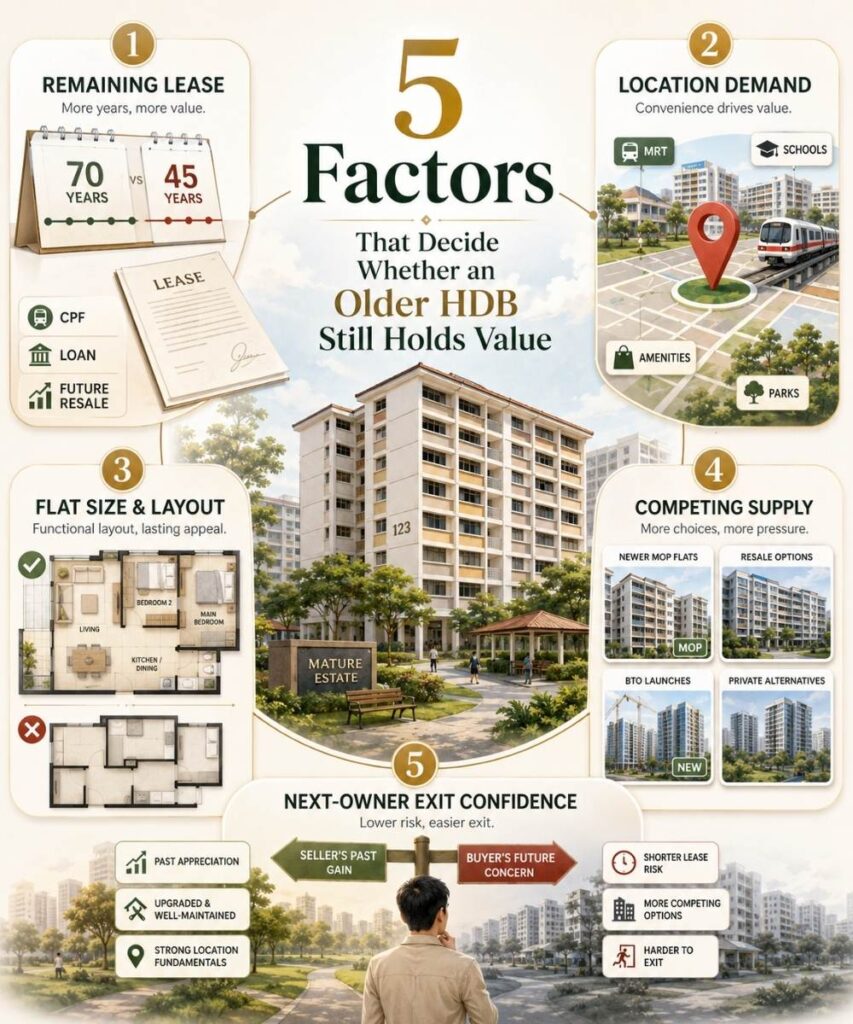
The 5 Factors That Decide Whether an Older HDB Still Holds Value

Infographic showing five main factors that affect whether an older HDB flat still holds value: remaining lease, location demand, flat size and layout, competing supply, and next-owner exit confidence, illustrated around a mature HDB estate.

Not every older HDB flat performs badly.

Some continue to command strong demand because they solve real buyer needs.

The question is not simply:

“How old is the flat?”

The better question is:

“What does this flat still offer that buyers value?”

There are five major factors.

1. Remaining Lease

The shorter the lease, the more buyers will think about CPF usage, loan eligibility, retirement plans, and future resale.

A flat with 70 years of lease remaining usually feels very different from one with 45 years left.

The flat may still be liveable.

But the financing and future-exit questions become heavier.

2. Location Demand

Mature estates can still attract strong interest if buyers want convenience, transport, schools, family support, or lifestyle amenities.

A shorter lease in a strong location may still appeal to buyers who value that estate.

But location cannot remove lease decay completely.

It can only help support demand.

3. Flat Size and Layout

Some older flats are larger than newer flats.

This can be a real advantage, especially for families who need space.

But size alone is not enough.

Buyers will also look at how usable the space is, whether the layout fits modern living, and how much renovation is needed.

A spacious flat with poor flow may not feel as attractive as the floor area suggests.

4. Competing Supply

Your competition is not only the unit next door.

Buyers may compare your flat against newer MOP flats, nearby resale options, BTO launches, Sale of Balance Flats, private property alternatives, or even the choice to wait.

If buyers have many alternatives, they may become more price-sensitive.

If your flat offers something rare, demand can be stronger.


5. Next-Owner Exit Confidence

This is one of the most overlooked factors.

Sellers often look backward:

“I bought at $350,000. If I sell at $650,000, I made a good gain.”

Buyers look forward:

“If I buy at $650,000 today, will it still make sense when I need to sell?”

Both sides are looking at the same flat from different timelines.

The seller sees past gains.

The buyer sees future risk.

A strong selling strategy must understand both.

Why Some Older HDB Flats Still Sell Well

Some older flats continue to sell well because they match very specific buyer needs.

A buyer may want to live near parents.

Another may need to stay within 1km of a school.

A family may prefer a larger flat instead of a newer but smaller unit.

Some buyers may want a mature estate and do not want to wait for BTO.

Others may be buying for lifestyle convenience rather than long-term capital growth.

For these buyers, the flat is not just an old leasehold asset.

It is a practical solution.

But sellers should not rely on broad claims like:

“Good location.”

“Rare size.”

“Mature estate.”

Those phrases are too general.

The value must be explained in buyer terms.

Why does this location matter?

Who is the likely buyer?

What problem does this flat solve?

What alternatives will buyers compare against?

What gives them confidence despite the lease?

The older the flat, the more important this explanation becomes.

Why Some HDB Flats Face More Pressure Over Time

Some flats may face more pressure when several weaker signals appear together.

For example:

  • shorter remaining lease
  • less convenient location
  • heavy renovation required
  • less efficient layout
  • many competing flats nearby
  • newer alternatives within reach
  • high asking price compared with newer options
  • weaker buyer confidence about future resale

When these factors stack up, buyers may still like the flat, but hesitate on the price.

This is where sellers need to be careful.

A flat may have grown well since purchase.

But that does not automatically mean the next buyer will accept the same optimism.

Buyers are not paying for your past gain.

They are paying for their future home, their future risk, and their future options.

That is why pricing cannot be based only on what neighbours achieved before.

It has to be based on what buyers are willing and able to support now.

Remaining Lease, CPF Usage and Buyer Demand

CPF usage is one of the most important parts of the HDB depreciation discussion.

Many buyers depend heavily on their CPF Ordinary Account savings when buying a home.

So when CPF usage becomes limited, the buyer pool can become smaller.

The key principle is this:

If the remaining lease of the property can cover the youngest buyer until age 95, CPF usage is generally more flexible.

If the remaining lease does not cover the youngest buyer until age 95, CPF usage may be limited.

If the property has at least 20 years of remaining lease but does not cover the youngest buyer until age 95, CPF usage may be pro-rated.

If the remaining lease is 20 years or less, CPF usage becomes very restricted.

This matters because buyers may need more cash if they cannot use as much CPF.

And once more cash is needed, fewer buyers may be able or willing to proceed.

That is why lease decay affects value indirectly.

It does not only make the flat older.

It changes how easily the next buyer can finance the purchase.

For homeowners of older flats, this does not mean the flat cannot be sold.

It means the target buyer profile becomes more important.

The question is no longer only:

“How much is my flat worth?”

It becomes:

“Who can buy this flat comfortably, and why would they choose it?”

Cooling Measures and Buyer Affordability

Government cooling measures also shape HDB resale demand.

They are meant to keep the market more stable and encourage prudent borrowing.

One important change happened in August 2024, when the HDB loan-to-value limit was lowered from 80% to 75%.

In simple terms, eligible buyers using an HDB loan may need to set aside a larger upfront amount.

This affects buyer budgets.

A buyer may like a flat.

But if the upfront cash and CPF requirement becomes too heavy, they may lower their offer or choose another option.

This is why sellers must look beyond emotional demand.

Interest can be high.

Viewings can be strong.

But the real test is whether buyers can comfortably support the price.

A healthy resale strategy should consider both:

What buyers want.

And what buyers can finance.

Cash Over Valuation: Why the Highest Offer Is Not Always the Strongest

Cash Over Valuation, or COV, is the amount paid above HDB’s valuation.

For example, if the agreed resale price is $620,000 and the valuation is $600,000, the $20,000 difference is COV.

That amount usually has to be paid in cash because CPF and the housing loan are based on the valuation, not the portion above valuation.

This matters because COV affects buyer commitment.

A buyer may offer a high price, but if the valuation comes in lower and they are not prepared to pay the cash difference, the deal may become shaky.

Before 2014, COV was more visible in the market.

After HDB changed the process, buyers would agree on the price first before requesting valuation.

This made buyers more cautious.

They may still offer strongly, especially in a tight market.

But many will think carefully before stretching too much above valuation.

For sellers, the lesson is simple:

The highest offer is not always the safest offer.

A strong offer should be backed by realistic financing, enough cash buffer, and clear buyer commitment.

SERS, VERS and Redevelopment Hope

Screenshot of a Straits Times article explaining VERS and possible HDB estates for future redevelopment, used to illustrate why homeowners should not rely on SERS or VERS when planning around older HDB flats.

For many years, some owners of older HDB flats hoped their blocks might be selected for SERS.

SERS stands for Selective En bloc Redevelopment Scheme.

When a precinct is selected, eligible flat owners may be offered compensation and rehousing options.

Because SERS can be meaningful, some owners assumed older flats might eventually receive a similar outcome.

But this is risky thinking.

SERS is highly selective.

Not every old flat will qualify.

A property plan should not depend on something the owner cannot control.

VERS, or Voluntary Early Redevelopment Scheme, is being developed as a future framework for selected ageing precincts when they reach around 70 years old or older.

But VERS is different from SERS.

It is expected to be more orderly and voluntary, with residents voting on whether to proceed. The final details and market impact will only become clearer when the scheme is implemented.

So the safer mindset is this:

Do not price an older flat based on redevelopment hope.

If SERS or VERS happens, it may change the outcome.

But your decision should still make sense even if it does not.

Supply and Demand Still Matter

Lease is important, but it is not the only factor.

HDB resale demand also depends on what other options buyers have.

If BTO supply increases, waiting times improve, or more newer resale flats enter the market, some buyers may become less dependent on older resale flats.

On the other hand, resale flats can still attract demand when buyers need a home quickly, want a specific estate, need to live near family, or prefer a larger space.

This is why every flat must be judged in context.

A 4-room flat in one town may face strong competition.

A similar flat in another estate may have a deeper buyer pool.

A large older flat may still stand out if newer alternatives are too small.

A newer MOP flat may still struggle if the asking price stretches beyond buyer comfort.

Market value is not decided by age alone.

It is decided by buyer alternatives.

Market Value and Personal Value Are Not the Same

This is one of the hardest parts of selling a home.

To the owner, the flat carries years of memories.

Family milestones.

Renovation effort.

Daily routines.

A sense of safety.

To the buyer, the same flat is a future commitment.

They will look at price, lease, renovation cost, financing, location, and whether they can sell it next time.

Neither side is wrong.

They are simply standing at different points of the journey.

The owner remembers what the home has meant.

The buyer asks what the home will mean from here.

A good selling plan respects both.

It helps the seller protect the value of the home while presenting it in a way buyers can understand, trust, and act on.

Should You Sell Before Your HDB Depreciates?

This is a common question.

But it is not the best question.

Selling early is not always better.

Holding longer is not always wrong.

The better question is:

“What role should this HDB flat play in my next phase of life?”

For some owners, selling may make sense because the flat still has strong demand and the proceeds can support an upgrade, right-sizing move, or retirement plan.

For others, holding may be better because the flat is fully paid, the family is comfortable, and the monthly commitment is low.

Some owners may want to upgrade, but the next property may stretch them too much.

Some may want to right-size, but the timing may not yet feel right.

That is why the decision should not be made from fear of depreciation alone.

It should be made from your full position:

your flat’s market demand, your CPF refund, your outstanding loan, your next housing budget, your family needs, and your comfort with the next step.

Simple Holding vs Selling Scenarios

Simple Holding vs Selling Scenarios

To make the decision more practical, here are three simple ways homeowners can think about their HDB position.

Scenario 1: Hold
When staying may still make sense

Holding may make sense if your flat is still suitable, your monthly costs are low, and selling does not improve your next step meaningfully.

This is especially true if the flat still supports your family lifestyle and you are not under pressure to move.

Scenario 2: Review Soon
When it is time to understand your position

A review may be useful if your flat is getting older, nearby competition is increasing, or your next-step plan is still unclear.

This does not mean you must sell.

It simply means you should know where you stand before the market becomes less favourable.

Scenario 3: Consider Selling
When selling may open up a better next step

Selling may be worth considering if your flat still has strong buyer demand, your net proceeds can support a better move, and holding longer may reduce your future options.

The key is not to sell because of fear.

The key is to sell only when the numbers, timing, and next step make sense together.

A good decision is not just about whether your flat can sell today. It is about whether holding, reviewing, or selling gives you the steadier path from here.

Conclusion: Do Not Panic, But Do Not Ignore It

A family standing together at an HDB corridor during sunset, looking over a mature Singapore estate, symbolising calm reflection, HDB depreciation planning, and the decision to hold, sell, or move on.

If you own an HDB flat, especially one with a shorter remaining lease, it is worth reviewing your position early.

Not because you must sell.

But because time affects your options.

Key things to consider:

• Buyer demand may narrow as the lease gets shorter.
• Location helps, but may not fully offset lease concerns.
• Your actual position depends on factors such as your loan, CPF refund, selling costs, and next property plans.
• The best decision is not always to hold or sell—it is about choosing the option that supports your goals.

To help you assess where you stand, we will be going through a simple checklist together. If you would like personalised guidance on your situation, click the WhatsApp button below to connect with us and get clarity on your options.

FAQ: HDB Depreciation Curve in Singapore

FAQ: HDB Depreciation Curve in Singapore

Here are some common questions homeowners ask when thinking about HDB lease decay, resale value, CPF usage, SERS, VERS, and whether they should hold or sell.

At what age does an HDB flat start to depreciate?

There is no single age where every HDB flat starts to depreciate.

Lease decay becomes more important as the remaining lease gets shorter, but demand also depends on location, size, amenities, buyer affordability, and supply.

Do old HDB flats still appreciate in Singapore?

Some older HDB flats may still appreciate or hold value well, especially if they are in strong locations, have larger layouts, or meet specific buyer needs.

But owners should not assume all old flats will behave the same way.

Can buyers use CPF for an older HDB flat?

CPF usage depends partly on whether the remaining lease can cover the youngest buyer until age 95.

If not, CPF usage may be limited. If the remaining lease is at least 20 years but does not cover the youngest buyer until age 95, CPF usage may be pro-rated.

What happens when the 99-year HDB lease ends?

When the lease runs out, the flat returns to the state.

This is why remaining lease is an important part of long-term planning.

Is SERS still something homeowners can rely on?

No homeowner should rely on SERS as a property plan.

SERS is highly selective, and not every old HDB flat will qualify. If it happens, it may change the outcome, but your decision should still make sense without it.

What is VERS?

VERS stands for Voluntary Early Redevelopment Scheme.

It is being developed as a future framework for selected ageing HDB precincts when they reach around 70 years old or older. Details and outcomes will become clearer when the scheme is implemented.

Should I sell my HDB before the lease gets shorter?

Not automatically.

The right decision depends on your flat’s demand, remaining lease, CPF refund, outstanding loan, next housing budget, family needs, and whether selling gives you a better next step.

What My Clients Say | Genuine Experiences

Real stories, real experiences—because your journey deserves nothing less than the best.

Awards and Accolades

Self Introduction

blog-pic

Hi, I’m Rick Long

With decades of experience in Singapore’s real estate market, I’ve had the privilege of being mentioned in media outlets such as Channel NewsAsia, The Straits Times, and 99.co.

Over the years, I’ve written extensively on the local property landscape — tackling the real questions buyers and sellers face, and helping them navigate each step with greater clarity and confidence.

Many of my clients have become long-time friends — their trust and kind reviews continue to inspire me to raise the bar in everything I do. 

I believe real estate should be strategic, seamless, and deeply aligned with your life’s journey.

Related Articles:

Ever wonder if you are suitable for Sell one buy two investment concept? – Read more (Sell one buy two)

Is buying new launch or resale condo have better returns? – Read more (New Launch vs Resale condo)

Looking to upgrade from Hdb to condo? – Read more (Sell Hdb buy condo)

What to take note when selling Hdb resale flat? – Read more (Hdb Resale Process)

Buying another Hdb flat, and using the fund from current home? – Read more (Hdb contra)

Why do some Hdb flat price depreciate so much? – Read more (Hdb depreciation curve)

What is one of the most common reason for property negative sales? – Read more (Cpf accrued interest)

Financial calculation for selling a Hdb flat? – Read more (Hdb resale calculator)

Buying EC before selling your HDB? – Read more (Upgrade to EC before selling your HDB)

Should you sell your EC after 5 years? – Read more (Selling EC)

What Is the HDB Resale Price Index?

Leave a Reply