• Post author:

Thinking of selling your EC (Executive Condominium) after 5 years? (2026 updated)

A Singaporean family standing by their condo window with moving boxes nearby, reflecting on their next home decision after their Executive Condominium reaches MOP.

Five years ago, your Executive Condominium (EC) was likely the right step into private property ownership.

Now that it has reached its Minimum Occupation Period (MOP), you have more options.

You may be able to sell, rent out the entire unit, upgrade to a private condominium, cash out, or hold until full privatisation.

That sounds like freedom.

But it also raises an important question:

More importantly:

“What should this EC do for my next stage of life?”

Should it unlock cash?

Should it support your next home purchase?

Should it generate rental income?

Should it be held for future growth?

Or should you simply pause first, because selling well does not automatically mean moving well?

This guide explains what changes after MOP, the options available to EC owners, how to estimate your sale proceeds, and the key factors to consider before making your next move.

The goal is simple: to help you make an informed decision with confidence and proper planning.

Table of Contents

Where Are You in Your EC Timeline?

A Singaporean family sitting together at home, looking over a floor plan with house keys and a child’s drawing on the table, reflecting on where they are in their EC journey and what comes next.

Every EC journey is different.

Some owners have just reached MOP.

Others are counting down to it.

Some are between Year 5 and Year 10.

Some are waiting for full privatisation.

Others have already crossed the Year 10 mark.

That is why there is no one-size-fits-all answer.

The right decision depends on where you are today, what your family needs, and what choices are realistically available to you now.

Before thinking about selling, start with this question:

“Which stage am I at, and what options do I actually have today?”

That answer shapes everything that follows.

The Real Question: Sell, Hold, or Replan?

When an EC reaches MOP, many owners naturally ask:

“Should I sell now?”

But the sale is not the whole decision.

The more important question is:

“What should this home help my family do next?”

Maybe it is time to upgrade.

Maybe it is time to unlock cash and create more breathing room.

Maybe it should be rented out, held longer, or used as part of a bigger plan.

A strong selling price matters.

But what matters more is what remains after the loan, CPF refund, costs, and next-home commitment are all accounted for.

Because the right move is not simply the one that gives you profit.

It is the one that gives your family a steadier next chapter.

Which Post-MOP Path Fits You?

Answer three quick questions. Get a calm, personalised suggestion — then WhatsApp Rick for a no-obligation discussion.

1) What do you want most from your next move?
2) How ready is your financing?
3) Timeline & complexity comfort?

Understanding Your EC Timeline: Year 0 to Year 10

An Executive Condominium is not just a property type.

It is also a timeline.

From the time you collect your keys, your EC moves through different stages. Each stage affects what you can do with the property, who can buy it, and how you should plan your next move.

The three major checkpoints are:

EC Stage What It Means Why It Matters
Year 0 to 5 Minimum Occupation Period You generally cannot sell or rent out the entire unit during this period.
Year 5 to 10 Semi-private stage You may generally sell to Singapore Citizens and Permanent Residents, and may rent out the whole unit, subject to prevailing rules.
Year 10 onwards Full privatisation The buyer pool may widen, including foreigners, subject to prevailing rules.

Understanding these checkpoints helps you avoid treating the EC as if it behaves like a normal private condominium from day one.

It does not.

The rules change with time.

And when the rules change, your options change too.

Year 0 to 5: Minimum Occupation Period

For the first five years, your EC is under the Minimum Occupation Period.

During this period, you must generally live in the unit and cannot sell or rent out the entire property.

While this stage may seem uneventful, your financial position is still changing in the background.

Your loan balance may be reducing.

Your CPF usage may be increasing.

Accrued interest may be building up.

Your property value may also be moving with the market.

That is why the MOP milestone is an important checkpoint to review:

  • How much has your EC appreciated?

  • How much would you receive if you sold?

  • How much must be refunded to CPF?

  • Can this property support your next housing or investment goal?

Year 5 to 10: Semi-Private Stage

Once your EC reaches MOP, it enters the semi-private stage.

This is when your options open up.

You may generally be able to sell your EC to Singapore Citizens and Permanent Residents.

You may also be able to rent out the whole unit.

You can start reviewing whether the EC should be sold, retained, rented out, or used as part of a bigger property plan.

However, your EC is still not fully privatised yet.

Foreign buyers are generally not part of your buyer pool until the EC reaches full privatisation at Year 10, subject to prevailing rules.

This matters because buyer pool affects demand, liquidity, and how your property may be positioned in the resale market.

For many owners, Year 5 to Year 10 is the most active decision window.

Some sell shortly after MOP to lock in gains and upgrade.

Some wait a few more years to observe the market.

Some rent out the unit if they have another housing arrangement.

Some explore ownership restructuring.

There is no perfect answer for every household.

But this is the stage where planning becomes important, because every option has a different effect on cash, CPF, loan capacity, risk, and timeline.

Year 10 Onwards: Full Privatisation

When your EC reaches Year 10 from TOP, it becomes fully privatised.

The buyer pool may widen as foreigners can generally be eligible to buy, subject to prevailing rules.

For some owners, this can improve marketability and liquidity.

However, full privatisation does not automatically mean prices will suddenly increase.

For many ECs, the foreign buyer profile may still be limited by location, quantum, buyer preferences, and prevailing stamp duties.

That is why waiting until Year 10 is not always the best strategy.

It depends on your goals, finances, current market conditions, and next property plans.

The key is to compare the benefits of holding against the cost of waiting.

If waiting gives your EC a stronger resale position and your household remains comfortable, it may make sense.

If waiting only delays a move you already need to make, it may not.

What Changes After EC MOP?

After your EC reaches MOP, four things usually become more important.

First, you now have more control over the property.

You may consider selling, renting, or planning your next move.

Second, your property becomes more liquid compared to the MOP period.

You now have a resale buyer pool made up of eligible Singapore Citizens and Permanent Residents, subject to prevailing rules.

Third, your financial position becomes reviewable.

You can estimate your sale proceeds, CPF refund, loan redemption, and next-home budget more accurately.

Fourth, your decision becomes more strategic.

Before MOP, the answer is usually simple: you cannot sell the whole unit.

After MOP, the question becomes more open:

Should you sell?

Should you hold?

Should you rent?

Should you upgrade?

Should you restructure?

Should you wait?

More options can create more opportunity.

But they can also create more confusion if you do not map the numbers properly.

2026 EC Rule Changes: Does the New 10-Year MOP Affect You?

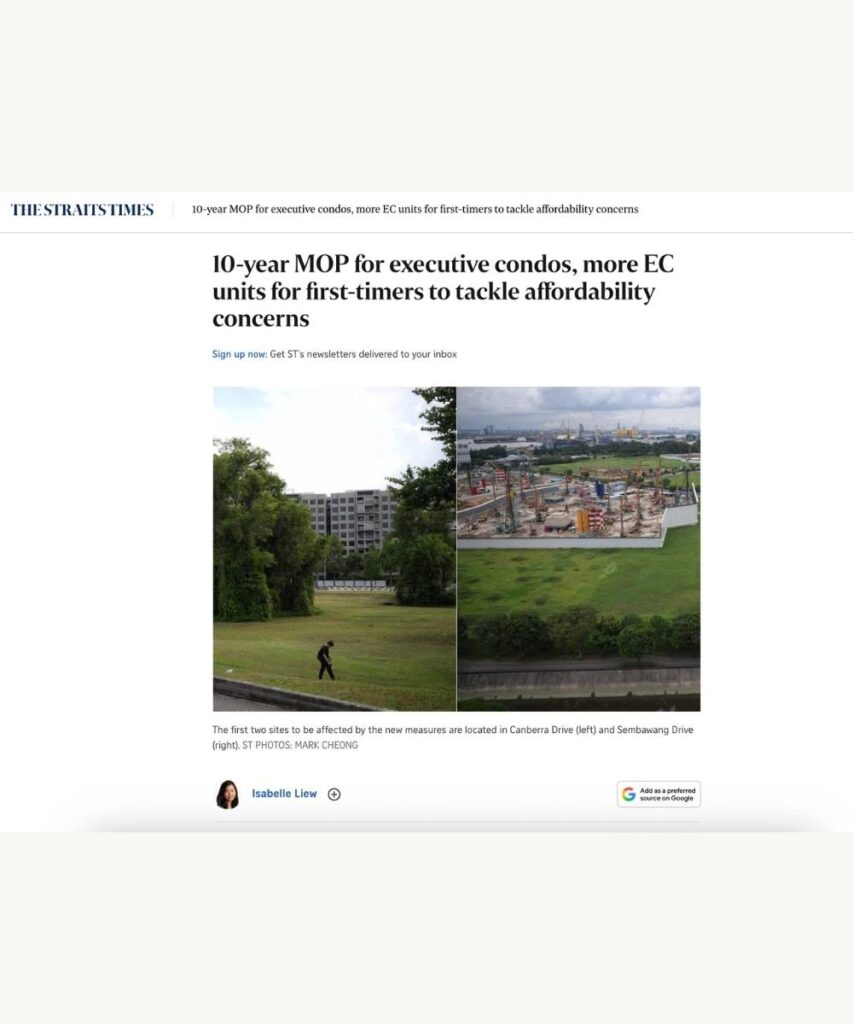
In May 2026, new measures were announced for future Executive Condominium projects.

One of the biggest changes is that buyers of affected new ECs will need to live in their homes for 10 years before they can sell, instead of the current 5-year Minimum Occupation Period.

This is a significant shift.

For many years, EC owners have treated the fifth year as the first major review point — the moment where they can consider selling, renting out the whole unit, upgrading, or restructuring their property plans.

Under the new measures, affected future EC buyers will have to wait longer before reaching that first resale milestone.

However, this is important:

The new 10-year MOP does not apply to all ECs.

Based on the announced measures, the new rules apply to government land sale EC sites with tenders closing from 8 May 2026. They do not apply to EC projects that have already been launched for sale, or sites where tenders have already closed.

This means existing EC owners who are already approaching MOP, have just reached MOP, or are holding an EC bought under the earlier rules should not assume their 5-year MOP has automatically changed.

Still, the policy shift matters.

It tells us something about the direction of the EC market.

The Government appears to be moving the EC scheme closer to its original purpose: helping eligible households meet owner-occupation needs, rather than treating ECs mainly as a short holding-period investment.

The changes also include:

  • A higher proportion of EC units set aside for first-time buyers

  • A longer priority period for first-time buyers

  • Removal of the deferred payment scheme for affected future EC projects

  • A longer holding period before affected new EC buyers can sell

For existing EC owners, this may affect how buyers think about older ECs with a 5-year MOP structure.

Some buyers may see existing or near-MOP ECs differently because they offer resale flexibility much earlier than future 10-year MOP ECs.

At the same time, this does not automatically mean every existing EC will become more valuable.

Price still depends on location, age, layout, supply nearby, buyer demand, affordability, and the condition of the broader market.

The more practical takeaway is this:

If you already own an EC under the existing 5-year MOP structure, your flexibility may become more meaningful.

You may want to review your position earlier, not because you must sell, but because the policy landscape has changed.

Ask yourself:

  • Does my EC still fit my family’s next stage?

  • Has my unit reached a useful resale window?

  • Would holding longer improve my position?

  • Would selling now unlock better options?

  • Could future EC supply rules affect buyer behaviour?

  • How does my current 5-year MOP flexibility compare with future 10-year MOP projects?

The new rule does not mean every EC owner should rush to sell.

But it does make one thing clearer:

The ability to review your EC after 5 years is now a more important advantage than before.

If you have reached MOP or are approaching it soon, this is a good time to map your numbers, timeline, and next-home options properly before deciding whether to sell, hold, rent, or wait.

Quick Decision Table: Which EC Path Fits You?

Before going into each option in detail, here is a simple way to frame the decision.

Path May Suit You If... Main Trade-Off Key Thing To Check
Sell EC and upgrade to private condo You want a better home, location, or longer-term private property plan Higher next-home price and monthly commitment Sale proceeds, CPF refund, new loan, BSD, ABSD exposure, and monthly repayment
Sell EC and buy HDB You want to cash out, reduce pressure, or simplify your lifestyle HDB eligibility and possible wait-out rules may apply HDB eligibility, timeline, financing, and how much cash you want to retain
Hold EC and rent out You have another place to stay and want rental income Your funds remain tied to the EC Rental yield, mortgage, maintenance, tax, vacancy risk, and opportunity cost
Sell one, buy two You and your spouse want separate property ownership or portfolio flexibility Higher complexity and risk Separate loan capacity, CPF/cash split, ABSD rules, and ability to hold two mortgages
Decouple or transfer ownership You want to retain the EC while freeing one owner’s name Feasibility is highly fact-specific Valuation, loan takeover, CPF refund, stamp duties, legal advice, and eligibility
Wait until Year 10 You are comfortable holding and want full privatisation optionality Next property may become harder or more expensive later Potential upside of waiting versus CPF interest, age, loan tenure, and next-home prices

This table is only a starting point.

The right path still depends on your actual numbers, family needs, and timeline.

Option 1: Sell EC and Upgrade to a Private Condominium

This is one of the most common paths for EC owners after MOP.

You sell your EC, unlock the equity built over the years, refund the CPF used with accrued interest, and use the remaining cash and CPF for your next home.

For some owners, this is about upgrading to a better location.
For others, it is about finding a right-sized home, moving closer to school or MRT, or building a stronger long-term property plan.

But a good move should never be based only on how much your EC has grown.

A common thought is:

“My EC made $500,000, so I can move comfortably.”

That gain matters.

But what matters more is what remains after the loan is redeemed, CPF is refunded, selling costs are paid, and the next home begins.

Selling first can give you a steadier base because you are planning with the actual sale proceeds, not an estimate. It may also help reduce ABSD exposure, depending on your ownership profile and the rules at the time.

Still, the sequence must be checked carefully. Buying first may work in some situations, but it can also create higher upfront cashflow pressure.

Before choosing this path, ask a quieter but more useful question:

“After everything is settled, will the next home still support the lifestyle and financial comfort my family needs?”

A successful move is not measured only by profit.

It is measured by whether the next chapter still feels steady after the transaction is over.

Option 2: Sell EC and Buy HDB

Not every EC owner wants to upgrade.

Some owners prefer to cash out, simplify their lifestyle, and reduce monthly commitments.

Selling the EC and buying a HDB flat may suit owners who want:

  • Lower housing expenses

  • More cash reserves

  • A simpler monthly commitment

  • A larger space at a more manageable quantum

  • More flexibility for retirement, children, business, or family needs

This path is not a “downgrade” if it supports the life you want.

For some families, the best move is not to stretch into a larger private property.

The best move may be to convert part of the property gain into financial breathing room.

However, this path needs careful checking.

You must review HDB eligibility, income rules, ownership rules, wait-out periods if applicable, timeline, financing, CPF usage, and whether the HDB purchase can be properly coordinated with the EC sale.

This is especially important because private property owners may be subject to HDB wait-out rules before buying certain resale flats, unless they meet specific exemptions under prevailing HDB policies.

Do not assume you can sell your EC and immediately buy any HDB flat of your choice.

The key question is not:

“Am I moving from private to HDB?”

The better question is:

“Will this move reduce pressure and give my family more choices, after all HDB rules and timelines are checked?”

If the answer is yes, this can be a very sensible path.

Before choosing this path

Start with eligibility.

Then check timing.

Only after that should you think about the preferred flat type, location, and budget.

This path can be powerful, but it must be sequenced properly.

Option 3: Hold EC and Rent Out

Selling is not the only option after MOP.

Once your EC reaches MOP, you may consider renting out the whole unit, subject to prevailing rules and your own housing arrangement.

This path may suit owners who have another place to stay, want rental income, do not need sale proceeds immediately, or prefer to wait until full privatisation.

Holding can be powerful if the numbers work.

But holding should not be based only on the thought that “property prices may continue going up.”

You need to assess:

  • Realistic rental income

  • Mortgage instalment

  • Maintenance fees

  • Property tax

  • Repair costs

  • Vacancy risk

  • Interest rate risk

  • Whether the EC still fits your household plan

You also need to consider opportunity cost.

If you keep the EC, your funds remain tied to the property.

That may limit your ability to buy another property unless your income, CPF, cash, and ownership structure allow it.

Holding works best when rental income, loan comfort, and future planning are aligned.

It is not simply a passive choice.

It still requires management, discipline, and a future exit plan.

A useful way to think about holding

Keeping the EC is not the same as doing nothing.

You are choosing to keep your capital, loan, CPF usage, and risk inside the property.

That can be worthwhile.

But only if the rental yield, future growth potential, and personal flexibility are strong enough to justify it.

Option 4: Sell One, Buy Two

Some couples explore the “sell one, buy two” strategy after their EC has appreciated.

The idea is to sell the EC fully, then use the combined cash and CPF refunds to support two separate property purchases under different owners.

This may allow each spouse to own one property separately, subject to loan eligibility, CPF availability, cash, income, ABSD rules, and prevailing regulations.

This strategy can potentially create:

  • More portfolio flexibility

  • One home for own stay and one investment property

  • Separate ownership structures

  • Better long-term optionality

But this is not a strategy to attempt casually.

It requires detailed financial planning.

Each buyer must be assessed individually.

Each loan must be sustainable.

The household must be comfortable managing two mortgages, two sets of costs, and possibly one rental-dependent property.

The danger is not in the concept.

The danger is over-stretching because the EC sale proceeds look large.

A successful sell-one-buy-two plan is not just about buying two properties.

It is about creating a structure that can survive interest rate changes, vacancy, unexpected expenses, and life changes.

The real test

Ask this before exploring the strategy:

“If rental income stops for six months, can the household still carry both properties calmly?”

If the answer is no, the plan may be too tight.

If the answer is yes, the next step is to check each person’s loan, CPF, cash, and ABSD position properly.

Option 5: Decouple or Transfer Ownership

Some EC owners may consider keeping the EC while freeing one spouse’s name to buy another property.

This usually involves one spouse buying over the other spouse’s share, resulting in one owner holding the EC while the other owner exits the ownership.

The exiting owner’s CPF used, with accrued interest, may need to be refunded.

Stamp duties, legal fees, valuation, and loan restructuring may apply.

This path may suit households that want to retain the EC, have enough income for one owner to hold the EC loan, and want one spouse to buy another property separately.

However, this option must be treated carefully.

It is highly fact-specific.

It is not just a paperwork exercise.

The remaining owner must be able to take over the loan.

The household must understand the cash and CPF flow.

The buying spouse must have enough funds for duties and costs.

The exiting spouse must understand how much CPF and cash they will receive, and whether that is enough for the next purchase.

This strategy can be useful, but only when the financial and legal structure is strong enough.

The caution

Do not assume decoupling is possible just because both owners agree.

Before building a plan around this route, check valuation, loan eligibility, CPF refund, stamp duties, legal feasibility, and prevailing regulations with the relevant professionals.

Option 6: Wait Until Year 10

Some owners wonder whether they should simply wait until the EC becomes fully privatised.

There are valid reasons to consider this.

After Year 10, the EC may be sold to a wider buyer pool, including foreigners, subject to prevailing rules.

The development may also behave more like a private condominium in the resale market.

Waiting may suit owners who:

  • Do not urgently need to sell

  • Are comfortable with the current home

  • Have manageable loan payments

  • Believe the location has more room to mature

  • Want to wait for a wider buyer pool

  • Prefer to observe the market before deciding

But waiting also has trade-offs.

Your next property may become more expensive.

Your loan tenure may shorten as you age.

Your CPF accrued interest may continue increasing.

Market conditions may change.

New supply may enter the area.

The EC may face more competition from newer condos nearby.

So waiting until Year 10 is not automatically the smarter move.

It is only smarter if the expected benefit of waiting is stronger than the cost of delay.

A simple way to frame the decision

Waiting makes sense only if the likely benefit of holding is stronger than:

  • The extra CPF accrued interest

  • The potential increase in next-home prices

  • The possible reduction in loan tenure as you age

  • The risk of market changes

  • The opportunity cost of not moving earlier

If waiting supports your family plan, it may be sensible.

If waiting only delays a decision, it may not.

Real EC Case Snapshots: Profit Is Only the First Layer

Many EC owners have seen strong gains after MOP, especially if they bought at an earlier launch price and held through a rising market.

Here are some examples of EC resale outcomes that show how powerful the EC growth path can be.

Real Case Snapshots — EC Owners After MOP

DevelopmentType / SizeHolding PeriodPurchase vs SoldEst. Gain
Inz Residence
(Choa Chu Kang Ave 5)
5 Bed / 1711 sqft 2017 → 2025 (~8 yrs) $1.26M → $2.36M ≈ $1.10M (+87%)
Hundred Palms Residences
(Yio Chu Kang Rd)
3 Bed / 969 sqft 2017 → 2025 (~8 yrs) $794K → $1.86M ≈ $1.07M (+134%)
The Brownstone
(Canberra Dr)
3 Bed / 1055 sqft 2015 → 2025 (~10 yrs) $744K → $1.45M ≈ $706K (+95%)
Treasure Crest
(Anchorvale Cres)
3 Bed / 1249 sqft 2016 → 2025 (~9 yrs) $973K → $2.02M ≈ $1.04M (+107%)
Data: URA caveats (2024–2025). Outcomes vary by facing, floor, and timing.

These examples show why many EC owners pay attention after MOP.

The gains can be meaningful.

But profit is only the first layer.

The key question is:

“What can this profit safely help you achieve next?”

A strong gain may allow one family to upgrade comfortably.

For another family, the same gain may not be enough if their next desired property is much more expensive, their income has changed, or their CPF refund is high.

A third family may decide not to upgrade at all, because the sale proceeds can create a stronger cash buffer by moving into a simpler home.

That is why every EC owner should avoid copying someone else’s move.

The right strategy depends on your numbers, your life stage, and your next-home options.

Note: The above figures are indicative examples based on selected transaction comparisons and should be verified against the latest caveat data before publication. Estimated gains do not account for outstanding loan, CPF refund, accrued interest, selling costs, renovation, stamp duties, or other transaction expenses.

Ready to see your next move come alive?

This interactive calculator gives EC owners a clear snapshot of what’s truly possible after selling — how much cash you’ll walk away with, what goes back into CPF, and your indicative next-home budget.

In just a few taps, you’ll see your numbers unfold — then WhatsApp Rick for an in-depth financial run-through to map your best next step with confidence.

Visualise Your Numbers — Calculator

Estimate what may remain after your EC sale, and get a first look at your possible next-home budget. This tool gives an indicative picture only — speak with your banker for your confirmed loan amount.

Your Indicative Outcome

Net Cash Proceeds
Available CPF Post-Refund
Indicative Next Loan
Estimated Purchase Range

Assumptions: TDSR cap 55%. Monthly capacity ≈ 55% of income minus commitments. Interest rate = 4% p.a., tenure capped at years, maximum 30 years or until age 65. Figures are estimates only.

Numbers are a mirror — not a decision. Use this as a calm starting point; then we can map your timing, options, and comfort level together.

Numbers Are a Mirror, Not a Decision

This calculator gives you visibility — not permission.
Having the figures doesn’t automatically mean you should buy again.
It’s equally important to understand:

  • What options realistically open next (private / HDB / investment)

  • How market cycles and interest rates could shift affordability

  • What emotional or timing factors may affect your decision

Use the tool to see your position calmly, not to rush the next move.

Timeline & Stress-Free Move Plan

Numbers show what’s possible.

Timing decides how smooth it feels.

Most EC owners don’t just worry about selling — they worry about what happens next.
Where will you stay? When do you buy again? How do you line up all the moving parts without stress?

This section maps out a calm, predictable flow — so you can plan each phase with breathing room and confidence.

The Typical 5-Step Flow When Selling Your EC

Stage What Happens Estimated Duration
1. Decision & Preparation Review your situation with your agent — financial readiness, CPF usage, and valuation range. 1–2 weeks
2. Marketing & Viewings Prepare visuals, listings, and positioning. A well-planned launch often shortens this phase dramatically. 2–12 weeks
3. Offer & Negotiation Assess offers, negotiate on both price and timeline, and align with your next-purchase plan. 1–2 weeks
4. OTP & Completion Once OTP is granted, legal completion takes ~10–12 weeks. Plan your CPF refund, loan redemption, and next purchase in parallel. ≈ 3–6 months (including marketing)
5. Transition & Next Move Redeploy CPF refund and cash proceeds toward your next home or investment — with timelines already aligned.
Tip: Lock your next-purchase plan during Stage 2 so timeline and financing stay smooth.

Smooth Move Checklist

Financial Readiness

  • Confirm completion date and CPF refund timing, and line both up with your next purchase schedule.

  • Build a 3–6 month buffer to cushion upcoming mortgage instalments.

  • Set aside funds for legal, valuation, and any bridging costs if sale and purchase overlap.

Logistics Readiness

  • Plan a temporary stay early: extension of stay, short-term rental, or family arrangement.

  • Book movers and lock in renovation quotes in advance to avoid rush premiums.

  • Organise key documents (digital + physical): loan letters, OTPs, valuation, legal correspondence.

Decision Readiness

  • Shortlist next properties now based on need, budget, and lifestyle.

  • Align expectations between spouses/co-owners on timing, risk, and priorities.

  • Have an in-depth scenario run-through with your agent: MOP timeline, CPF flow, financing, and sequencing.


When To Start Planning Your Next Move

Ideal window: start mapping your next move about 6 months before MOP.
Why: this gives time to

  • secure loan pre-approval (IPA) and financing clarity,

  • prepare marketing content and pricing strategy,

  • decide your sequence (sell → buy, or buy → sell with bridging).

Already past MOP? No rush. Focus on valuation, financing readiness, and timing your listing with seasonal buyer traffic for better exposure.

Common Questions & Misconceptions About Selling Your EC After MOP

Clear, concise answers to the questions EC owners ask most — in plain English, with zero guesswork.

1️⃣ Can I sell my EC before 5 years?

Generally, no. ECs must meet the 5‑year Minimum Occupation Period (MOP) before they can be sold on the open market.

Exceptions are rare and considered only under special circumstances (e.g., divorce, loss of citizenship, or unforeseen hardship), all subject to HDB’s approval.

2️⃣ Who can buy my EC after MOP?

Years 5–10: You may sell to Singapore Citizens and Permanent Residents only.
After Year 10 (fully privatised): Your EC can be sold to foreigners as well.

Key tip: Right after MOP, the largest buyer pool is local upgraders moving from HDB. Position pricing and marketing for that segment.
3️⃣ Do I have to pay ABSD when selling my EC and buying next?

Not if you sell first before you buy. At the moment you exercise the OTP for your next purchase, you should own no other property — therefore no ABSD (subject to current IRAS rules).

If you buy before selling, ABSD is payable upfront and refundable only under specific conditions (e.g., married couples where at least one spouse is a Singapore Citizen, within stipulated timelines).

Best practice: Complete your EC sale first or use a bridging loan with a clear exit plan to avoid double‑stamp‑duty risk.
4️⃣ What happens to my CPF after selling my EC?

All CPF used for the purchase — plus accrued interest — is refunded to your CPF OA upon completion. These funds can be used for your next property, but they return to CPF, not as cash.

Critical timing note: Align your sale completion and next‑purchase payment schedule so the CPF refund lands before your downpayment is due.
5️⃣ Will I make a profit after 5 years?

Many owners do. Historically, post‑MOP gross gains often range from S$300K to S$1M, depending on location, layout, holding period, and market cycle. Outcomes vary — run your numbers.

Use the Money Map Calculator to estimate net proceeds (after loan, CPF refund with interest, and fees) before deciding your next step.

6️⃣ Should I upgrade immediately after selling my EC?

Not automatically. Having proceeds and CPF funds doesn’t mean you must buy again straightaway. Consider loan comfort (rates & tenure), whether a short rental period positions you better, and which path (upgrade, reinvest, or reset) aligns with your long‑term goals.

WhatsApp Rick — Get a scenario walkthrough

Conclusion

A warm, cinematic desk scene with an open notebook and phone beside a window overlooking Singapore housing — symbolising reflection before an EC owner's next property decision after MOP.

Conclusion: Let’s Look at Your EC Position Together

If your EC has reached MOP, this may be a good time to pause and review where you stand.

Not because you must sell.

But because your options have changed.

We can go through your estimated sale price, outstanding loan, CPF refund, cash proceeds, next-home affordability, and possible timeline.

From there, we can compare what makes sense for you — whether that means selling, holding, renting out, upgrading, buying HDB, restructuring, or waiting until Year 10.

Sometimes the answer is to move.

Sometimes the answer is to wait.

What matters is that the decision is made with a steady view of the numbers, and the life you are planning next.

If you are thinking about your next step after EC MOP, you are welcome to connect for a discussion.

We can walk through it properly before you make any move.

EC Readiness Quiz

Answer 10 quick questions to see your EC Readiness Profile and next step. It is free and private. Takes about 3 minutes.

1) What best describes your current EC situation?
2) What is your biggest question right now?
3) How confident are you in your current financial readiness?
4) Have you calculated your outstanding loan and CPF refund recently?
5) Do you already know your loan eligibility for the next purchase?
6) How soon would you like to make your next move?
7) Have you aligned with family or co-owners on your next plan?
8) Which outcome matters most to you?
9) What kind of guidance suits you best?
10) Preferred contact method?

What My Clients Say | Genuine Experiences

Real stories, real experiences—because your journey deserves nothing less than the best.

Media Mention

Sharing my vision on MoneyFM 89.3 — how technology and empathy can work together so buyers, sellers, and even agents stay in sync from first thought to final handover.

This isn’t just about the property you choose. It’s about how you move through the decision.

Listen to the conversation below if you want to see how I guide clients through big property moves with structure, calm, and accountability.

Awards and Accolades

Share on facebook
Facebook
Share on linkedin
LinkedIn

Have you learned something New Today? Please help to share.

Self Introduction

blog-pic

Hi, I’m Rick Long

With decades of experience in Singapore’s real estate market, I’ve had the privilege of being mentioned in media outlets such as Channel NewsAsia, The Straits Times, and 99.co.

Over the years, I’ve written extensively on the local property landscape — tackling the real questions buyers and sellers face, and helping them navigate each step with greater clarity and confidence.

Many of my clients have become long-time friends — their trust and kind reviews continue to inspire me to raise the bar in everything I do. 

I believe real estate should be strategic, seamless, and deeply aligned with your life’s journey.

Related Articles:

Ever wonder if you are suitable for Sell one buy two investment concept? – Read more (Sell one buy two)

Is buying new launch or resale condo have better returns? – Read more (New Launch vs Resale condo)

Looking to upgrade from Hdb to condo? – Read more (Sell Hdb buy condo)

What to take note when selling Hdb resale flat? – Read more (Hdb Resale Process)

Buying another Hdb flat, and using the fund from current home? – Read more (Hdb contra)

Why do some Hdb flat price depreciate so much? – Read more (Hdb depreciation curve)

What is one of the most common reason for property negative sales? – Read more (Cpf accrued interest)

Financial calculation for selling a Hdb flat? – Read more (Hdb resale calculator)

Buying EC before selling your HDB? – Read more (Upgrade to EC before selling your HDB)

Should you sell your EC after 5 years? – Read more (Selling EC)

This Post Has 4 Comments

  1. Chan

    With the current situation. Whats your take on moving forward. My unit is going MOP soon. Have not decided if i should sell

    1. Rick Huang

      Hi Mr Chan. thanks for reading our article. I would suggest assessing your current situation/life stage. Understand your priority in moving forward. We would work out the financial calculation with you and see the options available.

  2. Jenny Teo

    Thank you for the information. For option 2 – sell EC buy resale HDB – am I able to buy a resale hdb first then sell my EC? What is the time frame?

    1. Rick Huang

      Hi Jenny,

      Yes you can purchase a resale Hdb 1st. Time frame is 6month to sell after completion of the Hdb.

Leave a Reply