Sell One, Buy Two in Singapore: How a Couple Ends Up Holding Two Properties

Quick answer: “Sell one, buy two” means selling the property you own together, then buying your next home in one spouse’s name and leaving the second name free for another property.

Because each purchase is that buyer’s first housing loan, both can be financed at up to 75%.

That arithmetic is what the whole plan rests on.

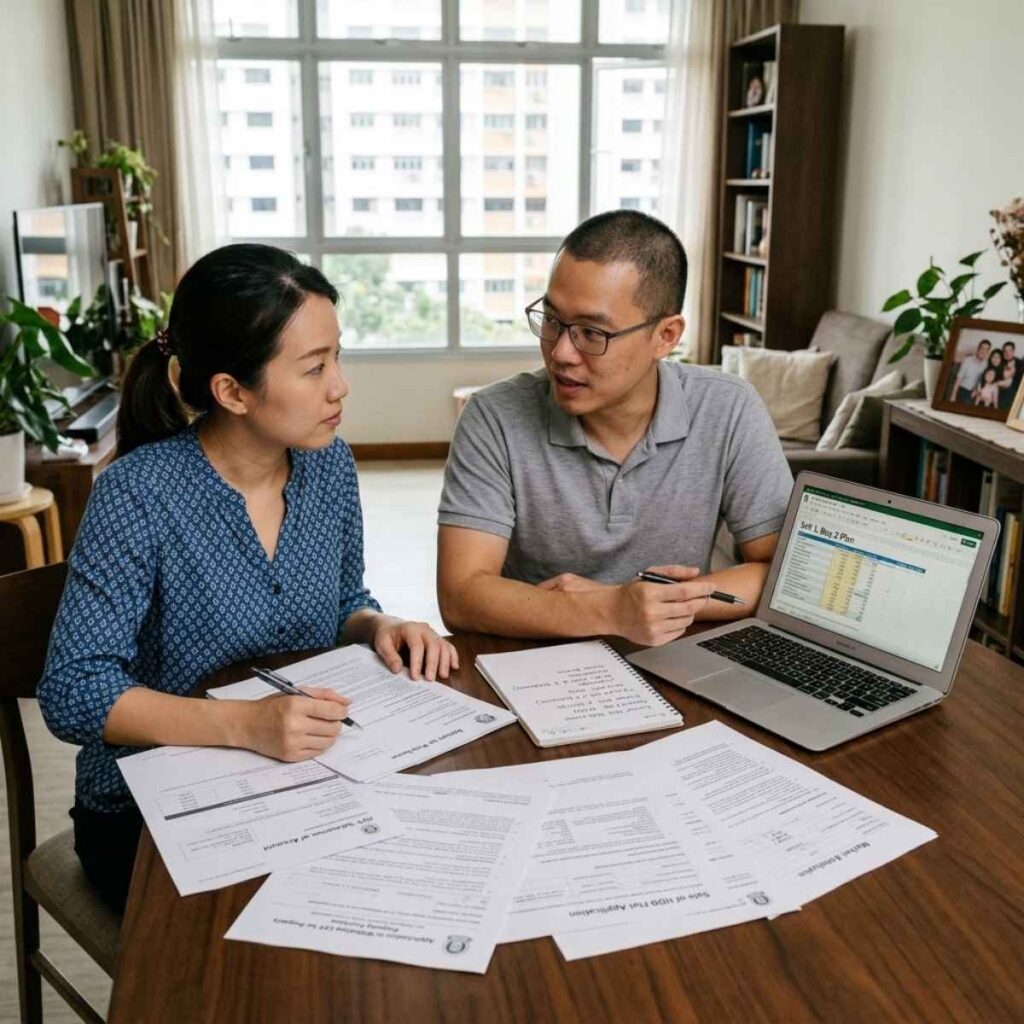
Couple reviewing property and CPF documents at a table before deciding to sell one and buy two
The numbers this decision runs on

Every figure below is the current official position as at 10 September 2026. Rates change; check the source before you rely on any of them.

Loan limits, debt ratios, stamp duties and CPF interest that decide whether a sell-one-buy-two plan works, with the official source for each rule.
RuleCurrent positionSource
LTV — first housing loan Up to 75%; at least 5% of price in cash MAS — macroprudential policies
LTV — one outstanding housing loan Up to 45%; at least 25% in cash MAS — macroprudential policies
LTV — two or more outstanding loans Up to 35% MAS — macroprudential policies
TDSR 55% of gross monthly income MAS — TDSR and MSR rules
MSR 30% — HDB flats and ECs bought from a developer MAS — macroprudential policies
ABSD — Singapore Citizen, second property 20% of price or market value, whichever is higher IRAS — Additional Buyer's Stamp Duty
SSD — bought on or after 4 Jul 2025 16% / 12% / 8% / 4% across four years IRAS — Seller's Stamp Duty
CPF Ordinary Account interest 2.5% floor; 2.5% p.a. for 1 Jul–30 Sep 2026 CPF Board — interest rates, Jul–Sep 2026

Table of Contents

What "sell one, buy two" actually means

It means selling the home two person own together, then buying the next home in one name only.

The second name buys nothing at that point. It stays free, and it is the free name that makes a second property possible later, or straight away if the money is there.

Most people first hear the phrase in a seminar, where it is presented as a way around Additional Buyer’s Stamp Duty.

That framing sells the idea short and makes it sound like a trick. It is not a trick.

It is a structure, and like any structure it either holds your weight or it does not.

Two things have to be true for it to hold. One income has to carry the home you want to live in.

And there has to be enough cash and CPF left over, after the sale, to fund a second purchase in the other name.

One mechanic matters more than most people realise.

IRAS counts the properties you own on the date you buy, and a property drops out of that count only once there is a contract to sell it and the new buyer has exercised his option to buy.

A verbal agreement or a hopeful listing is not enough.

Until the buyer exercises, you still own it, and the next purchase is counted as a second property.

Loan limits: why two names finance better than one

Because each spouse is buying in their own name, each purchase is that person’s first housing loan, so both can be financed at up to 75% of the price.

If one person tried to hold both, the second loan would be capped at 45%, with at least 25% of the price in cash.

That single difference is why the structure exists.

Here is the same property priced at S$1.5 million, financed two ways.

Maximum loan and minimum cash on a S$1.5 million property, bought as a first housing loan versus a second housing loan, at standard MAS limits (loan tenure within 30 years, age plus tenure within 65). Stamp duties and fees are not included.
FigureBought as a first housing loanBought as a second housing loan
Maximum loan S$1,125,000 (75%) S$675,000 (45%)
Balance to fund S$375,000 S$825,000
Minimum in cash S$75,000 (5%) S$375,000 (25%)

Note: These figures are illustrative and opinion-based, produced with calculation tools — not a valuation or financial advice. Human error is possible; verify against official sources before relying on them.

The loan gap is S$450,000. The cash gap is S$300,000.

Both come from the same MAS limits, and neither can be negotiated with a bank.

There is a second gate underneath the first. TDSR caps total monthly debt at 55% of gross income, and banks must test the instalment using a floor rate set by MAS rather than the rate you are actually offered.

For residential loans that floor is 4%.

On a S$1,125,000 loan over 25 years, tested at 4%, the monthly figure works out to roughly S$5,940.

Against the 55% cap, and assuming no car loan and no other commitments, that needs a gross income of about S$10,800 a month from the one person whose name is on it.

That is the real test, and it is worth sitting with.

The test rate is not the rate you pay. It is the rate the bank uses to decide whether you could still pay if rates moved.

Can one income carry the home you actually want?

This is where most plans fail, and it fails quietly, because the arithmetic only shows up at the loan-approval stage.

Two names on one purchase means two incomes and two CPF accounts supporting it, which buys a bigger home. One name means one income, one CPF account, and a smaller ceiling.

So the honest version of the trade is this.

Buying together gets you more house. Buying in one name gets you a second name that is still free.

You cannot have both, and the second property is only worth having if the first one is somewhere you actually want to live.

A few couples find the answer is simply no.

The home they want needs both incomes, and no restructuring changes that. That is not a failed plan.

It is a clear one, and it saves a great deal of money and disruption to find it out before the flat is listed rather than after.

Which name should carry the home loan?

There is no default answer, and anyone who gives you one without asking for both ages and both incomes is guessing. Four factors decide it.

Income, and the size of the loan each of you can support on your own.

The higher earner usually supports the larger loan.

That points to the higher earner carrying the home, since the home is normally the bigger of the two purchases.

Age, and the tenure it leaves. Loan tenure is capped at 35 years for private property.

Go past a 30-year tenure, or let age plus tenure run past 65, and the LTV drops from 75% to 55% — with more cash required up front.

The younger spouse has more room here, which sometimes pulls against the income point.

CPF balances. Whoever buys uses their own Ordinary Account for the downpayment and instalments.

The other person’s OA stays where it is.

If the balances are lopsided, that shapes which purchase each of you can realistically fund.

Income stability. A commission-based or self-employed income is treated with a haircut by banks, and it carries a different kind of risk over a 25-year hold than a fixed salary does.

These four factors often point in different directions.

That is normal, and resolving them needs your two actual ages, your two actual incomes, and both CPF balances — which is exactly the arithmetic a web page cannot run for you.

CPF: what happens to the non-owner's savings

The spouse who is not on the purchase keeps their CPF where it is. It cannot go into a home they do not own, so it stays in their Ordinary Account, earning the OA rate, which is currently 2.5% a year.

That is not money sitting idle.

It is the downpayment for property two, and while it waits it is doing its original job of building retirement savings.

When you sell the current home, the CPF each of you used, plus the accrued interest, returns to your own CPF accounts.

That is your own retirement money coming back to you, not a fee and not a loss.

It does mean the cash in hand after a sale is usually smaller than the sale price suggests, which is the single most common surprise in this whole exercise.

Our guide to CPF accrued interest works through how that lands.

What it costs to hold two properties

Two properties means two mortgages, and both incomes become load-bearing at the same time.

If one of you stops working, or takes a pay cut, or has a year out, the household is carrying two instalments on a reduced income.

That is the risk in a sentence.

The recurring costs are easy to underestimate.

Two sets of property tax, maintenance and conservancy charges, two insurance policies, and repairs on a home you are not living in.

Rental income is an assumption, not a salary.

Tenants leave, units sit empty for a month or three, and rents move with the market rather than with your instalment.

Plan the numbers on the basis that the second property might be empty for a stretch, because at some point it will be.

Interest rates move too.

A loan taken at one rate will be refinanced two or three times across a 25-year hold, and the instalment will not be the same each time.

The MAS floor rate exists precisely because the regulator expects this.

There is also an exit cost worth knowing before you enter.

If you sell a residential property bought on or after 4 July 2025 within four years, Seller’s Stamp Duty applies at 16%, 12%, 8% or 4% depending on how long you held it.

HDB, EC and private owners: what changes

HDB owners: the flat cannot be decoupled

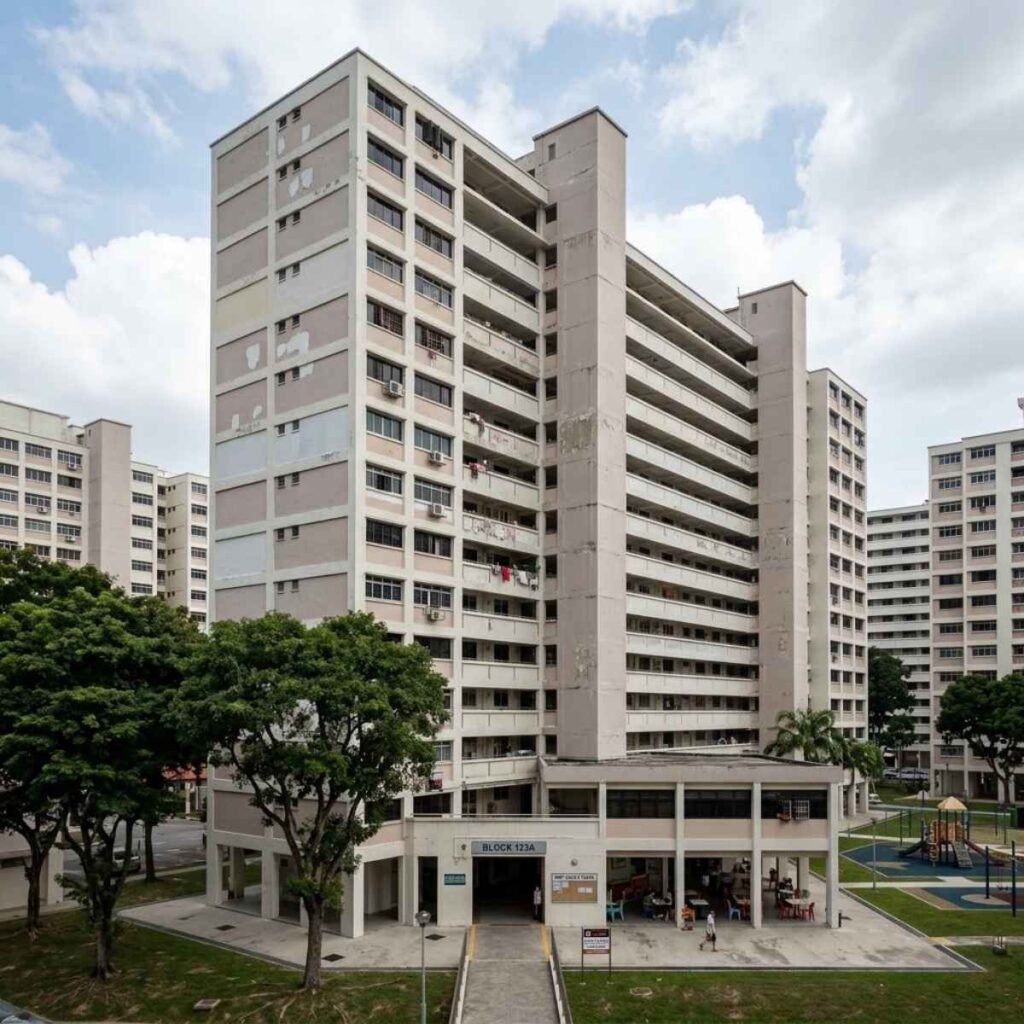
An HDB flat cannot be decoupled to free a name for a second property.

HDB allows a change in flat ownership without a sale only where family circumstances call for it — marriage, divorce or the death of an owner, and buying an investment property is not on the list.

That closes the restructuring route entirely, which sounds like a disadvantage and mostly is not.

Selling the flat leaves both names clean, and you skip the whole cost stack a private decoupling carries.

Timing is simpler too.

HDB flats come with a five-year Minimum Occupation Period, and because that period is longer than the SSD window, the revised SSD does not affect HDB owners.

EC owners past MOP: two routes, not one

An EC past its five-year MOP can be sold on the open market, and the proceeds work the same way an HDB sale does.

It can also be decoupled, with or without a loan outstanding, which an HDB flat cannot.

Financing once you are past MOP is assessed under TDSR at 55%, not MSR at 30%. The MSR cap applies to HDB flats and ECs bought directly from a developer, which yours no longer is.

For a household with other commitments, that difference alone can change what is affordable.

If you are weighing the sale itself rather than the structure, our guide to selling an EC covers that side.

Private owners in joint names: sell or restructure

You have both routes open. Decoupling keeps the property and transfers one share to the other, which frees a name without a sale.

Selling frees both names and releases more cash and CPF, but you give up the asset.

The comparison is not really about which is cheaper on paper.

It is about whether the property you own is one you would buy again today.

More on that below, and in our decoupling guide.

Should you sell it, or restructure what you have?

The question underneath this one is short: is the asset the problem, or is the structure the problem?

If the property is fine and only the ownership is wrong, decoupling is the tool built for exactly that.

It keeps a home you are happy with and frees a name without a sale, without moving, and without buying back into the market at today’s prices.

If the complaint is about the property itself — the age, the layout, the facilities, the size now that the household has changed, the view, the area — then decoupling cannot fix any of it.

You would be paying to restructure something you already want to leave.

The cost of leaving is real and cuts the other way.

Selling and buying again means agent fees, Buyer’s Stamp Duty on the new purchase, legal costs, moving, renovating, and re-entering the market at whatever prices are then.

A property you already own, already paid the entry costs on, and are happy in, is often worth more to you than the arithmetic of a swap suggests.

The strongest single question is this one: would you buy this property again today, at today’s price?

An honest yes points toward keeping it. An honest no points toward selling.

Most people know their answer before they finish reading the question.
Two short steps. First, whether each route can be financed. Then, where your reasons for moving actually sit.

Step 1 — Can each route be financed?
Can one income alone support the loan on the home you want?

Banks cap total monthly debt repayments at 55% of gross monthly income.

If you kept the property and bought out your spouse's share, would the buyout fit within a 75% loan and the remaining owner's income limits?

Banks cap total monthly debt repayments at 55% of gross monthly income.

Do you already have a firm buyer for your current home?
Step 2 — Where do your reasons sit?
The condition and age of the place is starting to show
The facilities no longer suit how we live
The view or the stack is not what we want long-term
The place is too big for us now
The place is too small for us now
The area has not grown the way we expected
The value has been flat for a while
Moving would disrupt school, work or family arrangements
I am attached to this home in a way that is hard to put a number on
Replacing this property would cost more than it is worth to us
I would buy this property again today, at today's price

Answer the three questions in Step 1 to continue.

Note: This reflects the answers you gave, not advice. It does not value your property or assess your finances.

Sell one, buy two, decoupling, and the other routes compared

Four routes lead to holding a second property. They are not equally suited to everyone, and the right one depends on which of the constraints below actually binds for you.

Four ways a Singapore couple can end up holding a second property, compared on what happens to the current home, how the second purchase is financed, and the main constraint. The 45% loan limits assume the current home still has a housing loan outstanding.
RouteCurrent homeFinancing of the second purchaseMain constraint
Sell one, buy two Sold Each name buys as a first housing loan, up to 75% One income must carry the home
Decouple, then buy Kept, one name Buyout is financed at up to 75% by the remaining owner; the freed name buys at up to 75% Buyout must fit the remaining owner's LTV and TDSR
Buy first, sell within 6 months Sold after Must be in both names to qualify for the married-couple remission; while the current home still has a loan, the new loan is capped at 45% ABSD paid up front and refunded only if the current home is sold within the 6-month window
Keep it and pay the ABSD Kept, both names Second purchase is a second property: 45% LTV, ABSD payable Cash-heavy; ABSD is 20% for a Singapore Citizen's second property

That third row is the one people miss.

The married-couple ABSD remission requires the new property to be purchased in both names of the couple only, and the first property must be sold inside the six-month window, which IRAS does not extend.

A single-name purchase does not qualify for it.

In other words, the remission route and the free-name route point in opposite directions, and you have to choose one.

One exclusion is worth stating plainly.

A new EC bought from a developer requires a family nucleus, so both names go on it.

That path cannot produce a free name and drops out of this strategy entirely.

A resale EC past its MOP is bought on the open market and does work.

If the upgrade itself is the question rather than the structure, our HDB to condo guide covers the remission route in full.

To sanity-check the duties and the loan on your own figures, use the stamp duty calculator and the affordability calculator.

About the author

Rick Long is an Associate Senior Division Director at Huttons Asia.

Through YouHome.sg — Right Property Matters — he shares the frameworks, tools and field experience behind his advisory work, helping Singapore buyers and sellers across HDB, EC and private residential decisions with structured, calm, next-step guidance.

CEA Reg. R026818Z · Huttons Asia · YouHome.sg

For more Singapore property planning tips, follow me on Instagram.

@agent_rick_long

Your support means a lot.

Before you commit to either route

Guide read: 20% complete.

What's left is the part no guide can do — which name carries the home, and whether selling or keeping wins on your own figures. One session with Rick settles both.

YOUR PROGRESS 20%

Guide read — you've done the groundwork.

2. How much time shall we set aside?
3. Pick a day to meet Rick
4. What time of day?
Request sent — 100% ✓
Rick will confirm the session with you directly on WhatsApp.
If WhatsApp didn't open, tap here

This sends a session request via your own WhatsApp — Rick confirms the timing and meeting place with you personally. Nothing is stored on this page.

Sell one, buy two: questions owners ask

Can I decouple my HDB flat to buy a second property?

No. HDB permits a change in flat ownership without a sale only in limited family circumstances such as marriage, divorce or the death of an owner. Buying another property is not one of them. For an HDB owner, selling is the route that frees both names.

Do we pay ABSD if we each buy one property?

ABSD depends on how many residential properties each buyer owns on the date of purchase. A Singapore Citizen buying their first residential property pays no ABSD. The count is taken on the purchase date, so the sale of your current home has to be firm before the next purchase, not merely agreed.

Do we have to sell before we buy?

For this structure, effectively yes. Until a buyer has exercised the option on your current home, you still own it, and the next purchase counts as a second property: ABSD applies, and if your current home still has a loan, the new loan is capped at the lower 45% LTV.

What happens if one of us cannot get a loan alone?

Then the structure does not fit, and it is better to find that out early. A mortgage banker can confirm each person's borrowing capacity before anything is listed. Buying together and revisiting the second property later remains a perfectly good plan.

Is sell one, buy two cheaper than decoupling?

It depends on what your existing property is worth to you. Decoupling carries stamp duty on the transferred share and legal fees, and keeps the asset. The CPF used on that share, plus accrued interest, goes back to the departing owner's own CPF account, and the buyout price has to cover it. Selling carries agent fees, stamp duty on the new purchase and the cost of re-entering the market, but frees more cash and CPF. Neither is cheaper in general — only on your numbers.

Can we use a new EC as the second property?

Not as the one in a single name. A new EC from a developer requires a family nucleus, so both names go on the application. A resale EC that has passed its MOP has no such requirement.

How long can the second name stay free?

Indefinitely. Nothing forces you to use it. Some households buy the second property immediately; others hold the free name for five or ten years until income, CPF or life stage makes it sensible. The name does not expire.

Disclaimer: The case studies and information are for educational use only and i make no representation or guarantees with respect to the accuracy, applicability, or completeness of its contents. There shall be no liability for any loss or expense whatsoever, relating to investment decisions made by the reader.

What My Clients Say | Genuine Experiences

Real stories, real experiences—because your journey deserves nothing less than the best.

Awards and Accolades

Rick Long · Associate Senior Division Director, Huttons Asia · CEA R026818Z

Rick Long is an Associate Senior Division Director at Huttons Asia (CEA Reg. R026818Z). Through YouHome.sg — Right Property Matters — he shares the frameworks, tools and field experience behind his advisory work, helping Singapore buyers and sellers across HDB, EC and private residential decisions with structured, calm, next-step guidance.

This Post Has One Comment

  1. Ken

    Hi really appreciate the in-depth sharing. But i do have some doubts on the risk level. Will contact you for a meet up. Thanks

Leave a Reply